
Pulp Fiction, 1949 · page 18 of 68
Astounding British Edition, Vol. 6, No. 8 — page 18: what you’re looking at
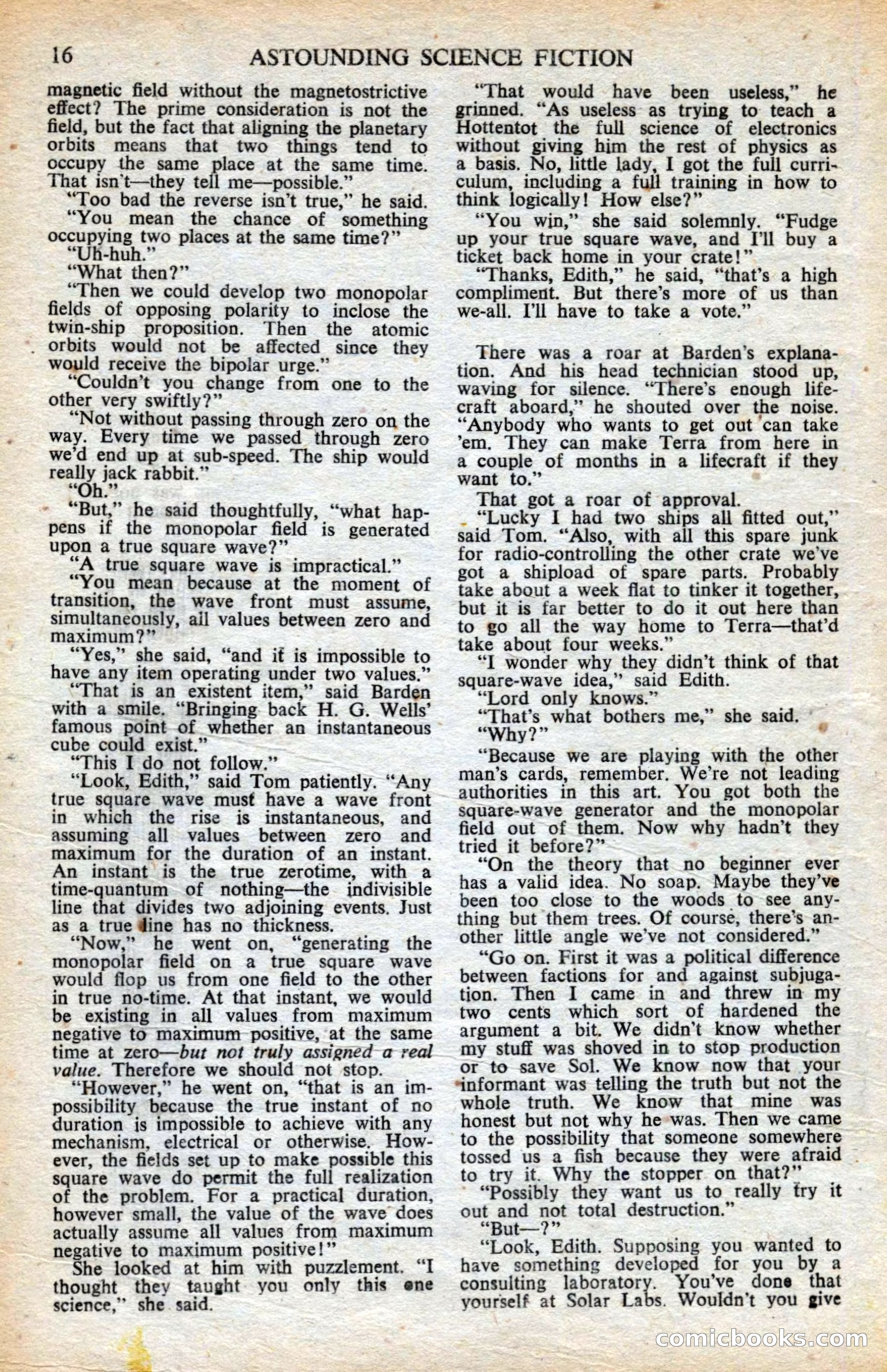
A restored page from Pulp Fiction, 1949. Page through the whole issue in the reader above.
📄 Transcribed text from this page (OCR, searchable)
Machine-transcribed from the original scan — historical spelling and the odd misread are preserved.
16 ASTOUNDING SCIENCE FICTION magnetic field without the magnetostrictive effect? The prime consideration is not the field, but the fact that aligning the planetary orbits means that two things tend to occupy the same place at the same time. That isn’t—they tell me—possible.” “Too bad the reverse isn’t true,” he said. “You mean the chance of something occupying two places at the same time?” “Uh-huh.” “What then?” “Then we could develop two monopolar fields of opposing polarity to inclose the twin-ship proposition. Then the atomic . orbits would not be affected since they would receive the bipolar urge.” “Couldn’t you change from one to the other very swiftly?” “Not without passing through zero on the way. Every time we passed through zero we'd end up at sub-speed. The ship would Sa pe rabbit.” ~ “But,” he said thoughtfully, “what hap- pens if the monopolar field is generated upon a true square wave?” “A true square wave is impractical.” “You mean because at the moment of transition, the wave front must assume, simultaneously, ail values between zero and maximum?” “Yes,” she said, “and if is impossible to have any item operating under two values.” “That is an existent item,” said Barden with a smile. “Bringing. back H. G. Wells’ famous point of whether an instantaneous cube could exist.” “This I do not follow.” “Look, Edith,” said Tom patiently. “Any true square wave must have a wave front in which the rise is instantaneous, and assuming all values between zero and maximum for the duration of an instant. An instant is the true zerotime, with a time-quantum of nothing—the- indivisible line that divides two adjoining events. Just as a true dine has no thickness. “Now,” he went on, “generating the monopolar field on a true square wave would flop us from one field to the other in true no-time. At that instant, we would be existing in all values from maximum negative to maximum positive, at the same time at zero—burt not truly assigned-a real value. Therefore we should not stop. “However,” he went on, “that is an im- possibility because the true instant of no duration is impossible to achieve with any mechanism, electrical or otherwise. How- ever, the fields set up to make possible this square wave do permit the full realization of the problem. For a practical duration, however small, the value of the wave does actually assume all values from maximum negative to maximum positive!” She looked at him with puzzlement. “I thought they taught you only this ene science,” she. said. “That would have been useless,” he grinned. “As useless as trying to teach a Hottentot the full science of electronics without giving him the rest of physics as a basis. No, little lady, I got the full curri- culum, including a full training in how to think logically! How else?” “You win,” she said solemnly. “Fudge up your true square wave, and [I'll buy a ticket back home in your crate!” “Thanks, Edith,” he said, “that’s a high compliment. But there’s more of us than we-all. I'll have to take a vote.” There was a roar at Barden’s explana- tion. And his head technician stood up, waving for silence. “There’s enough life- craft aboard,” he shouted over the noise. “Anybody who wants to get out can take "em. They can make Terra from here in a couple of months in a lifecraft if they want to.” That got a roar of approval. _ “Lucky I had two ships all fitted out,” said Tom. “Also, with all this spare junk for radio-controlling the other crate we've got a shipload of spare parts. Probably take about a week flat to tinker it together, but it is far better to do it out here than to go all the way home to Terra—that’d take about four weeks.” “T wonder why they didn’t think of that square-wave idea,” said Edith. “Lord only knows.” “That’s what bothers me,” she said. ° “Why? 3 &) “Because we are playing with the other man’s cards, remember. We're not leading authorities in this art. You got both the square-wave generator and the monopolar field out of them. Now why hadn’t they tried it before?” “On the theory that no beginner ever has a valid idea. No soap. Maybe they’ve been too close to the woods to see any- thing but them trees. Of course, there’s an- other little angle we’ve not considered.” “Go on. First it was a political difference between factions for and against subjuga- tion. Then I came in and threw in my two cents which sort of hardened the argument a bit. We didn’t know whether my stuff was shoved in to stop production or to save Sol. We know now that your ‘informant was telling the truth but not the whole truth. We know that mine was honest but not why he»was. Then we came to the possibility that someone somewhere tossed us a fish because they were afraid | to try it. Why the stopper on that?” | “Possibly they want us to really fry it out and not total destruction.” “But—?” “Took, Edith. Supposing you wanted to have something developed for you by a consulting laboratory. You’ve done that yourself at Solar Labs. Wouldn't you give COmmcoooks.co