
Pulp Fiction, 1949 · page 20 of 68
Astounding British Edition, Vol. 6, No. 8 — page 20: what you’re looking at
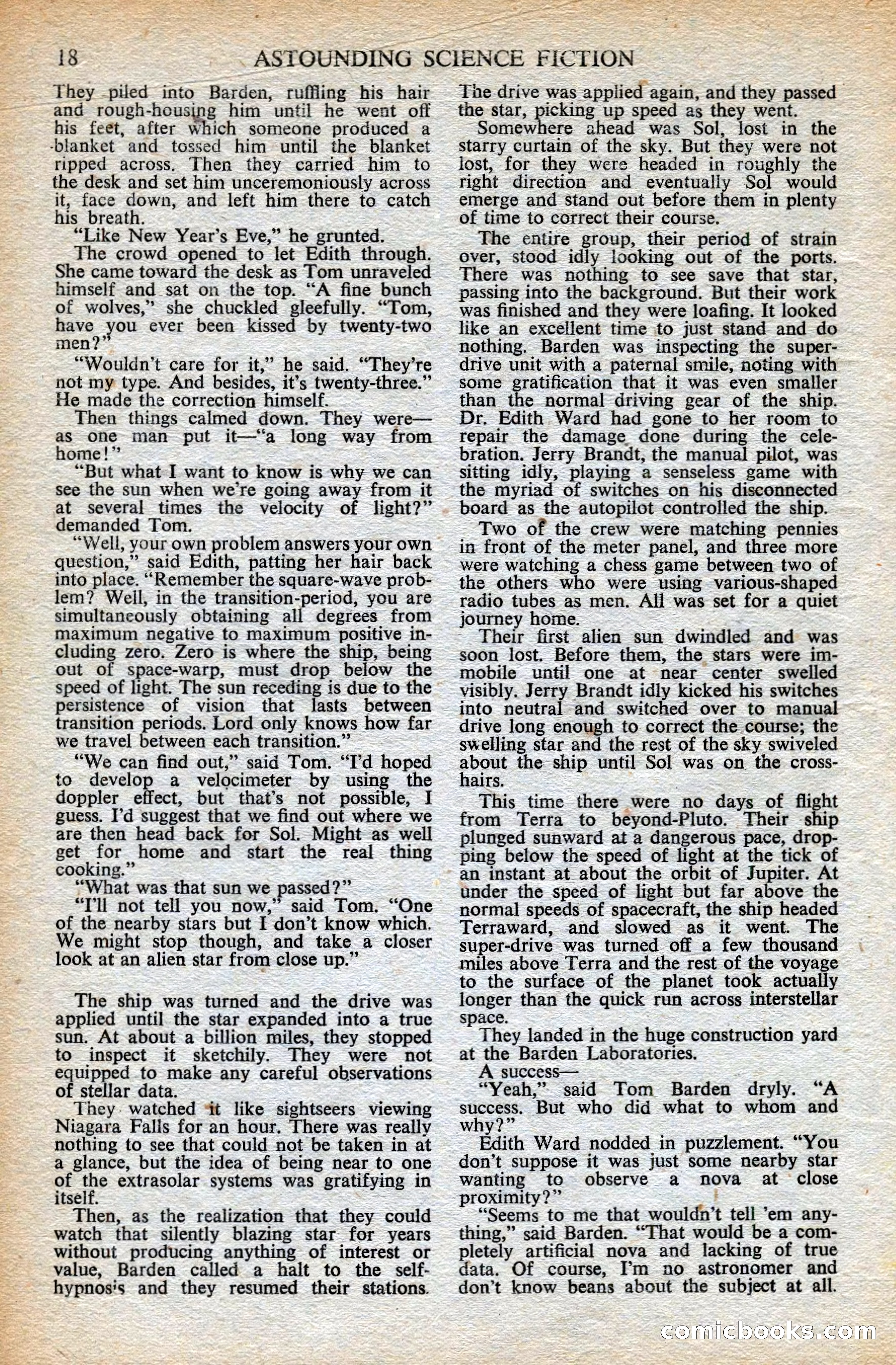
A restored page from Pulp Fiction, 1949. Page through the whole issue in the reader above.
📄 Transcribed text from this page (OCR, searchable)
Machine-transcribed from the original scan — historical spelling and the odd misread are preserved.
"2 ae - —_ ae oo. wel ee ee — ae om _ pa - ~ : —fo~ ~~ They -piled into Barden, ruffling his hair and rough-housing him until he went off his feet, after which someone produced a -blanket and tossed him until the blanket ripped across. Then they carried him to the desk and set him unceremoniously across it, face down, and left him there to catch his breath. “Like New Year’s Eve,” he grunted. The crowd opened to let Edith through. She came toward the desk as Tom unraveled himself and sat on the top. “A fine bunch of wolves,” she chuckled gleefully. “Tom, have you ever been kissed by twenty-two men?’ “Wouldn't care for it,” he said. “They’re not my type. And besides, it’s twenty-three.” He made the correction himself. : Then things calmed down. They were— as one man put it—‘a long way from home!” “But what-I want to know is why we can see the sun when we're going away from it at several times the velocity of light?” demanded Tom. “Well, your own problem answers your own question,” said Edith, patting her hair back into place. “Remember the square-wave prob- lem? Well, in the transition-period, you are simultaneously obtaining all degrees from maximum negative to maximum positive in- cluding zero. Zero is where the ship, being out of space-warp, must drop below the speed of light. The sun receding is due to the persistence of vision that lasts between transition periods. Lord only knows how far we travel between each transition.” “We can find out,” said Tom. “I’d hoped to develop a velocimeter by using the doppler effect, but that’s not possible, I guess. I’d suggest that we find out where we are then head back for Sol. Might as well get for home and start the real thing cooking.” “What was that sun we passed?” “Tll not tell you now,” said Tom. “One of the nearby stars but I don’t know which. We might stop though, and take a closer look at an alien star from close up.” The ship was turned and the drive was applied until the star expanded into a true sun. At about a billion miles, they stopped to inspect it sketchily. They were not equipped to make any careful observations of stellar data. | They: watched “it like sightseers viewing Niagara Falls for an hour. There was really nothing to see that could not be taken in at a glance, but the idea of being near to one of ue extrasolar systems was gratifying in itself. Then, as the realization that they could watch that silently blazing star for years without producing anything of interest or value, Barden called a halt to the self- hypnos's and they resumed their stations. —— a ee PO ate er EL an” OE — = 7 - - - ag -* Rr - 18 _ASTOUNDING SCIENCE FICTION The drive was applied again, and they passed the star, picking up speed as they went. Somewhere ahead was Sol, lost in the starry curtain of the sky. But they were not lost, for they were headed in roughly the right direction and eventually Sol would emerge and stand out before them in plenty of time to correct their course. The entire group, their period of strain over, stood idly looking out of the ports. There was nothing to see save that star, passing into the background. But their work was finished and they were loafing. It looked like an excellent time to just stand and do nothing. Barden was inspecting the super- drive unit with a paternal smile; noting with some gratification that it was even smaller than the normal driving gear of the ship. Dr. Edith Ward had gone to her room to repair the damage done during the cele- bration. Jerry Brandt, the manual pilot, was sitting idly, playing a senseless game with the myriad of switches on his disconnected board as the autopilot controlled the ship. Two of the crew were matching pennies in front of the meter panel, and three more were watching a chess game between two of the others who were using various-shaped radio tubes as men. All was set for a quiet journey home. - Their first alien sun dwindled and was soon lost. Before them, the stars were im- mobile until one at near center swelled visibly. Jerry Brandt idly kicked his switches into neutral and switched over to manual drive long enough to correct the course; the swelling star and the rest of the sky swiveled about the ship until Sol was on the cross- hairs. | This time there were no days of flight from Terra to beyond-Pluto. Their ‘ship plunged sunward at a dangerous pace, drop- ping below the speed of light at the tick of an instant at about the orbit of Jupiter. At under the speed of light but far above the normal speeds of spacecraft, the ship headed Terraward, and slowed as it went. The super-drive was turned off a few thousand miles above Terra and the rest of the voyage to the surface of the planet took actually longer than the quick run across interstellar space. They landed in the huge construction yard at the Barden Laboratories. A success— “Yeah,” said Tom Barden dryly. “A SUCCESS. But who did what to whom and Edith Ward nodded in puzzlement. “You don’t suppose it was just some nearby star wanting to observe a nova at close proximity?” F “Seems to me that wouldn’t tell “em any- thing,” said Barden. “That would be a com- pletely artificial nova and lacking of true data. Of course, [m no astronomer and don’t know beans about the subject at all. (COMIC OOS (S©)