
Pulp Fiction, 1949 · page 17 of 68
Astounding British Edition, Vol. 6, No. 8 — page 17: what you’re looking at
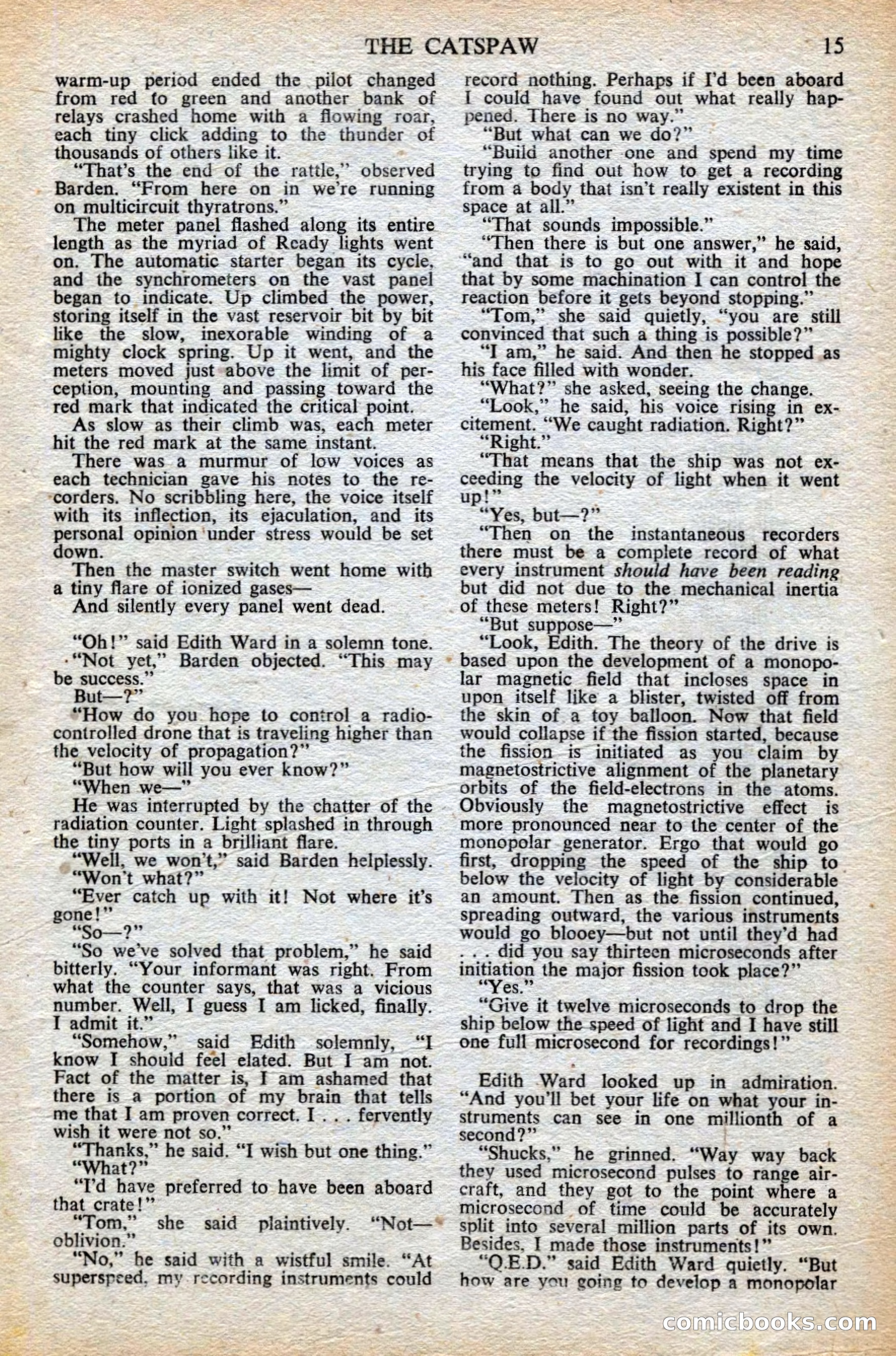
A restored page from Pulp Fiction, 1949. Page through the whole issue in the reader above.
📄 Transcribed text from this page (OCR, searchable)
Machine-transcribed from the original scan — historical spelling and the odd misread are preserved.
THE CATSPAW =F0 warm-up period ended the pilot changed from red fo green and another bank of relays crashed home with a flowing roar, each tiny click adding to the thunder of thousands of others like it. “That’s the end of the rattle,” observed - Barden. “From here on in were running on multicircuit thyratrons.” The meter panel flashed along its entire length as the myriad of Ready lights went on. The automatic starter began its cycle. and the synchrometers on the vast panel began to indicate. Up climbed the power, storing itself in the vast reservoir bit by bit like the slow, inexorable winding of a mighty clock spring. Up it went, and the meters moved just»above the limit of per- ception, mounting and passing toward the red mark that indicated the critical point. As slow as their climb was, each meter hit the red mark at the same instant. There was. a murmur of low voices as each technician gave his notes to the re- ‘corders. No scribbling here, the voice itself with its inflection, its ejaculation, and its personal opinion ‘under stress would be set down. Then the master switch went home with a tiny flare of ionized gases— And silently every panel went dead. “Oh!” said Edith Ward in a solemn tone. -“Not yet,” Barden objected. “This may be success.” But—?” “How do you hope to control a radio- controlled drone that is traveling higher than the velocity of propagation?” “But how will you ever know?” “When we—” He was interrupted by the chatter of the radiation counter. Light splashed in through the tiny ports in a brilliant flare. “Well, we won't,” said Barden helplessly. “Won't what?” | “Ever catch up with it! Not where it’s gone!” “So—?” : “So we've solved that problem,” he said bitterly. “Your informant was right. From what the counter says, that was a vicious number. Well, I guess I am licked, finally. I admit it.” “Somehow,” said Edith solemnly, “I know I should feel elated. But I-am not. Fact of the matter is, f am ashamed that there is a portion of my brain that tells me that I am proven correct. I... . fervently wish it were not so.” | “Thanks,” he said. “I wish but one thing.” “What?” “Il’d have preferred to have been aboard that crate!” “Tom,” she said plaintively. “Not—* oblivion.” “No,” he said with a wistful smile. “At superspeed, my- recording instruments could record nothing. Perhaps if I'd been aboard I could have found out what really hap- pened. There is no way.” “But what can we do?” “Build another one and spend my time trying to find out how to get a recording from a body that isn’t really existent in this space at all.” “That sounds impossible.” ‘Then there is but one answer,” he said, “and that is to go out with it and hope that by some machination I can control the reaction before it gets beyond stopping.” “Tom,” she said quietly, “you are still convinced that such a thing is possible?” “T am,” he said. And then he stopped as his face filled with wonder. “What?” she asked, seeing the change. “Look,” he said, his voice rising in ex- citement. “We caught radiation. Right?” “Right.” “That means that the ship was not ex- ceeding the velocity of light when it went up!” “Yes, but—?” “Then on the instantaneous recorders there must be a complete record of what every instrument should have been reading but did not due to the mechanical inertia of these meters! Right?” “But suppose—” “Look, Edith. The theory of the drive is based upon the development of a monopo- lar magnetic field that incloses space in upon itself like a blister, twisted off from the skin of a toy balloon. Now that field would collapse if the fission started, because the fission is initiated as you claim by magnetostrictive alignment of the planetary orbits of the field-electrons in the atoms. Obviously the magnetostrictive effect is more pronounced near to the center of the monopolar generator. Ergo that would go first, dropping the speed of the ship to below the velocity of light by considerable an amount. Then as the fission continued, spreading outward, the various instruments would go blooey—but not until they’d had . . . did you say thirteen microseconds after eens the major fission took place?” ‘ es.”” “Give it twelve microseconds to drop the ship below the speed of light and I have still one full microsecond for recordings!” Edith Ward looked up in admiration. “And you'll bet your life on what your in- struments can see in one millionth of a second?” “Shucks,” he grinned. “Way way back they used microsecond pulses to range air- craft, and they got to the point where a microsecond of time could be accurately split into several million parts of its own. Besides, I made those instruments!” “Q.E.D.” said Edith Ward quietly. “But how are you going to develop a monopolar Eomicbooks.co ~ OE AOE As ——