
Pulp Fiction, 1949 · page 11 of 68
Astounding British Edition, Vol. 6, No. 8 — page 11: what you’re looking at
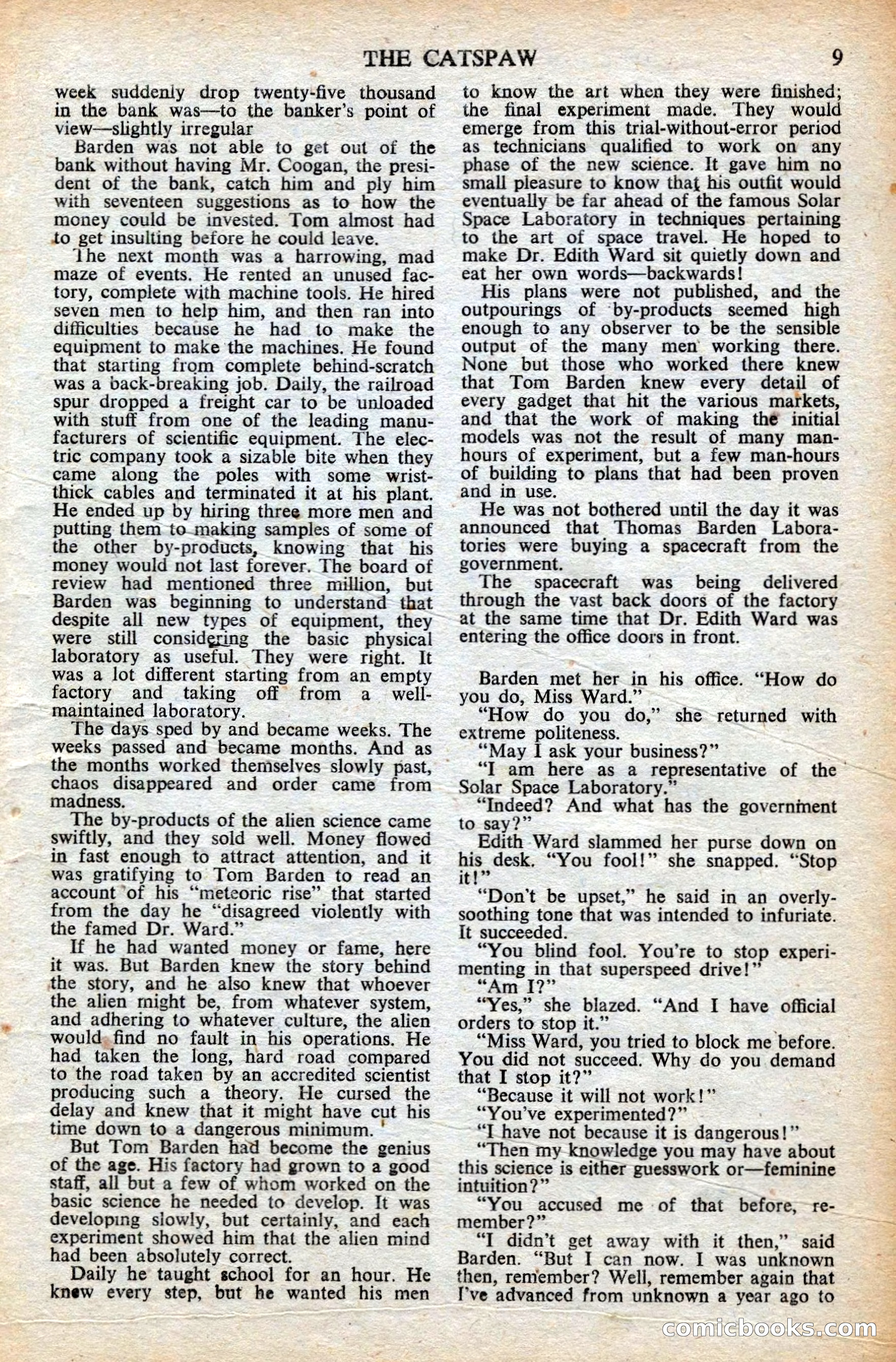
A restored page from Pulp Fiction, 1949. Page through the whole issue in the reader above.
📄 Transcribed text from this page (OCR, searchable)
Machine-transcribed from the original scan — historical spelling and the odd misread are preserved.
THE CATSPAW Ee week suddenly drop twenty-five thousand in the bank was—to the banker’s point of view—slightly irregular Barden was not able to get out of the bank without having Mr. Coogan, the presi- dent of the bank, catch him and ply him with seventeen suggestions as to how the money could be invested. Tom almost had to get insulting before he could leave. the next month was a harrowing, mad maze of events. He rented an unused fac- tory, complete with machine tools. He hired seven men to help him, and then ran into difficulties because he had to make the equipment to make the machines. He found that starting from complete behind-scratch was a back-breaking job. Daily, the railroad spur dropped a freight car to be unloaded with stuff from one of the leading manu- facturers of scientific equipment. The elec- tric company took a sizable bite when they came along the poles with some wrist- thick cables and terminated it at his plant. He ended up by hiring three more men and putting them to.making samples of some of the other by-products, knowing that his money would not last forever. The board of review had mentioned three million, but Barden was beginning to understand that despite all new types of equipment, they were still considering the basic physical laboratory as useful. They were right. It was a lot different starting from an empty factory and taking off from a_ well- maintained laboratory. The days sped by and became weeks. The weeks passed and became months. And as the months worked themselves slowly past, chaos disappeared and order came from madness. The by-products of the alien science came swiftly, and they sold well. Money flowed in fast enough to attract attention, and it was gratifying to Tom Barden to read an account ‘of his “meteoric rise” that started from the day he “disagreed violently with the famed Dr. Ward.” If he had wanted money or fame, here it was. But Barden knew the story behind the story, and he also knew that whoever the alien might be, from whatever system, and adhering to whatever culture, the alien would, find no fault in his operations. He had taken the long, hard road compared to the road taken by an accredited scientist producing such a theory. He cursed the delay and knew that it might have cut his time down to a dangerous minimum. ' But Tom Barden had become the genius of the age. His factory had grown to a good staff, all but a few of whom worked on the basic science he needed to develop. It was developing slowly, but certainly, and each experiment showed him that the alien mind had been absolutely correct. Daily he taught school for an hour. He knew every step, but he wanted his men to know the art when they were finished; the final experiment made. They would emerge from this trial-without-error period as technicians qualified to work on any phase of the new science. It gave him no small pleasure to know that his outfit would eventually be far ahead of the famous Solar Space Laboratory in techniques pertaining to the art of space travel. He hoped to make Dr. Edith Ward sit quietly down and eat her own words—backwards! His plans were not published, and the outpourings of ‘by-products seemed high enough to any observer to be the sensible output of the many men working there. None but those who worked there knew that Tom Barden knew every detail of every gadget that hit the various markets, and that the work of making thé initial models was not the result of many man- hours of experiment, but a few man-hours of building to plans that had been proven and in use. He was not bothered until the day it was announced that Thomas Barden Labora- tories were buying a spacecraft from the government. The spacecraft was being delivered through the vast back doors of the factory at the same time that Dr. Edith Ward was entering the office doors in front. Barden met her in his office. “How do you do, Miss Ward.” “How do you do,” she returned with extreme politeness. ““May I ask your business?” “I am here as a representative of the Solar Space Laboratory.” “Indeed? And what has the governinent to say?” Edith Ward slammed her purse down on _ desk, “You fool!” she snapped. “Stop it > “Don't be upset,” he said in an overly- soothing tone that was intended to infuriate. It succeeded. “You blind fool. You’re to stop experi- menting in that superspeed drive!” “Am Sy tes “Yes,” she blazed. “And I have official orders to stop it.” “Miss Ward, you tried to block me before. — You did not succeed. Why do you demand that I stop it?” “Because it will not work!” “You've experimented?” “I have not because it is dangerous!” “Then my knowledge you may have about this science is either guesswork or—feminine intuition?” “You accused me of that before, -re- member?” “IT didn’t get away with it then,” said Barden. “But I can now. I was unknown then, reniember? Well, remember again that | I've advanced from unknown a year ago to Oo Gomichbooksaco