
Pulp Fiction, 1922 · page 104 of 185
Argosy All-Story Weekly, October 7, 1922 — page 104: what you’re looking at
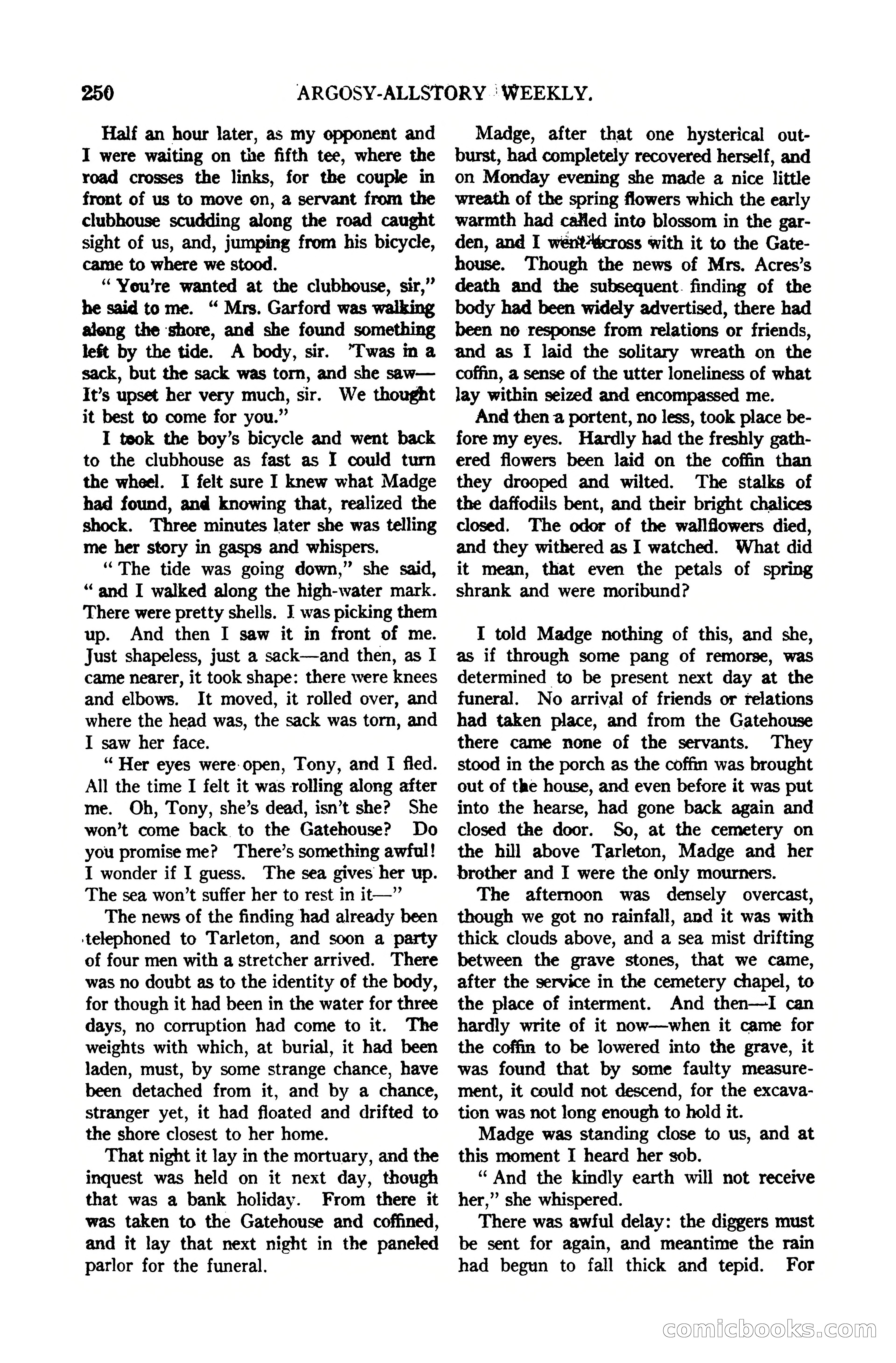
A restored page from Pulp Fiction, 1922. Page through the whole issue in the reader above.
📄 Transcribed text from this page (OCR, searchable)
Machine-transcribed from the original scan — historical spelling and the odd misread are preserved.
250 Half an hour later, as my opponent and I were waiting on the fifth tee, where the road crosses the links, for the couple in front of us to move on, a servant from the clubhouse scudding along the road caught sight of us, and, jumping from his bicycle, came to where we stood. “You're wanted at the clubhouse, sir,” he said to me. “ Mrs. Garford was walking aleng the shore, and she found something left by the tide. A body, sir. “Iwas in a sack, but the sack was torn, and she saw— It’s upset her very much, sir. We thought it best to come for you.”’ I teok the boy’s bicycle and went back to the clubhouse as fast as I could turn the wheel. I felt sure I knew what Madge had found, and knowing that, realized the shock. Three minutes later she was telling me her story in gasps and whispers. “The tide was going down,” she said, “and I walked along the high-water mark. There were pretty shells. J was picking them up. And then I saw it in front of me. Just shapeless, just a sack—and then, as I came nearer, it took shape: there were knees and elbows. It moved, it rolled over, and where the head was, the sack was torn, and I saw her face. “Her eyes were.open, Tony, and I fied. All the time I felt it was rolling along after me. Oh, Tony, she’s dead, isn’t she? She won’t come back to the Gatehouse? Do you promise me? There’s something awful! I wonder if I guess. The sea gives her up. The sea won’t suffer her to rest in it—” The news of the finding had already been ‘telephoned to Tarleton, and soon a party of four men with a stretcher arrived. There was no doubt as to the identity of the body, for though it had been in the water for three days, no corruption had come to it. The weights with which, at burial, it had been laden, must, by some strange chance, have been detached from it, and by a chance, stranger yet, it had floated and drifted to the shore closest to her home. That night it lay in the mortuary, and the inquest was held on it next day, though that was a bank holiday. From there it was taken to the Gatehouse and coffined, and it lay that next night in the paneled parlor for the funeral. ARGOSY-ALLSTORY ‘WEEKLY. Madge, after that one hysterical out- burst, had completely recovered herself, and on Monday evening she made a nice little wreath of the spring flowers which the early warmth had called inte blossom in the gar- den, and I wént*écross with it to the Gate- house. Though the news of Mrs. Acres’s death and the subsequent. finding of the body had been widely advertised, there had been no response from relations or friends, and as [I laid the solitary wreath on the coffin, a sense of the utter loneliness of what lay within seized and encompassed me. And then a portent, no less, took place be- fore my eyes. Hardly had the freshly gath- ered flowers been laid on the coffin than they drooped and wilted. The stalks of the daffodils bent, and their bright chalices closed. The odor of the wallflowers died, and they withered as I watched. What did it mean, that even the petals of spring shrank and were moribund? I told Madge nothing of this, and she, as if through some pang of remorse, was determined to be present next day at the funeral. No arrival of friends or relations had taken place, and from the Gatehouse there came none of the servants. They stood in the porch as the coffin was brought out of the house, and even before it was put into the hearse, had gone back again and closed the door. So, at the cemetery on the hill above Tarleton, Madge and her brother and I were the only mourners. The afternoon was densely overcast, though we got no rainfall, and it was with thick clouds above, and a sea mist drifting between the grave stones, that we came, after the service in the cemetery chapel, to the place of interment. And then—I can hardly write of it now—when it came for the coffin to be lowered into the grave, it was found that by some faulty measure- ment, it could not descend, for the excava- tion was not long enough to hold it. Madge was standing close to us, and at this moment I heard her sob. “And the kindly earth will not receive her,”’ she whispered. There was awful delay: the diggers must be sent for again, and meantime the rain had begun to fall thick and tepid. For COMmiclboo SS C©