
Pulp Fiction, 1922 · page 103 of 185
Argosy All-Story Weekly, October 7, 1922 — page 103: what you’re looking at
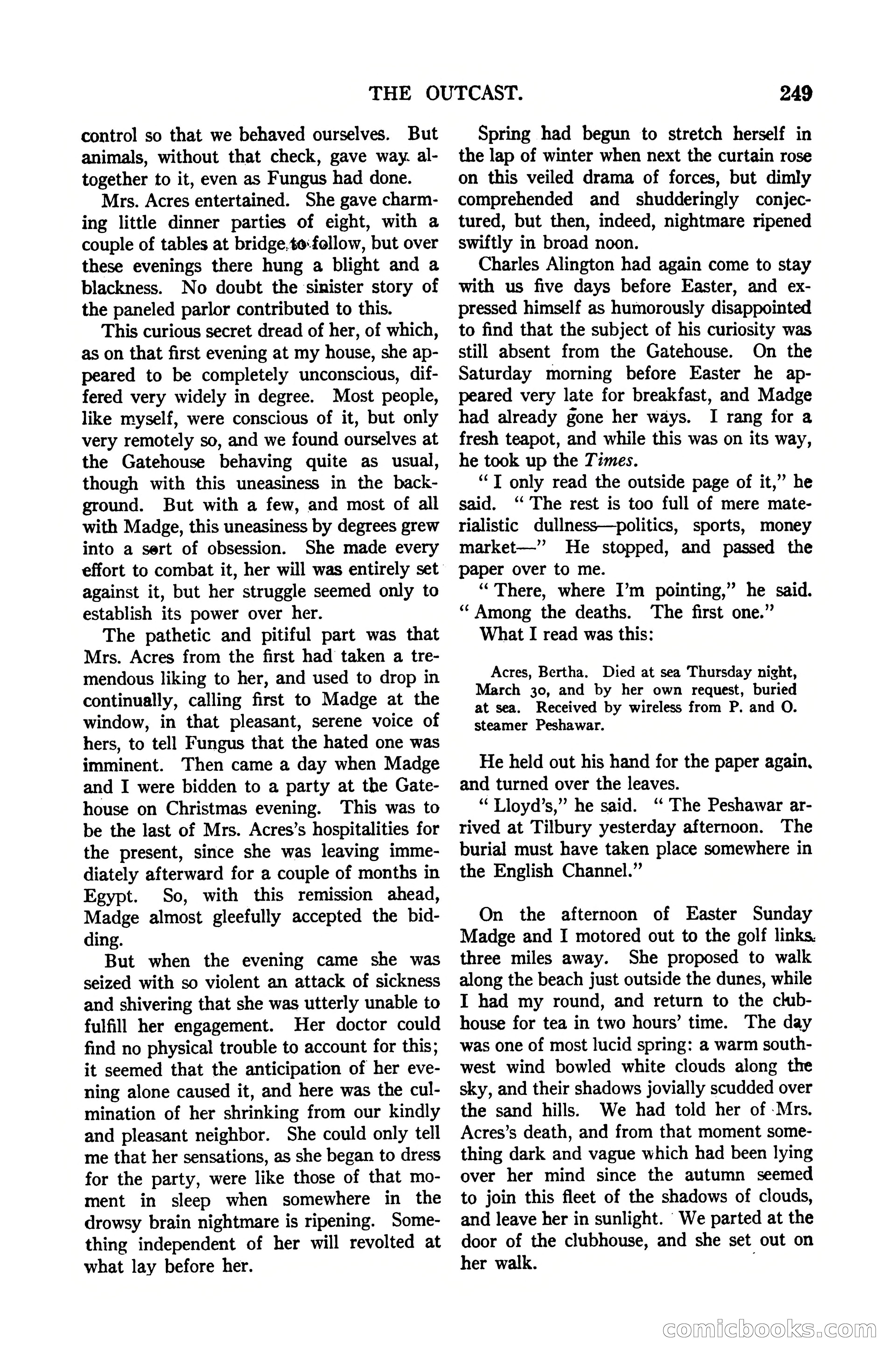
A restored page from Pulp Fiction, 1922. Page through the whole issue in the reader above.
📄 Transcribed text from this page (OCR, searchable)
Machine-transcribed from the original scan — historical spelling and the odd misread are preserved.
THE OUTCAST. control so that we behaved ourselves. But animals, without that check, gave way. al- together to it, even as Fungus had done. Mrs. Acres entertained. She gave charm- ing little dinner parties of eight, with a couple of tables at bridge,to.follow, but over these evenings there hung a blight and a blackness. No doubt the sinister story of the paneled parlor contributed to this. This curious secret dread of her, of which, as on that first evening at my house, she ap- peared to be completely unconscious, dif- fered very widely in degree. Most people, like myself, were conscious of it, but only very remotely so, and we found ourselves at the Gatehouse behaving quite as usual, though with this uneasiness in the back- ground. But with a few, and most of all with Madge, this uneasiness by degrees grew into a sert of obsession. She made every effort to combat it, her will was entirely set against it, but her struggle seemed only to establish its power over her. The pathetic and pitiful part was that Mrs. Acres from the first had taken a tre- mendous liking to her, and used to drop in continually, calling first to Madge at the window, in that pleasant, serene voice of hers, to tell Fungus that the hated one was imminent. Then came a day when Madge and I were bidden to a party at the Gate- house on Christmas evening. This was to be the last of Mrs. Acres’s hospitalities for the present, since she was leaving imme- diately afterward for a couple of months in Egypt. So, with this remission ahead, Madge almost gleefully accepted the bid- ding. But when the evening came she was seized with so violent an attack of sickness and shivering that she was utterly unable to fulfill her engagement. Her doctor could find no physical trouble to account for this; it seemed that the anticipation of her eve- ning alone caused it, and here was the cul- mination of her shrinking from our kindly and pleasant neighbor. She could only tell me that her sensations, as she began to dress for the party, were like those of that mo- ment in sleep when somewhere in the drowsy brain nightmare is ripening. Some- thing independent of her will revolted at what lay before her. 249 Spring had begun to stretch herself in the lap of winter when next the curtain rose on this veiled drama of forces, but dimly comprehended and shudderingly conjec- tured, but then, indeed, nightmare ripened swiftly in broad noon. Charles Alington had again come to stay with us five days before Easter, and ex- pressed himself as humorously disappointed to find that the subject of his curiosity was still absent from the Gatehouse. On the Saturday morning before Easter he ap- peared very late for breakfast, and Madge had already gone her ways. I rang for a fresh teapot, and while this was on its way, he took up the Times. ‘“‘T only read the outside page of it,” he said. “ The rest is too full of mere mate- rialistic dullness—politics, sports, money market—” He stopped, and passed the paper over to me. “There, where I’m pointing,” he said. “Among the deaths. ‘The first one.” What I read was this: Acres, Bertha. Died at sea Thursday night, March 30, and by her own request, buried at sea. Received by wireless from P. and O. steamer Peshawar. He held out his hand for the paper again, and turned over the leaves. “‘ Lloyd’s,” he said. ‘ The Peshawar ar- rived at Tilbury yesterday afternoon. The burial must have taken place somewhere in the English Channel.” On the afternoon of Easter Sunday Madge and I motored out to the golf links. three miles away. She proposed to walk along the beach just outside the dunes, while I had my round, and return to the club- house for tea in two hours’ time. The day was one of most lucid spring: a warm south- west wind bowled white clouds along the sky, and their shadows jovially scudded over the sand hills. We had told her of -Mrs. Acres’s death, and from that moment some- thing dark and vague which had been lying over her mind since the autumn seemed to join this fleet of the shadows of clouds, and leave her in sunlight. We parted at the door of the clubhouse, and she set out on her walk. MICLOOOK C©