
Pulp Fiction, 1922 · page 105 of 185
Argosy All-Story Weekly, October 7, 1922 — page 105: what you’re looking at
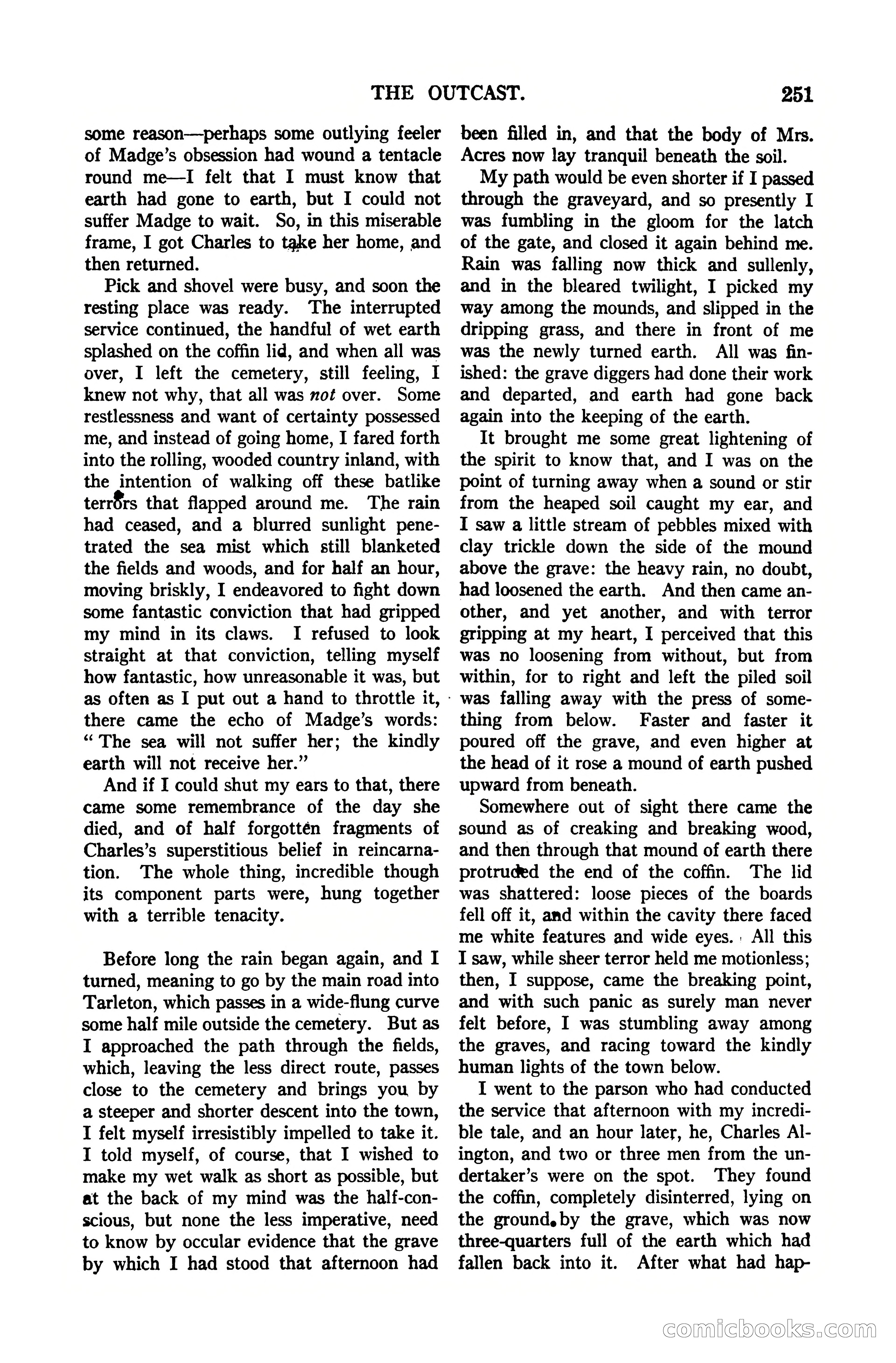
A restored page from Pulp Fiction, 1922. Page through the whole issue in the reader above.
📄 Transcribed text from this page (OCR, searchable)
Machine-transcribed from the original scan — historical spelling and the odd misread are preserved.
THE OUTCAST. some reason—perhaps some outlying feeler of Madge’s obsession had wound a tentacle round me—I felt that I must know that earth had gone to earth, but I could not suffer Madge to wait. So, in this miserable frame, I got Charles to take her home, and then returned. Pick and shovel were busy, and soon the resting place was ready. The interrupted service continued, the handful of wet earth splashed on the coffin lid, and when all was over, I left the cemetery, still feeling, I knew not why, that all was mot over. Some restlessness and want of certainty possessed me, and instead of going home, I fared forth into the rolling, wooded country inland, with the intention of walking off these batlike terrors that flapped around me. The rain had ceased, and a blurred sunlight pene- trated the sea mist which still blanketed the fields and woods, and for half an hour, moving briskly, I endeavored to fight down some fantastic conviction that had gripped my mind in its claws. I refused to look straight at that conviction, telling myself how fantastic, how unreasonable it was, but as often as I put out a hand to throttle it, - there came the echo of Madge’s words: “The sea will not suffer her; the kindly earth will not receive her.” And if I could shut my ears to that, there came some remembrance of the day she died, and of half forgottén fragments of Charles’s superstitious belief in reincarna- tion. The whole thing, incredible though its component parts were, hung together with a terrible tenacity. Before long the rain began again, and I turned, meaning to go by the main road into Tarleton, which passes in a wide-flung curve some half mile outside the cemetery. But as I approached the path through the fields, which, leaving the less direct route, passes close to the cemetery and brings you by a steeper and shorter descent into the town, I felt myself irresistibly impelled to take it. I told myself, of course, that I wished to make my wet walk as short as possible, but at the back of my mind was the half-con- scious, but none the less imperative, need to know by occular evidence that the grave by which I had stood that afternoon had 251 been filled in, and that the body of Mrs. Acres now lay tranquil beneath the soil. My path would be even shorter if I passed through the graveyard, and so presently I was fumbling in the gloom for the latch of the gate, and closed it again behind me. Rain was falling now thick and sullenly, and in the bleared twilight, I picked my way among the mounds, and slipped in the dripping grass, and there in front of me was the newly turned earth. All was fin- ished: the grave diggers had done their work and departed, and earth had gone back again into the keeping of the earth. It brought me some great lightening of the spirit to know that, and I was on the point of turning away when a sound or stir from the heaped soil caught my ear, and I saw a little stream of pebbles mixed with clay trickle down the side of the mound above the grave: the heavy rain, no doubt, had loosened the earth. And then came an- other, and yet another, and with terror gripping at my heart, I perceived that this was no loosening from without, but from within, for to right and left the piled soil was falling away with the press of some- thing from below. Faster and faster it poured off the grave, and even higher at the head of it rose a mound of earth pushed upward from beneath. Somewhere out of sight there came the sound as of creaking and breaking wood, and then through that mound of earth there protruded the end of the coffin. The lid was shattered: loose pieces of the boards fell off it, and within the cavity there faced me white features and wide eyes. : All this I saw, while sheer terror held me motionless; then, I suppose, came the breaking point, and with such panic as surely man never felt before, I was stumbling away among the graves, and racing toward the kindly human lights of the town below. I went to the parson who had conducted the service that afternoon with my incredi- ble tale, and an hour later, he, Charles Al- ington, and two or three men from the un- dertaker’s were on the spot. They found the coffin, completely disinterred, lying on the ground,by the grave, which was now three-quarters full of the earth which had fallen back into it. After what had hap- comicboooks C©