
Pulp Fiction, 1922 · page 100 of 185
Argosy All-Story Weekly, October 7, 1922 — page 100: what you’re looking at
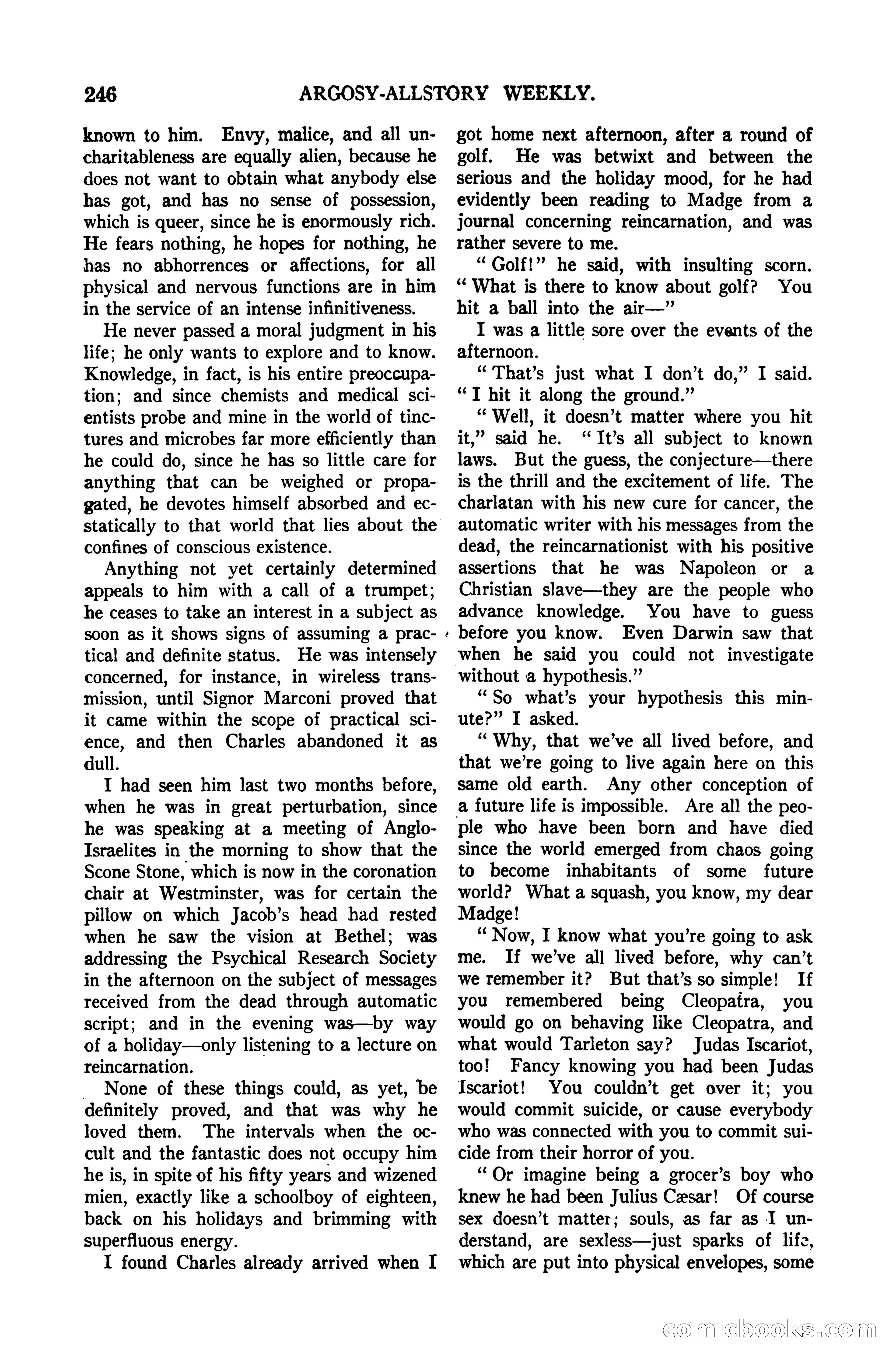
A restored page from Pulp Fiction, 1922. Page through the whole issue in the reader above.
📄 Transcribed text from this page (OCR, searchable)
Machine-transcribed from the original scan — historical spelling and the odd misread are preserved.
246 known to him. Envy, malice, and all un- charitableness are equally alien, because he does not want to obtain what anybody else has got, and has no sense of possession, which is queer, since he is enormously rich. He fears nothing, he hopes for nothing, he has no abhorrences or affections, for all physical and nervous functions are in him in the service of an intense infinitiveness. He never passed a moral judgment in his life; he only wants to explore and to know. Knowledge, in fact, is his entire preoccupa- tion; and since chemists and medical sci- entists probe and mine in the world of tinc- tures and microbes far more efficiently than he could do, since he has so little care for anything that can be weighed or propa- gated, he devotes himself absorbed and ec- statically to that world that lies about the confines of conscious existence. Anything not yet certainly determined appeals to him with a call of a trumpet; he ceases to take an interest in a subject as soon as it shows signs of assuming a prac- tical and definite status. He was intensely concerned, for instance, in wireless trans- mission, until Signor Marconi proved that it came within the scope of practical sci- ence, and then Charles abandoned it as dull. I had seen him last two months before, when he was in great perturbation, since he was speaking at a meeting of Anglo- Israelites in the morning to show that the Scone Stone, which is now in the coronation chair at Westminster, was for certain the pillow on which Jacob’s head had rested when he saw the vision at Bethel; was addressing the Psychical Research Society in the afternoon on the subject of messages received from the dead through automatic script; and in the evening was—by way of a holiday—only listening to a lecture on reincarnation. _ None of these things could, as yet, be definitely proved, and that was why he loved them. The intervals when the oc- cult and the fantastic does not occupy him he is, in spite of his fifty years and wizened mien, exactly like a schoolboy of eighteen, back on his holidays and brimming with superfluous energy. I found Charles already arrived when I é ARGOSY-ALLSTORY WEEKLY. got home next afternoon, after a round of golf. He was betwixt and between the serious and the holiday mood, for he had evidently been reading to Madge from a journal concerning reincarnation, and was rather severe to me. “Golf!” he said, with insulting scorn. “What is there to know about golf? You hit a ball into the air—”’ I was a little sore over the events of the afternoon. “That’s just what I don’t do,” I said. ““T hit it along the ground.” “Well, it doesn’t matter where you hit it,” said he. “It’s all subject to known laws. But the guess, the conjecture—there is the thrill and the excitement of life. The charlatan with his new cure for cancer, the automatic writer with his messages from the dead, the reincarnationist with his positive assertions that he was Napoleon or a Christian slave—they are the people who advance knowledge. You have to guess before you know. Even Darwin saw that when he said you could not investigate without a hypothesis.” “So what’s your hypothesis this min- ute?” I asked. ‘Why, that we’ve all lived before, and that we’re going to live again here on this same old earth. Any other conception of a future life is impossible. Are all the peo- ple who have been born and have died since the world emerged from chaos going to become inhabitants of some future world? What a squash, you know, my dear Madge! ‘* Now, I know what you're going to ask me. If we’ve all lived before, why can’t we remember it? But that’s so simple! If you remembered being Cleopatra, you would go on behaving like Cleopatra, and what would Tarleton say? Judas Iscariot, too! Fancy knowing you had been Judas Iscariot! You couldn’t get over it; you would commit suicide, or cause everybody who was connected with you to commit sui- cide from their horror of you. ‘Or imagine being a grocer’s boy who knew he had béen Julius Cesar! Of course sex doesn’t matter; souls, as far as I un- derstand, are sexless—just sparks of life, which are put into physical envelopes, some comicboooks C©