
Pulp Fiction, 1922 · page 99 of 185
Argosy All-Story Weekly, October 7, 1922 — page 99: what you’re looking at
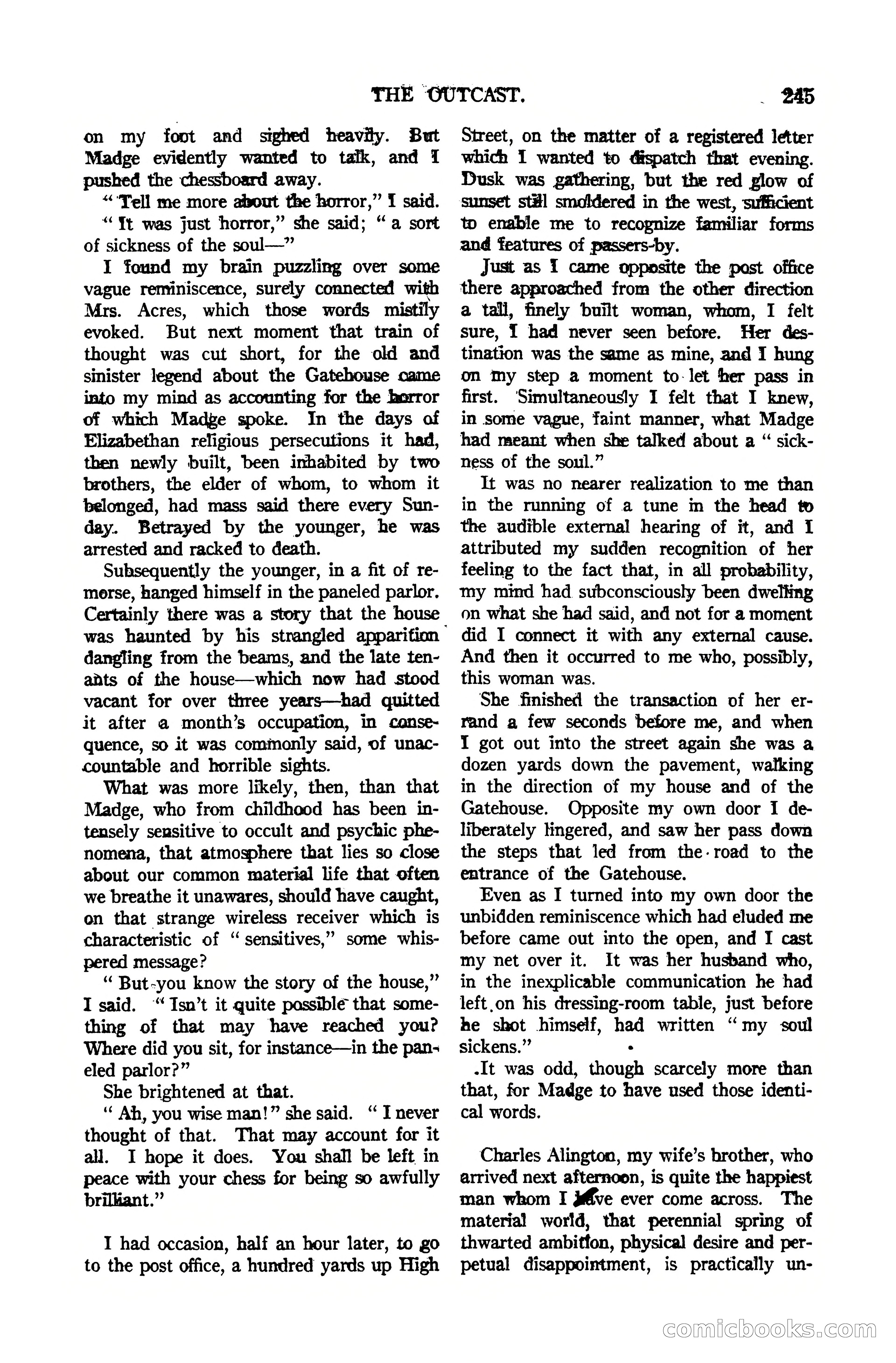
A restored page from Pulp Fiction, 1922. Page through the whole issue in the reader above.
📄 Transcribed text from this page (OCR, searchable)
Machine-transcribed from the original scan — historical spelling and the odd misread are preserved.
THE ‘OUTCAST. on my foot and sighed heavily. But Madge evidently wanted to talk, and I pushed the chessboard away. “Tell me more about the horror,’ I said. “Tt was just horror,” she said; “a sort of sickness of the soul—”’ I found my brain puzzling over some vague reminiscence, surely connected with Mrs. Acres, which those words mistily evoked. But next moment that train of thought was cut short, for the old and sinister legend about the Gatehouse came into my mind as accounting for the horror of which Madge spoke. In the days of Elizabethan religious persecutions it had, then newly built, been inhabited by two brothers, the elder of whom, to whom it belonged, had mass said there every Sun- day. Betrayed by the younger, he was arrested and racked to death. Subsequently the younger, in a fit of re- merse, hanged himself in the paneled parlor. Certainly there was a story that the house was haunted by his strangled apparition dangling from the beams, and the late ten- ants of the house—which now had stood vacant for over three years—had quitted it after a month’s occupation, in canse- quence, so it was commonly said, of unac- countable and horrible sights. What was more likely, then, than that Madge, who from childhood has been in- tensely sensitive to occult and psychic phe- nomena, that atmosphere that lies so close about our common material life that often we breathe it unawares, should have caught, on that strange wireless receiver which is characteristic of ‘“‘ sensitives,”’ some whis- pered message? ‘“ But-you know the story of the house,” I said. “Isn’t it quite passiblé that some- thing of that may have reached you? Where did you sit, for instance—in the pan- eled parlor?” She brightened at that. ‘‘ Ah, you wise man!” she said. “ I never thought of that. That may account for it all. I hope it does. You shall be left in peace with your chess for being so awfully brilliant.” I had occasion, half an hour later, to go to the post office, a hundred yards up High _ B45 Street, on the matter of a registered letter which 1 wanted to dispatch that evening. Dusk was gathering, but the red plow of sunset st#l smoldered in the west, sufficient to enable me to recognize familiar forms and features of passers-by. Just as I came opposite the post office there approached from the other direction a tall, finely built woman, whom, I felt sure, I had never seen before. Her des- tination was the same as mine, and I hung on my step a moment to-let ther pass in first. ‘Simultaneously I felt that I knew, in some vague, faint manner, what Madge had meant when she talked about a “ sick- ness of the soul.” It was no nearer realization to me than in the running of a tune im the head to the audible external hearing of it, and I attributed my sudden recognition of her feeling to the fact that, in all probability, my mind had subconsciously been dwelfing on what she had said, and not for a moment did I connect it with any external cause. And then it occurred to me who, possibly, this woman was. She finished the transaction of her er- rand a few seconds before me, and when I got out into the street again she was a dozen yards down the pavement, walking in the direction of my house and of the Gatehouse. Opposite my own door I de- liberately Hingered, and saw her pass down the steps that led from the-road to the entrance of the Gatehouse. Even as I turned into my own door the unbidden reminiscence which had eluded me before came out into the open, and I cast my net over it. It was her husband who, in the inexplicable communication he had left,on his dressing-room table, just before he shot himself, ae written “my soul sickens.” -It was odd, though scarcely more than that, for Madge to have used those identi- cal words. Charles Alington, my wife’s brother, who arrived next afternoon, is quite the happiest man whom I d@ve ever come across. The material world, that perennial spring of thwarted ambitfon, physical desire and per- petual disappointment, is practically un- comicboooks C©