
Pulp Fiction, 1922 · page 101 of 185
Argosy All-Story Weekly, October 7, 1922 — page 101: what you’re looking at
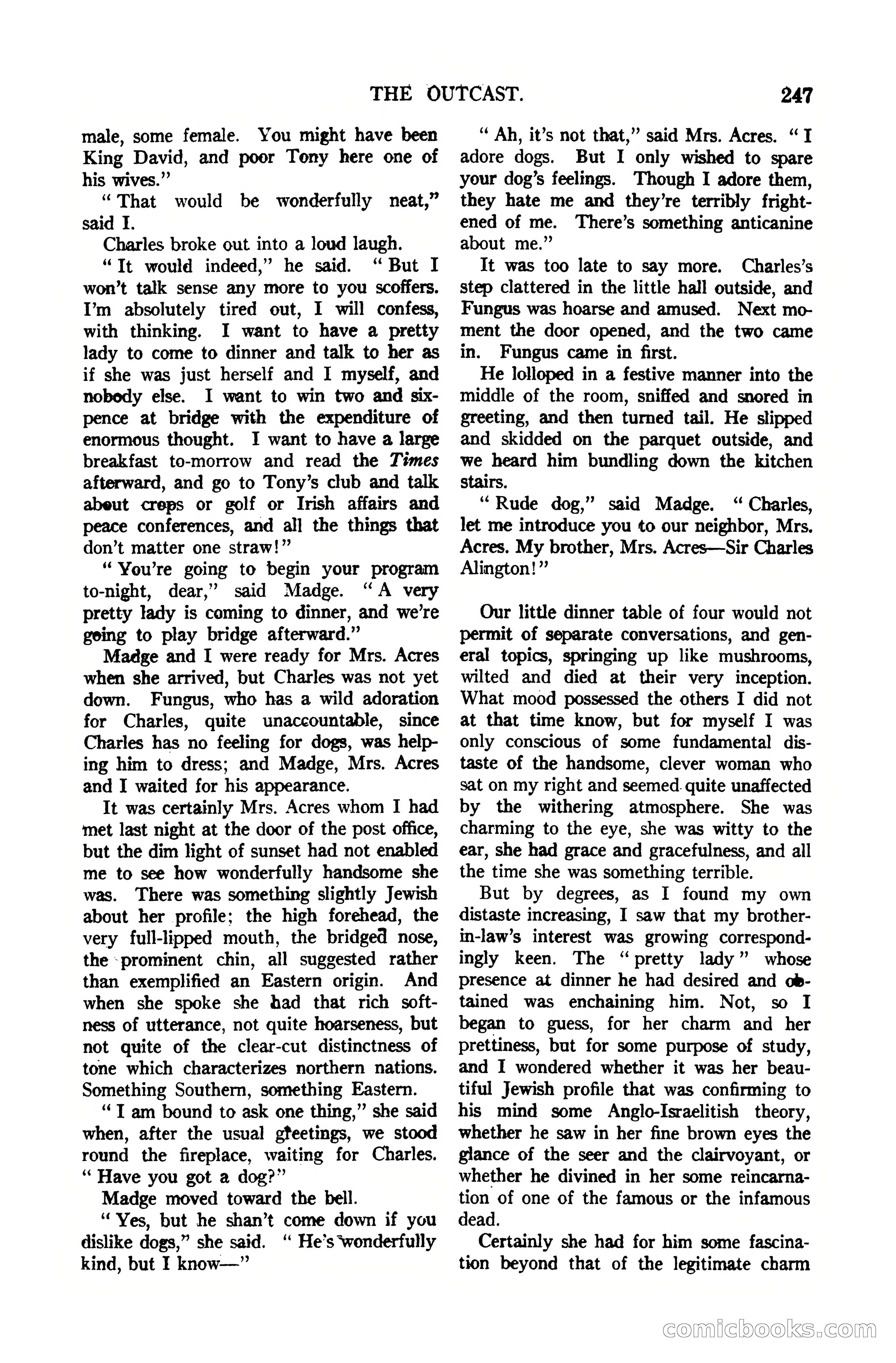
A restored page from Pulp Fiction, 1922. Page through the whole issue in the reader above.
📄 Transcribed text from this page (OCR, searchable)
Machine-transcribed from the original scan — historical spelling and the odd misread are preserved.
THE OUTCAST. male, some female. You might have been King David, and poor Tony here one of his wives.” “That would be wonderfully neat,” said I. Charles broke out into a loud laugh. “Tt would indeed,” he said. “ But I won’t talk sense any more to you scoffers. I’m absolutely tired out, I will confess, with thinking. I want to have a pretty lady to come to dinner and talk to her as if she was just herself and I myself, and nobody else. I want to win two and six- pence at bridge with the expenditure of enormous thought. I want to have a large breakfast to-morrow and read the Times afterward, and go to Tony’s club and talk abeut creps or golf or Irish affairs and peace conferences, and all the things that don’t matter one straw!”’ “You’re going to begin your program to-night, dear,” said Madge. “A very pretty lady is coming to dinner, and we’re geing to play bridge afterward.” Madge and I were ready for Mrs. Acres when she arrived, but Charles was not yet down. Fungus, who has a wild adoration for Charles, quite unaccountable, since Charles has no feeling for dogs, was help- ing him to dress; and Madge, Mrs. Acres and I waited for his appearance. It was certainly Mrs. Acres whom I had met last night at the door of the post office, but the dim light of sunset had not enabled me to see how wonderfully handsome she was. There was something slightly Jewish about her profile; the high forehead, the very full-lipped mouth, the bridged nose, the prominent chin, all suggested rather than exemplified an Eastern origin. And when she spoke she had that rich soft- ness of utterance, not quite hoarseness, but not quite of the clear-cut distinctness of tone which characterizes northern nations. Something Southern, something Eastern. ‘“T am bound to ask one thing,” she said when, after the usual gfeetings, we stood round the fireplace, waiting for Charles. ‘“‘ Have you got a dog?” Madge moved toward the bell. “Yes, but he shan’t come down if you dislike dogs,” she said. “ He’s ‘wonderfully kind, but I know—” 247 ‘* Ah, it’s not that,” said Mrs. Acres. “I adore dogs. But I only wished to spare your dog’s feelings. Though I adore them, they hate me and they’re terribly fright- ened of me. There’s something anticanine about me.” It was too late to say more. Charles’s step clattered in the little hall outside, and Fungus was hoarse and amused. Next mo- ment the door opened, and the two came in. Fungus came in first. He lolloped in a festive manner into the middle of the room, sniffed and snored in greeting, and then turned tail. He slipped and skidded on the parquet outside, and we heard him bundling down the kitchen stairs. “Rude dog,” said Madge. “Charles, let me introduce you to our neighbor, Mrs. Acres. My brother, Mrs. Acres—Sir Charles Alington!”’ Our little dinner table of four would not permit of separate conversations, and gen- eral topics, springing up like mushrooms, wilted and died at their very inception. What mood possessed the others I did not at that time know, but for myself I was only conscious of some fundamental dis- taste of the handsome, clever woman who sat on my right and seemed. quite unaffected by the withering atmosphere. She was charming to the eye, she was witty to the ear, she had grace and gracefulness, and all the time she was something terrible. But by degrees, as I found my own distaste increasing, I saw that my brother- in-law’s interest was growing correspond- ingly keen. The “pretty lady” whose presence at dinner he had desired and ob- tained was enchaining him. Not, so I began to guess, for her charm and her prettiness, but for some purpose of study, and I wondered whether it was her beau- tiful Jewish profile that was confirming to his mind some Anglo-Israelitish theory, whether he saw in her fine brown eyes the glance of the seer and the clairvoyant, or whether he divined in her some reincarna- tion of one of the famous or the infamous dead. Certainly she had for him some fascina- tion beyond that of the legitimate charm comicboooks C©