
Pulp Fiction, 1912 · page 91 of 276
The Argosy, Christmas 1912 — page 91: what you’re looking at
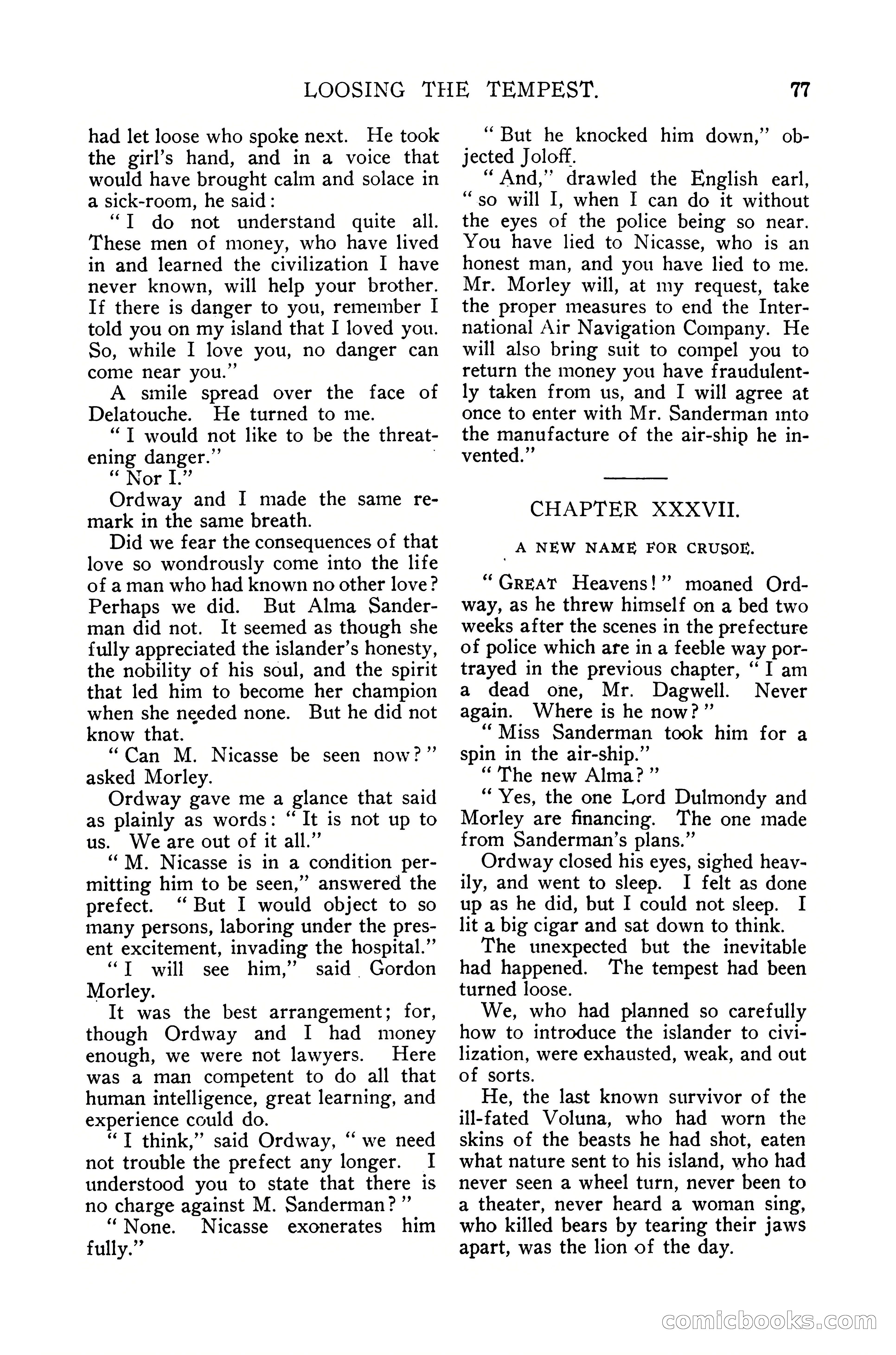
A restored page from Pulp Fiction, 1912. Page through the whole issue in the reader above.
📄 Transcribed text from this page (OCR, searchable)
Machine-transcribed from the original scan — historical spelling and the odd misread are preserved.
LOOSING THE TEMPEST. had let loose who spoke next. He took the girl’s hand, and in a voice that would have brought calm and solace in a sick-room, he said: “T do not understand quite all. These men of money, who have lived in and learned the civilization I have never known, will help your brother. If there is danger to you, remember I told you on my island that I loved you. So, while I love you, no danger can come near you.” A smile spread over the face of Delatouche. He turned to me. “T would not like to be the threat- ening danger.” : “Nor I.” Ordway and I made the same re- mark in the same breath. Did we fear the consequences of that love so wondrously come into the life of a man who had known no other love? Perhaps we did. But Alma Sander- man did not. It seemed as though she fully appreciated the islander’s honesty, the nobility of his soul, and the spirit that led him to become her champion when she needed none. But he did not know that. “Can M. Nicasse be seen now?” asked Morley. Ordway gave me a glance that said as plainly as words: “It is not up to us. Weare out of it all.” “M. Nicasse is in a condition per- mitting him to be seen,” answered the prefect. “ But I would object to so many persons, laboring under the pres- ent excitement, invading the hospital.” “T will see him,” said Gordon Morley. It was the best arrangement; for, though Ordway and I had money enough, we were not lawyers. Here was a man competent to do all that human intelligence, great learning, and experience could do. “T think,” said Ordway, “ we need not trouble the prefect any longer. I understood you to state that there ts no charge against M. Sanderman? ”’ “None. Nicasse exonerates him fully.” 17 “ But he knocked him down,” ob- jected Joloff. “And,” drawled the English earl, “so will I, when I can do it without the eyes of the police being so near. You have lied to Nicasse, who is an honest man, and you have lied to me. Mr. Morley will, at my request, take the proper measures to end the Inter- national Air Navigation Company. He will also bring suit to compel you to return the money you have fraudulent- ly taken from us, and I will agree at once to enter with Mr. Sanderman into the manufacture of the air-ship he in- vented.” CHAPTER XXXVII. _A NEW NAME FOR CRUSOE. “GREAT Heavens!” moaned Ord- way, as he threw himself on a bed two weeks after the scenes in the prefecture of police which are in a feeble way por- trayed in the previous chapter, “I am a dead one, Mr. Dagwell. Never again. Where is he now?” “Miss Sanderman took him for a spin in the air-ship.”’ “The new Alma?” “Yes, the one Lord Dulmondy and Morley are financing. The one made from Sanderman’s plans.” Ordway closed his eyes, sighed heav- ily, and went to sleep. I felt as done up as he did, but I could not sleep. I lit a big cigar and sat down to think. The unexpected but the inevitable had happened. The tempest had been turned loose. We, who had planned so carefully how to introduce the islander to civi- lization, were exhausted, weak, and out of sorts. He, the last known survivor of the ill-fated Voluna, who had worn the skins of the beasts he had shot, eaten what nature sent to his island, who had never seen a wheel turn, never been to a theater, never heard a woman sing, who killed bears by tearing their jaws apart, was the lion of the day. CoOMmicbook CO