
Pulp Fiction, 1912 · page 90 of 276
The Argosy, Christmas 1912 — page 90: what you’re looking at
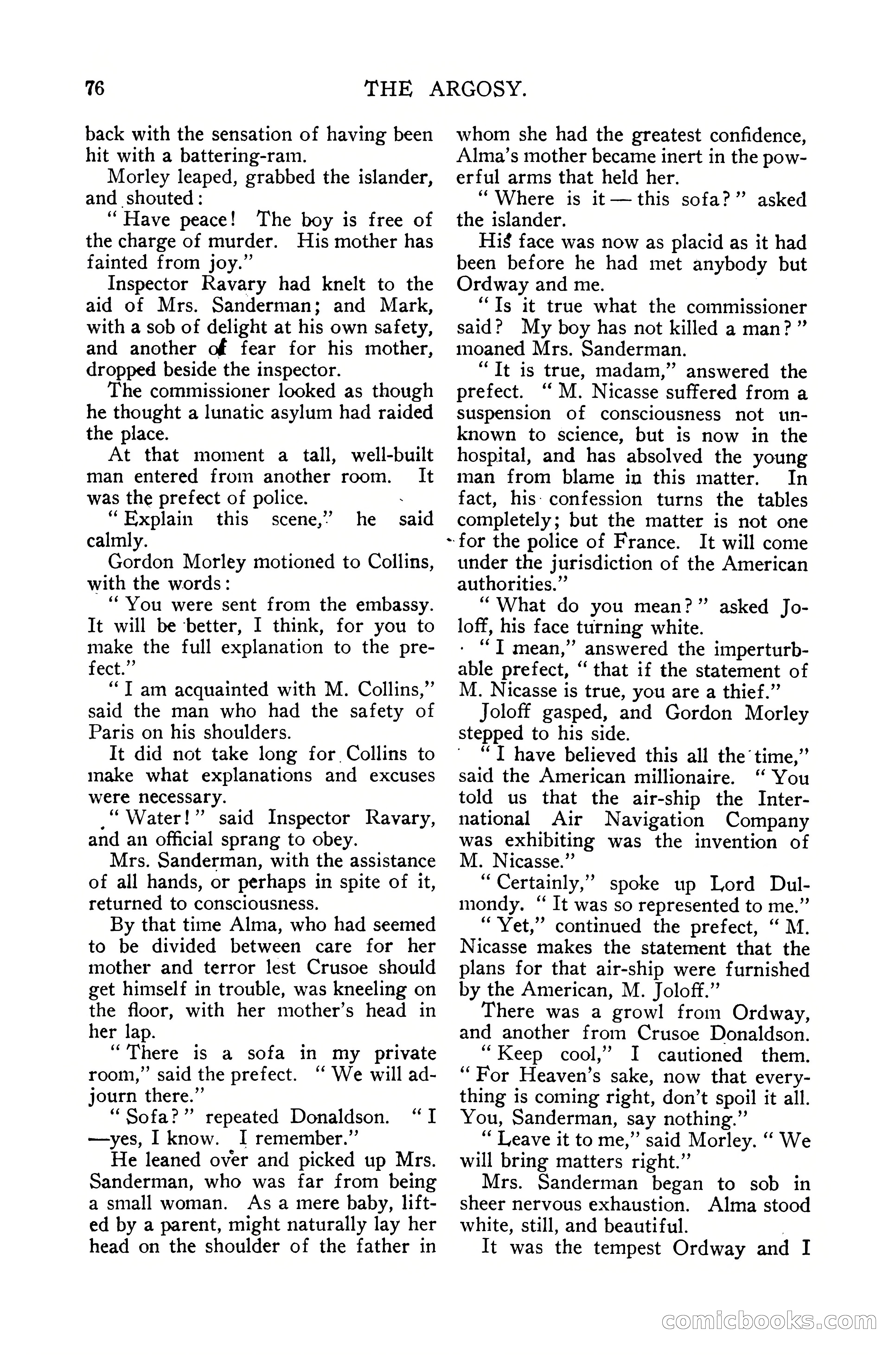
A restored page from Pulp Fiction, 1912. Page through the whole issue in the reader above.
📄 Transcribed text from this page (OCR, searchable)
Machine-transcribed from the original scan — historical spelling and the odd misread are preserved.
16 back with the sensation of having been hit with a battering-ram. Morley leaped, grabbed the islander, and shouted: “Have peace! The boy is free of the charge of murder. His mother has fainted from joy.” Inspector Ravary had knelt to the aid of Mrs. Sanderman; and Mark, with a sob of delight at his own safety, and another of fear for his mother, dropped beside the inspector. The commissioner looked as though he thought a lunatic asylum had raided the place. At that moment a tall, well-built man entered from another room. It was the prefect of police. . “Explain this scene,’ he said calmly. Gordon Morley motioned to Collins, with the words: “You were sent from the embassy. It will be better, I think, for you to make the full explanation to the pre- fect.” “T am acquainted with M. Collins,” said the man who had the safety of Paris on his shoulders. It did not take long for. Collins to make what explanations and excuses were necessary. “Water!” said Inspector Ravary, and an official sprang to obey. Mrs. Sanderman, with the assistance of all hands, or perhaps in spite of it, returned to consciousness. By that time Alma, who had seemed to be divided between care for her mother and terror lest Crusoe should get himself in trouble, was kneeling on the floor, with her mother’s head in her lap. “There is a sofa in my private room,” said the prefect. ‘“ We will ad- journ there.” “Sofa?” repeated Donaldson. —yes, I know. I remember.” He leaned over and picked up Mrs. Sanderman, who was far from being a small woman. As a mere baby, lift- ed by a parent, might naturally lay her head on the shoulder of the father in “TI ¢ THE ARGOSY. whom she had the greatest confidence, Alma’s mother became inert in the pow- erful arms that held her. “Where is it—this sofa?” asked the islander. Hig face was now as placid as it had been before he had met anybody but Ordway and me. | “Ts it true what the commissioner said? My boy has not killed a man? ” moaned Mrs. Sanderman. “It is true, madam,” answered the prefect. “‘ M. Nicasse suffered from a Suspension of consciousness not un- known to science, but is now in the hospital, and has absolved the young man from blame in this matter. In fact, his: confession turns the tables completely; but the matter is not one ‘for the police of France. It will come under the jurisdiction of the American authorities.”’ “What do you mean?” asked Jo- loff, his face turning white. - “T mean,” answered the imperturb- able prefect, “ that if the statement of M. Nicasse is true, you are a thief.” Joloff gasped, and Gordon Morley stepped to his side. ' “T have believed this all the time,” said the American millionaire. ‘“ You told us that the air-ship the Inter- national Air Navigation Company was exhibiting was the invention of M. Nicasse.”’ “ Certainly,’ spoke up Lord Dul- mondy. “ It was so represented to me.” “Yet,” continued the prefect, “ M. Nicasse makes the statement that the plans for that air-ship were furnished by the American, M. Joloff.” There was a growl from Ordway, and another from Crusoe Donaldson. “Keep cool,” I cautioned them. ‘For Heaven’s sake, now that every- thing is coming right, don’t spoil it all. You, Sanderman, say nothing.” “ Leave it to me,” said Morley. “ We will bring matters right.” Mrs. Sanderman began to sob in sheer nervous exhaustion. Alma stood white, still, and beautiful. | It was the tempest Ordway and I CoOMmicbook CO