
Pulp Fiction, 1912 · page 92 of 276
The Argosy, Christmas 1912 — page 92: what you’re looking at
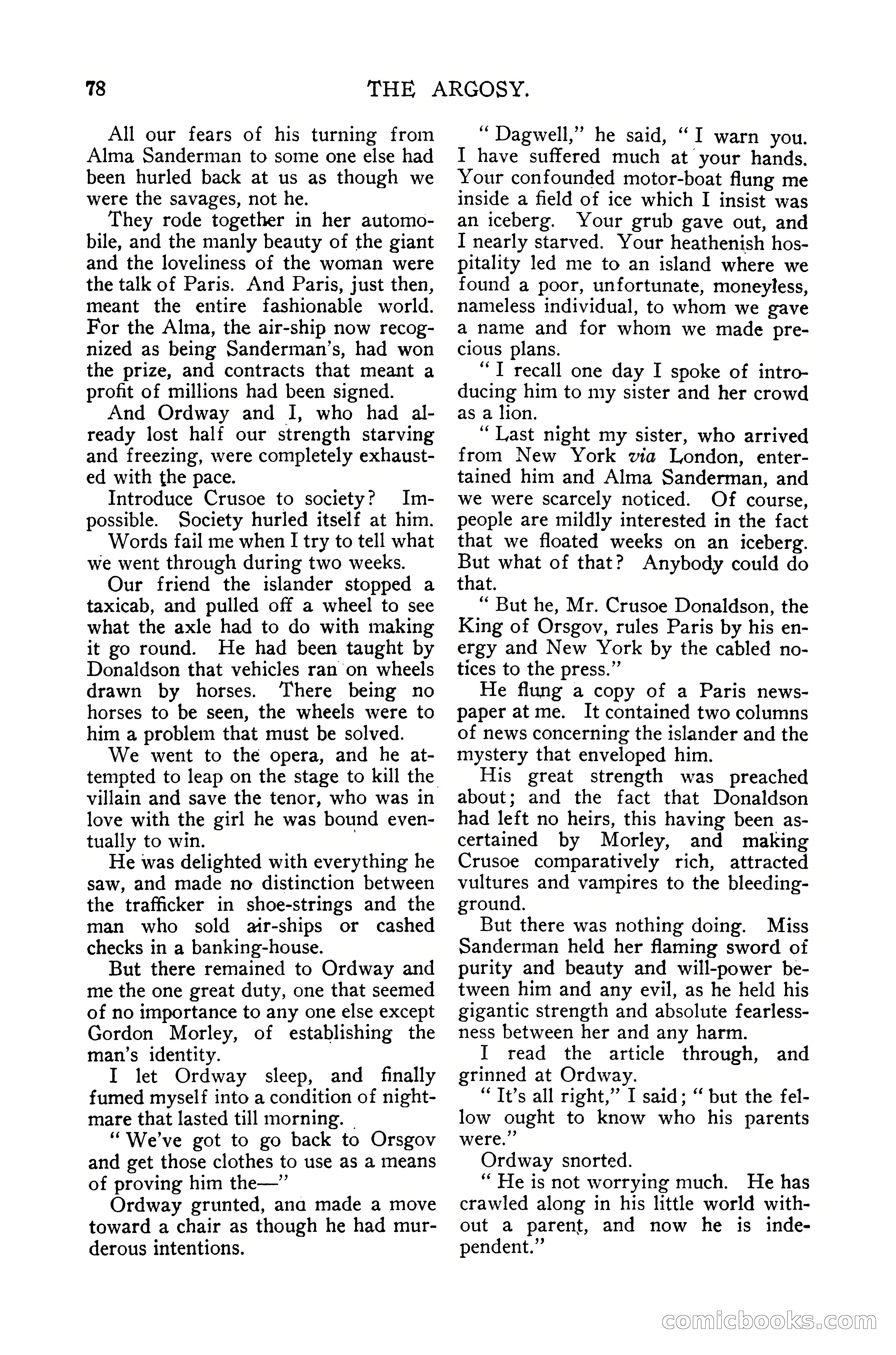
A restored page from Pulp Fiction, 1912. Page through the whole issue in the reader above.
📄 Transcribed text from this page (OCR, searchable)
Machine-transcribed from the original scan — historical spelling and the odd misread are preserved.
78 All our fears of his turning from Alma Sanderman to some one else had been hurled back at us as though we were the savages, not he. They rode together in her automo- bile, and the manly beauty of the giant and the loveliness of the woman were the talk of Paris. And Paris, just then, meant the entire fashionable world. For the Alma, the air-ship now recog- nized as being Sanderman’s, had won the prize, and contracts that meant a profit of millions had been signed. And Ordway and 1, who had al- ready lost half our strength starving and freezing, were completely exhaust- ed with the pace. Introduce Crusoe to society? Im- possible. Society hurled itself at him. Words fail me when I try to tell what we went through during two weeks. Our friend the islander stopped a taxicab, and pulled off a wheel to see what the axle had to do with making it go round. He had been taught by Donaldson that vehicles ran on wheels drawn by horses. There being no horses to be seen, the wheels were to him a problem that must be solved. We went to the opera, and he at- tempted to leap on the stage to kill the villain and save the tenor, who was in love with the girl he was bound even- tually to win. He was delighted with everything he saw, and made no distinction between the trafficker in shoe-strings and the man who sold air-ships or cashed checks in a banking-house. But there remained to Ordway and me the one great duty, one that seemed of no importance to any one else except Gordon Morley, of establishing the man’s identity. I let Ordway sleep, and finally fumed myself into a condition of night- mare that lasted till morning. | ‘We've got to go back to Orsgov and get those clothes to use as a means of proving him the—”’ Ordway grunted, ana made a move toward a chair as though he had mur- derous intentions. THE ARGOSY. “ Dagwell,” he said, “I warn you. I have suffered much at your hands. Your confounded motor-boat flung me inside a field of ice which I insist was an iceberg. Your grub gave out, and I nearly starved. Your heathenish hos- pitality led me to an island where we found a poor, unfortunate, moneyless, nameless individual, to whom we gave a name and for whom we made pre- cious plans. “TI recall one day I spoke of intro- ducing him to my sister and her crowd as a lion. “Last night my sister, who arrived from New York via London, enter- tained him and Alma Sanderman, and we were scarcely noticed. Of course, people are mildly interested in the fact that we floated weeks on an iceberg. But what of that? Anybody could do that. “ But he, Mr. Crusoe Donaldson, the King of Orsgov, rules Paris by his en- ergy and New York by the cabled no- tices to the press.”’ He flung a copy of a Paris news- paper atme. It contained two columns of news concerning the islander and the mystery that enveloped him. His great strength was preached about; and the fact that Donaldson had left no heirs, this having been as- certained by Morley, and making Crusoe comparatively rich, attracted vultures and vampires to the bleeding- ground. But there was nothing doing. Miss Sanderman held her flaming sword of purity and beauty and will-power be- tween him and any evil, as he held his gigantic strength and absolute fearless- ness between her and any harm. I read the article through, and grinned at Ordway. “It’s all right,” I said; “ but the fel- low ought to know who his parents were.” Ordway snorted. “ He is not worrying much. He has crawled along in his little world with- out a parent, and now he is inde- pendent.” CoOMmicbook CO