
Pulp Fiction, 1865 · page 74 of 399
The Argosy — page 74: what you’re looking at
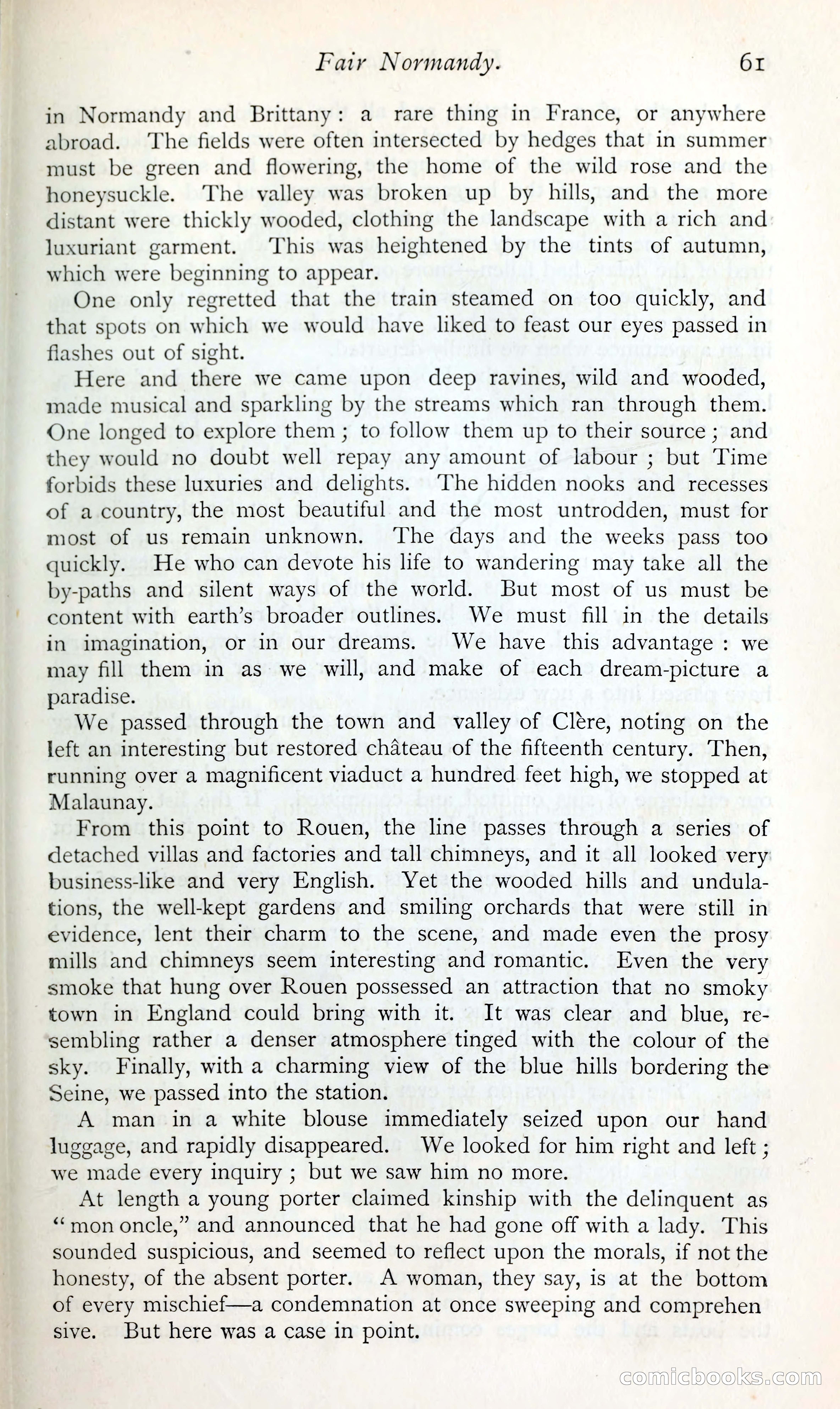
A restored page from Pulp Fiction, 1865. Page through the whole issue in the reader above.
📄 Transcribed text from this page (OCR, searchable)
Machine-transcribed from the original scan — historical spelling and the odd misread are preserved.
Far Normandy. 61 in Normandy and Brittany: a rare thing in France, or anywhere abroad. ‘The fields were often intersected by hedges that in summer must be green and flowering, the home of the wild rose and the honeysuckle. The valley was broken up by hills, and the more distant were thickly wooded, clothing the landscape with a rich and luxuriant garment. This was heightened by the tints of autumn, which were beginning to appear. One only regretted that the train steamed on too quickly, and that spots on which we would have liked to feast our eyes passed in flashes out of sight. Here and there we came upon deep ravines, wild and wooded, made musical and sparkling by the streams which ran through them. One longed to explore them ; to follow them up to their source ; and they would no doubt well repay any amount of labour ; but Time forbids these luxuries and delights. ‘The hidden nooks and recesses of a country, the most beautiful and the most untrodden, must for most of us remain unknown. ‘The days and the weeks pass too quickly. He who can devote his life to wandering may take all the by-paths and silent ways of the world. But most of us must be content with earth’s broader outlines. We must fill in the details in imagination, or in our dreams. We have this advantage : we may fill them in as we will, and make of each dream-picture a paradise. We passed through the town and valley of Clére, noting on the left an interesting but restored chateau of the fifteenth century. Then, running over a magnificent viaduct a hundred feet high, we stopped at Malaunay. From this point to Rouen, the line passes through a series of detached villas and factories and tall chimneys, and it all looked very business-like and very English. Yet the wooded hills and undula- tions, the well-kept gardens and smiling orchards that were still in evidence, lent their charm to the scene, and made even the prosy mills and chimneys seem interesting and romantic. Even the very smoke that hung over Rouen possessed an attraction that no smoky town in England could bring with it. It was clear and blue, re- sembling rather a denser atmosphere tinged with the colour of the sky. Finally, with a charming view of the blue hills bordering the Seine, we passed into the station. A man ina white blouse immediately seized upon our hand luggage, and rapidly disappeared. We looked for him right and left ; we made every inquiry ; but we saw him no more. At length a young porter claimed kinship with the delinquent as “mon oncle,” and announced that he had gone off with a lady. This sounded suspicious, and seemed to reflect upon the morals, if not the honesty, of the absent porter. A woman, they say, is at the bottom of every mischief—a condemnation at once sweeping and comprehen sive. But here was a case in point. COMM ) VOO|KS,CO im