
Pulp Fiction, 1865 · page 75 of 399
The Argosy — page 75: what you’re looking at
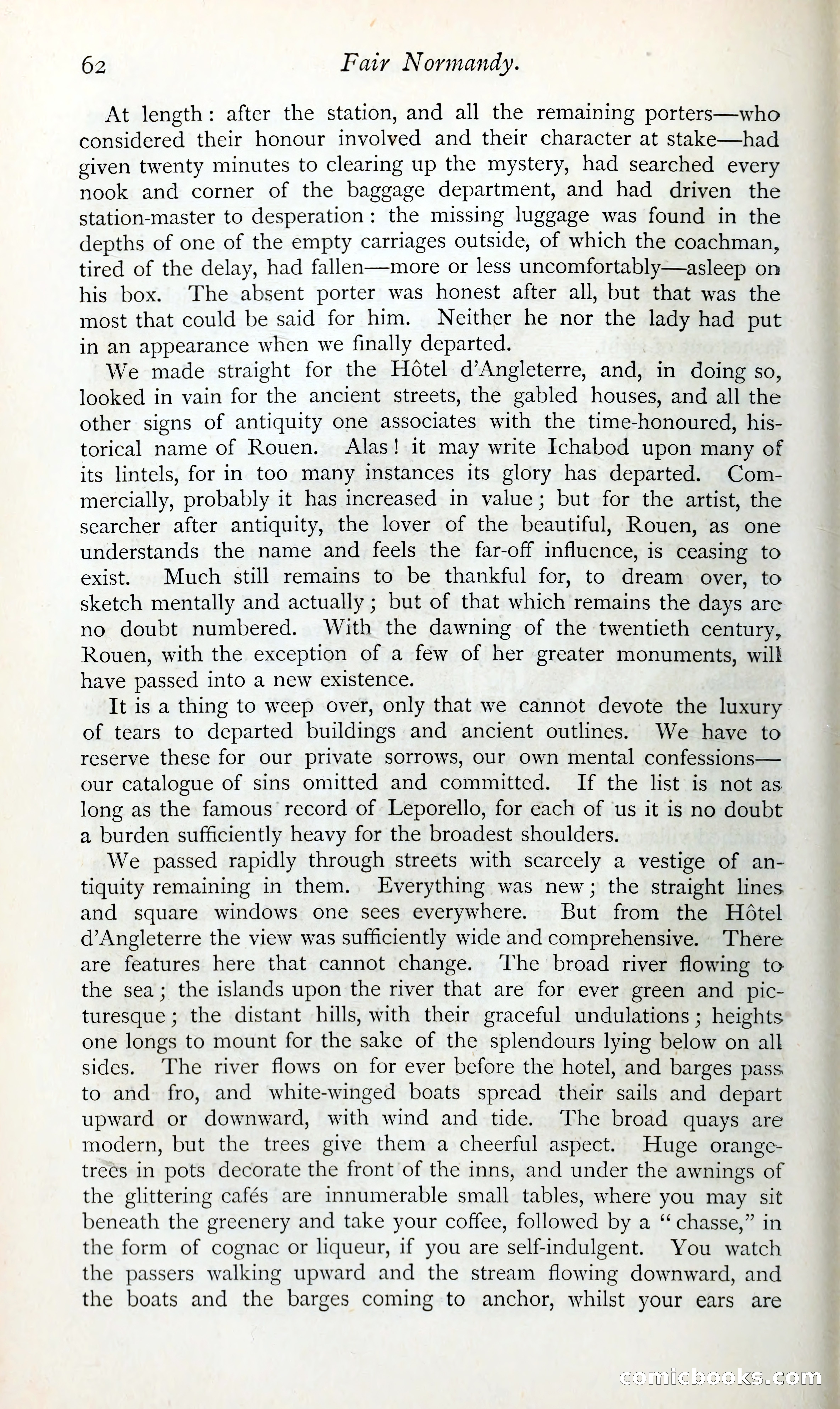
A restored page from Pulp Fiction, 1865. Page through the whole issue in the reader above.
📄 Transcribed text from this page (OCR, searchable)
Machine-transcribed from the original scan — historical spelling and the odd misread are preserved.
62 Far Normandy. At length: after the station, and all the remaining porters—who considered their honour involved and their character at stake—had given twenty minutes to clearing up the mystery, had searched every nook and corner of the baggage department, and had driven the station-master to desperation: the missing luggage was found in the depths of one of the empty carriages outside, of which the coachman, tired of the delay, had fallen—more or less uncomfortably—asleep on his box. The absent porter was honest after all, but that was the most that could be said for him. Neither he nor the lady had put in an appearance when we finally departed. We made straight for the Hotel d’Angleterre, and, in doing so, looked in vain for the ancient streets, the gabled houses, and all the other signs of antiquity one associates with the time-honoured, his- torical name of Rouen. Alas! it may write Ichabod upon many of its lintels, for in too many instances its glory has departed. Com- mercially, probably it has increased in value; but for the artist, the searcher after antiquity, the lover of the beautiful, Rouen, as one understands the name and feels the far-off influence, is ceasing to exist. Much still remains to be thankful for, to dream over, to sketch mentally and actually ; but of that which remains the days are no doubt numbered. With the dawning of the twentieth century, Rouen, with the exception of a few of her greater monuments, will have passed into a new existence. It is a thing to weep over, only that we cannot devote the luxury of tears to departed buildings and ancient outlines. We have to reserve these for our private sorrows, our own mental confessions— our catalogue of sins omitted and committed. If the list is not as long as the famous record of Leporello, for each of us it is no doubt a burden sufficiently heavy for the broadest shoulders. We passed rapidly through streets with scarcely a vestige of an- tiquity remaining in them. Everything was new; the straight lines and square windows one sees everywhere. But from the Hotel d’Angleterre the view was sufficiently wide and comprehensive. There are features here that cannot change. ‘The broad river flowing to the sea; the islands upon the river that are for ever green and pic- turesque; the distant hills, with their graceful undulations ; heights one longs to mount for the sake of the splendours lying below on all sides. ‘The river flows on for ever before the hotel, and barges pass. to and fro, and white-winged boats spread their sails and depart upward or downward, with wind and tide. The broad quays are modern, but the trees give them a cheerful aspect. Huge orange- trees in pots decorate the front of the inns, and under the awnings of the glittering cafés are innumerable small tables, where you may sit beneath the greenery and take your coffee, followed by a “ chasse,” in the form of cognac or liqueur, if you are self-indulgent. You watch the passers walking upward and the stream flowing downward, and the boats and the barges coming to anchor, whilst your ears are e€om | a eVOVONKSA(2C)