
Pulp Fiction, 1865 · page 73 of 399
The Argosy — page 73: what you’re looking at
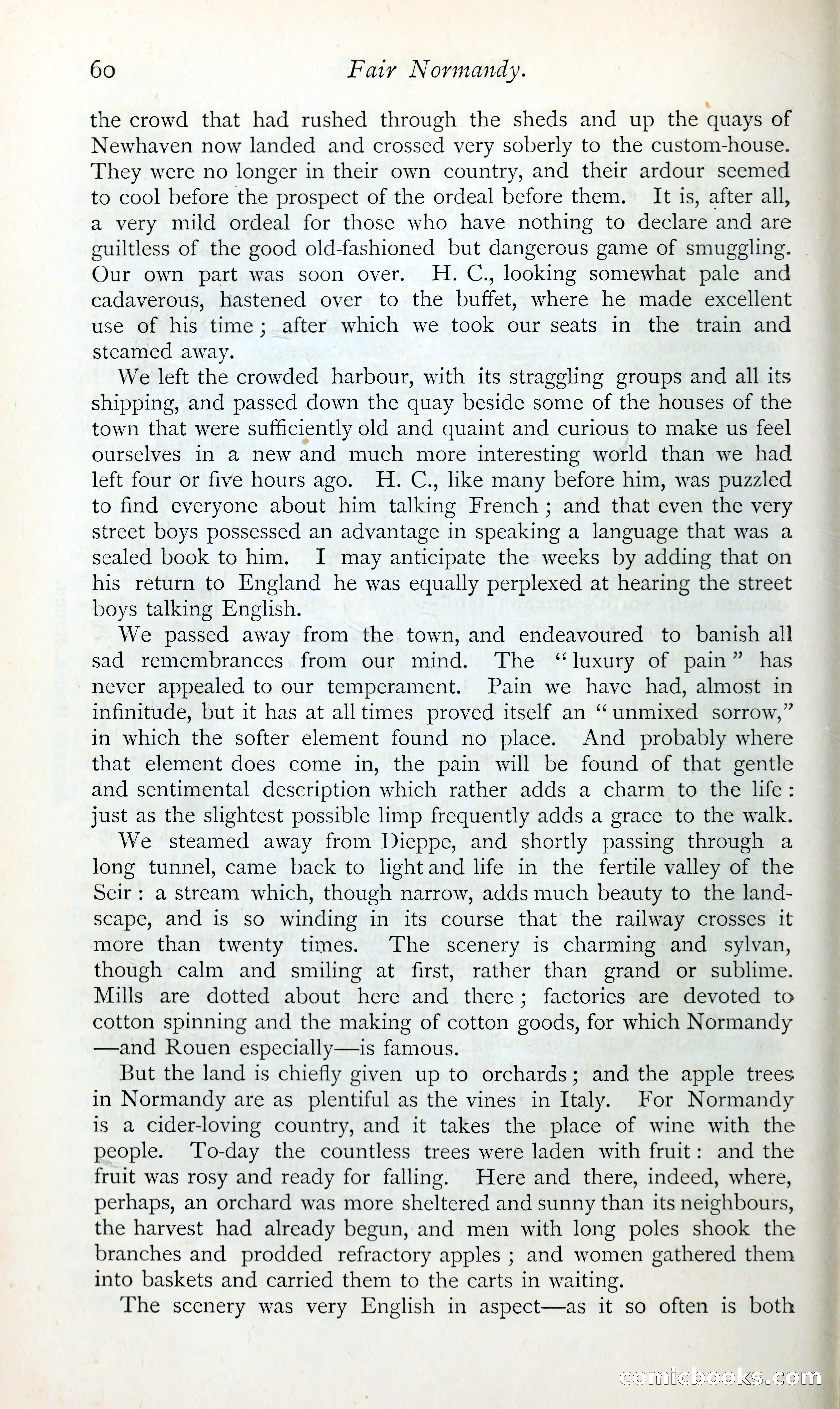
A restored page from Pulp Fiction, 1865. Page through the whole issue in the reader above.
📄 Transcribed text from this page (OCR, searchable)
Machine-transcribed from the original scan — historical spelling and the odd misread are preserved.
60 Far Normandy. the crowd that had rushed through the sheds and up the quays of Newhaven now landed and crossed very soberly to the custom-house. They were no longer in their own country, and their ardour seemed to cool before the prospect of the ordeal before them. It is, after all, a very mild ordeal for those who have nothing to declare and are guiltless of the good old-fashioned but dangerous game of smuggling. Our own part was soon over. H.C., looking somewhat pale and cadaverous, hastened over to the buffet, where he made excellent use of his time; after which we took our seats in the train and steamed away. We left the crowded harbour, with its straggling groups and all its shipping, and passed down the quay beside some of the houses of the town that were sufficiently old and quaint and curious to make us feel ourselves in a new and much more interesting world than we had left four or five hours ago. H. C., like many before him, was puzzled to find everyone about him talking French ; and that even the very street boys possessed an advantage in speaking a language that was a sealed book to him. I may anticipate the weeks by adding that on his return to England he was equally perplexed at hearing the street boys talking English. We passed away from the town, and endeavoured to banish all sad remembrances from our mind. The ‘luxury of pain” has never appealed to our temperament. Pain we have had, almost in infinitude, but it has at all times proved itself an ‘‘ unmixed sorrow,” in which the softer element found no place. And probably where that element does come in, the pain will be found of that gentle and sentimental description which rather adds a charm to the life: just as the shghtest possible limp frequently adds a grace to the walk. We steamed away from Dieppe, and shortly passing through a long tunnel, came back to lightand life in the fertile valley of the Seir : a stream which, though narrow, adds much beauty to the land- scape, and is so winding in its course that the railway crosses it more than twenty times. ‘The scenery is charming and _ sylvan, though calm and smiling at first, rather than grand or sublime. Mills are dotted about here and there; factories are devoted to cotton spinning and the making of cotton goods, for which Normandy —and Rouen especially—is famous. But the land is chiefly given up to orchards; and the apple trees in Normandy are as plentiful as the vines in Italy. For Normandy is a cider-loving country, and it takes the place of wine with the people. To-day the countless trees were laden with fruit: and the fruit was rosy and ready for falling. Here and there, indeed, where, perhaps, an orchard was more sheltered and sunny than its neighbours, the harvest had already begun, and men with long poles shook the branches and prodded refractory apples ; and women gathered them into baskets and carried them to the carts in waiting. The scenery was very English in aspect—as it so often is both EO MMIELIOO<S, (EC)