
Pulp Fiction, 1865 · page 258 of 399
The Argosy — page 258: what you’re looking at
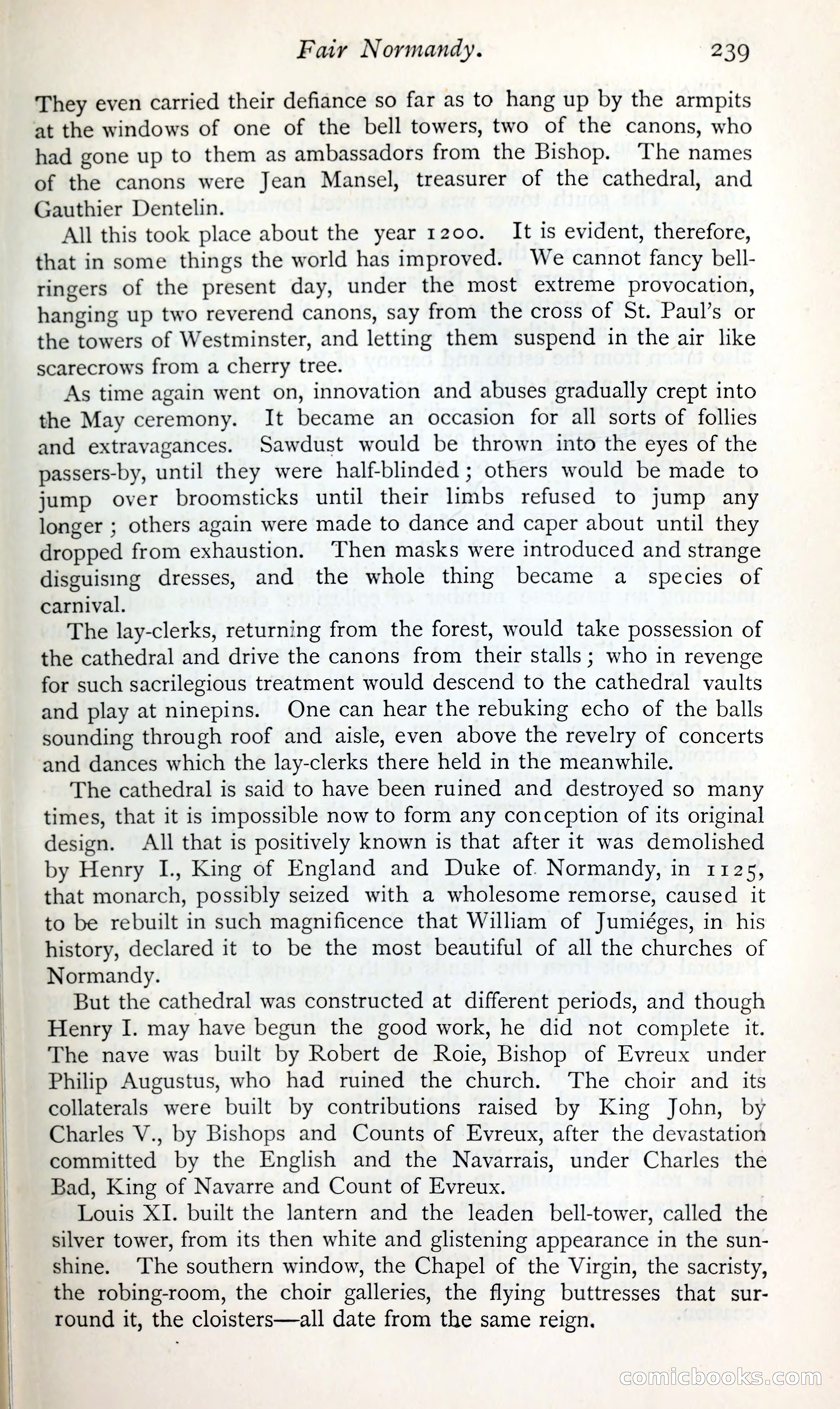
A restored page from Pulp Fiction, 1865. Page through the whole issue in the reader above.
📄 Transcribed text from this page (OCR, searchable)
Machine-transcribed from the original scan — historical spelling and the odd misread are preserved.
Fair Normandy. 239 They even carried their defiance so far as to hang up by the armpits at the windows of one of the bell towers, two of the canons, who had gone up to them as ambassadors from the Bishop. ‘The names of the canons were Jean Mansel, treasurer of the cathedral, and Gauthier Dentelin. All this took place about the year 1200. It is evident, therefore, that in some things the world has improved. We cannot fancy bell- ringers of the present day, under the most extreme provocation, hanging up two reverend canons, say from the cross of St. Paul’s or the towers of Westminster, and letting them suspend in the air like scarecrows from a cherry tree. As time again went on, innovation and abuses gradually crept into the May ceremony. It became an occasion for all sorts of follies and extravagances. Sawdust would be thrown into the eyes of the passers-by, until they were half-blinded; others would be made to jump over broomsticks until their limbs refused to jump any longer ; others again were made to dance and caper about until they dropped from exhaustion. ‘Then masks were introduced and strange disguising dresses, and the whole thing became a species of carnival. The lay-clerks, returning from the forest, would take possession of the cathedral and drive the canons from their stalls; who in revenge for such sacrilegious treatment would descend to the cathedral vaults and play at ninepins. One can hear the rebuking echo of the balls sounding through roof and aisle, even above the revelry of concerts and dances which the lay-clerks there held in the meanwhile. The cathedral is said to have been ruined and destroyed so many times, that it is impossible now to form any conception of its original design. All that is positively known is that after it was demolished by Henry I., King of England and Duke of. Normandy, in 1125, that monarch, possibly seized with a wholesome remorse, caused it to be rebuilt in such magnificence that William of Jumiéges, in his history, declared it to be the most beautiful of all the churches of Normandy. But the cathedral was constructed at different periods, and though Henry I. may have begun the good work, he did not complete it. The nave was built by Robert de Roie, Bishop of Evreux under Philip Augustus, who had ruined the church. The choir and its collaterals were built by contributions raised by King John, by Charles V., by Bishops and Counts of Evreux, after the devastation committed by the English and the Navarrais, under Charles the Bad, King of Navarre and Count of Evreux. Louis XI. built the lantern and the leaden bell-tower, called the silver tower, from its then white and glistening appearance in the sun- shine. ‘The southern window, the Chapel of the Virgin, the sacristy, the robing-room, the choir galleries, the flying buttresses that sur- round it, the cloisters—all date from the same reign. COMICOOoOlKS.EO im