
Pulp Fiction, 1865 · page 259 of 399
The Argosy — page 259: what you’re looking at
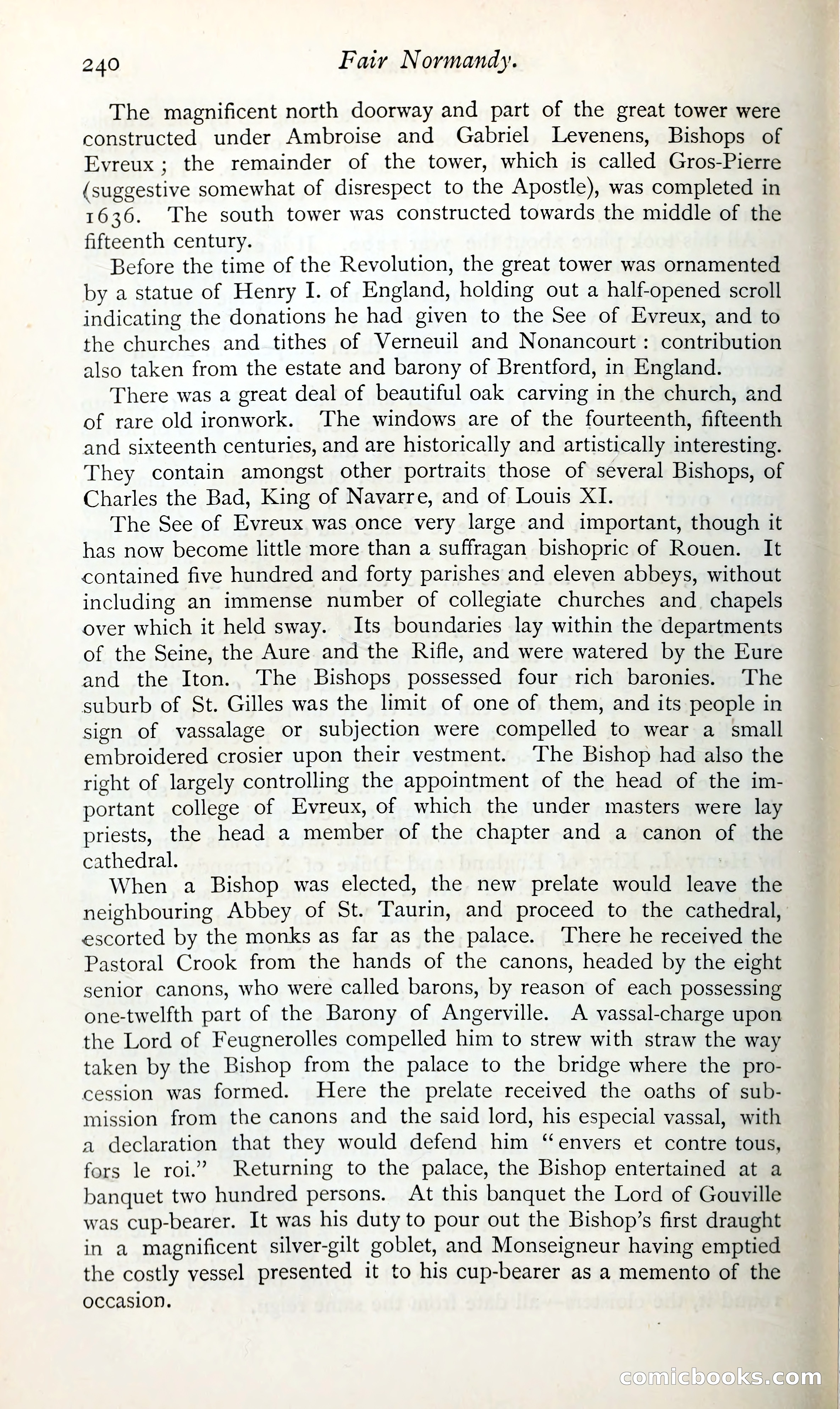
A restored page from Pulp Fiction, 1865. Page through the whole issue in the reader above.
📄 Transcribed text from this page (OCR, searchable)
Machine-transcribed from the original scan — historical spelling and the odd misread are preserved.
240 Fawr Normandy. The magnificent north doorway and part of the great tower were constructed under Ambroise and Gabriel Levenens, Bishops of Evreux; the remainder of the tower, which is called Gros-Pierre (suggestive somewhat of disrespect to the Apostle), was completed in 1636. The south tower was constructed towards the middle of the fifteenth century. Before the time of the Revolution, the great tower was ornamented by a statue of Henry I. of England, holding out a half-opened scroll indicating the donations he had given to the See of Evreux, and to the churches and tithes of Verneuil and Nonancourt: contribution also taken from the estate and barony of Brentford, in England. There was a great deal of beautiful oak carving in the church, and of rare old ironwork. ‘The windows are of the fourteenth, fifteenth and sixteenth centuries, and are historically and artistically interesting. They contain amongst other portraits those of several Bishops, of Charles the Bad, King of Navarre, and of Louis XI. The See of Evreux was once very large and important, though it has now become little more than a suffragan bishopric of Rouen. It contained five hundred and forty parishes and eleven abbeys, without including an immense number of collegiate churches and_ chapels over which it held sway. Its boundaries lay within the departments of the Seine, the Aure and the Rifle, and were watered by the Eure and the Iton. ‘The Bishops possessed four rich baronies. The suburb of St. Gilles was the limit of one of them, and its people in sign of vassalage or subjection were compelled to wear a small embroidered crosier upon their vestment. ‘The Bishop had also the right of largely controlling the appointment of the head of the im- portant college of Evreux, of which the under masters were lay priests, the head a member of the chapter and a canon of the cathedral. | When a Bishop was elected, the new prelate would leave the neighbouring Abbey of St. Taurin, and proceed to the cathedral, escorted by the monks as far as the palace. ‘There he received the Pastoral Crook from the hands of the canons, headed by the eight senior canons, who were called barons, by reason of each possessing one-twelfth part of the Barony of Angerville. A vassal-charge upon the Lord of Feugnerolles compelled him to strew with straw the way taken by the Bishop from the palace to the bridge where the pro- cession was formed. Here the prelate received the oaths of sub- mission from the canons and the said lord, his especial vassal, with a declaration that they would defend him ‘‘envers et contre tous, fors le roi.” Returning to the palace, the Bishop entertained at a banquet two hundred persons. At this banquet the Lord of Gouville was cup-bearer. It was his duty to pour out the Bishop’s first draught in a magnificent silver-gilt goblet, and Monseigneur having emptied the costly vessel presented it to his cup-bearer as a memento of the occasion. Gomilcbooks.co mn