
Pulp Fiction, 1865 · page 15 of 399
The Argosy — page 15: what you’re looking at
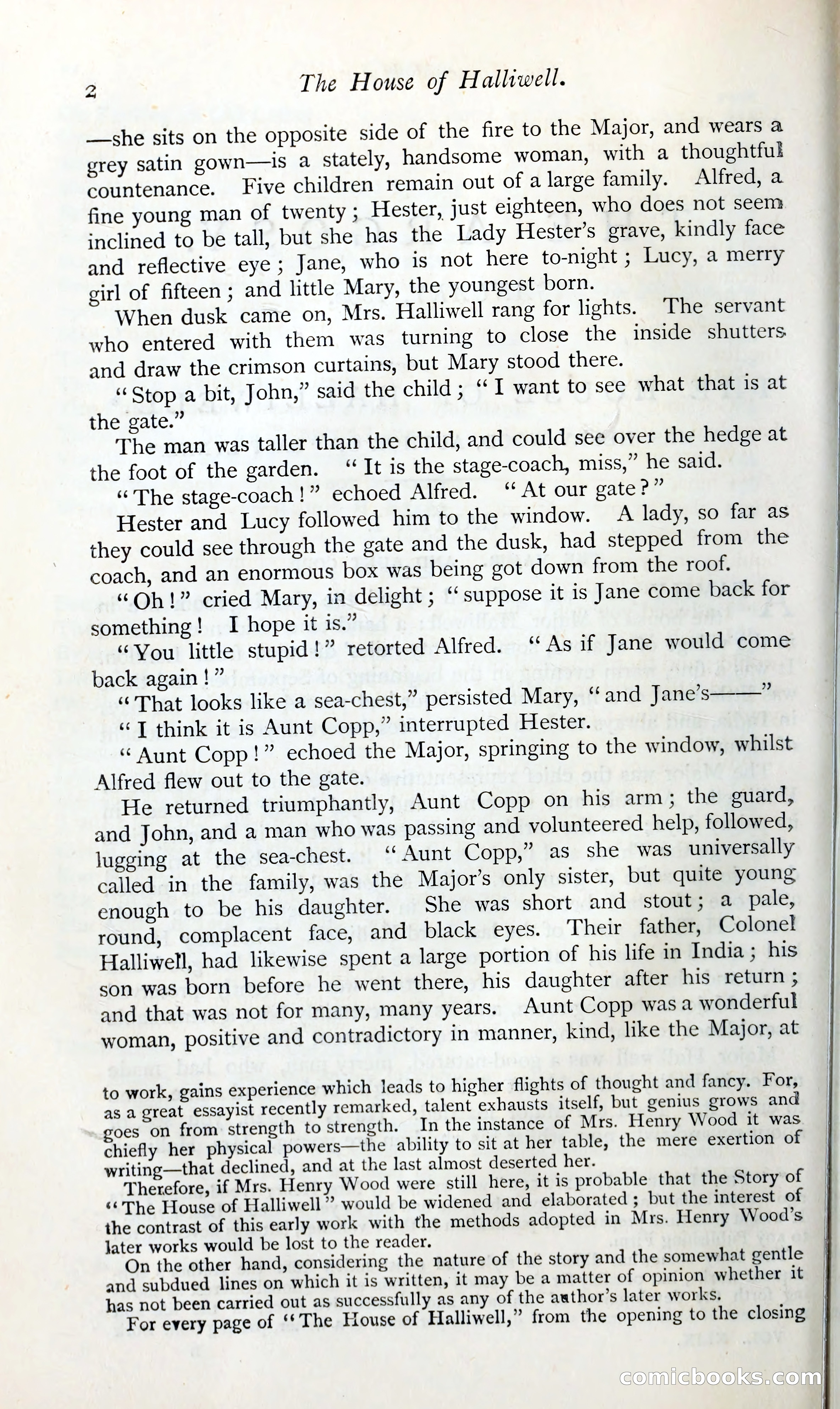
A restored page from Pulp Fiction, 1865. Page through the whole issue in the reader above.
📄 Transcribed text from this page (OCR, searchable)
Machine-transcribed from the original scan — historical spelling and the odd misread are preserved.
Z The House of Halliwell. __she sits on the opposite side of the fire to the Major, and wears a grey satin gown—ls a stately, handsome woman, with a thoughtful countenance. Five children remain out of a large family. Alfred, a fine young man of twenty ; Hester, just eighteen, who does not seem ‘nclined to be tall, but she has the Lady Hester's grave, kindly face and reflective eye; Jane, who is not here to-night ; Lucy, a merry girl of fifteen; and little Mary, the youngest born. When dusk came on, Mrs. Halliwell rang for lights. The servant who entered with them was turning to close the inside shutters and draw the crimson curtains, but Mary stood there. “Stop a bit, John,” said the child ; “I want to see what that is at the gate.” The man was taller than the child, and could see over the hedge at the foot of the garden. “It is the stage-coach, miss,” he said. “The stage-coach!” echoed Alfred. “ At our gate?” Hester and Lucy followed him to the window. A lady, so far as they could see through the gate and the dusk, had stepped from the coach, and an enormous box was being got down from the roof. “Oh!” cried Mary, in delight ; “suppose it is Jane come back for something! I hope it is.” “You little stupid!” retorted Alfred. “As if Jane would come back again!” “ That looks like a sea-chest,” persisted Mary, “and Jane’s “| think it is Aunt Copp,” interrupted Hester. “ Aunt Copp!” echoed the Major, springing to the window, whilst Alfred flew out to the gate. He returned triumphantly, Aunt Copp on his arm; the guard, and John, and a man who was passing and volunteered help, followed, lugging at the sea-chest. ‘Aunt Copp,” as she was universally called in the family, was the Major’s only sister, but quite young enough to be his daughter. She was short and stout; a pale, round, complacent face, and black eyes. Their father, Colonel Halliwell, had likewise spent a large portion of his life in India ; his son was born before he went there, his daughter after his return ; and that was not for many, many years. Aunt Copp wasa wonderful woman, positive and contradictory in manner, kind, like the Major, at yp) to work, gains experience which leads to higher flights of thought and fancy. For, as a great essayist recently remarked, talent exhausts itself, but genius grows and goes on from strength to strength. In the instance of Mrs. Henry Wood it was chiefly her physical powers—the ability to sit at her table, the mere exertion of writing—that declined, and at the last almost deserted her. Therefore, if Mrs. Henry Wood were still here, it is probable that the Story of ‘‘The House of Halliwell? would be widened and elaborated ; but the interest of the contrast of this early work with the methods adopted in Mrs. Henry Wood’s later works would be lost to the reader. On the other hand, considering the nature of the story and the somewhat gentle and subdued lines on which it is written, it may be a matter of opinion whether it has not been carried out as successfully as any of the aathor’s later works. For every page of ‘‘ The House of Halliwell,” from the opening to the closing Gomichbooks.co