
Pulp Fiction, 1865 · page 16 of 399
The Argosy — page 16: what you’re looking at
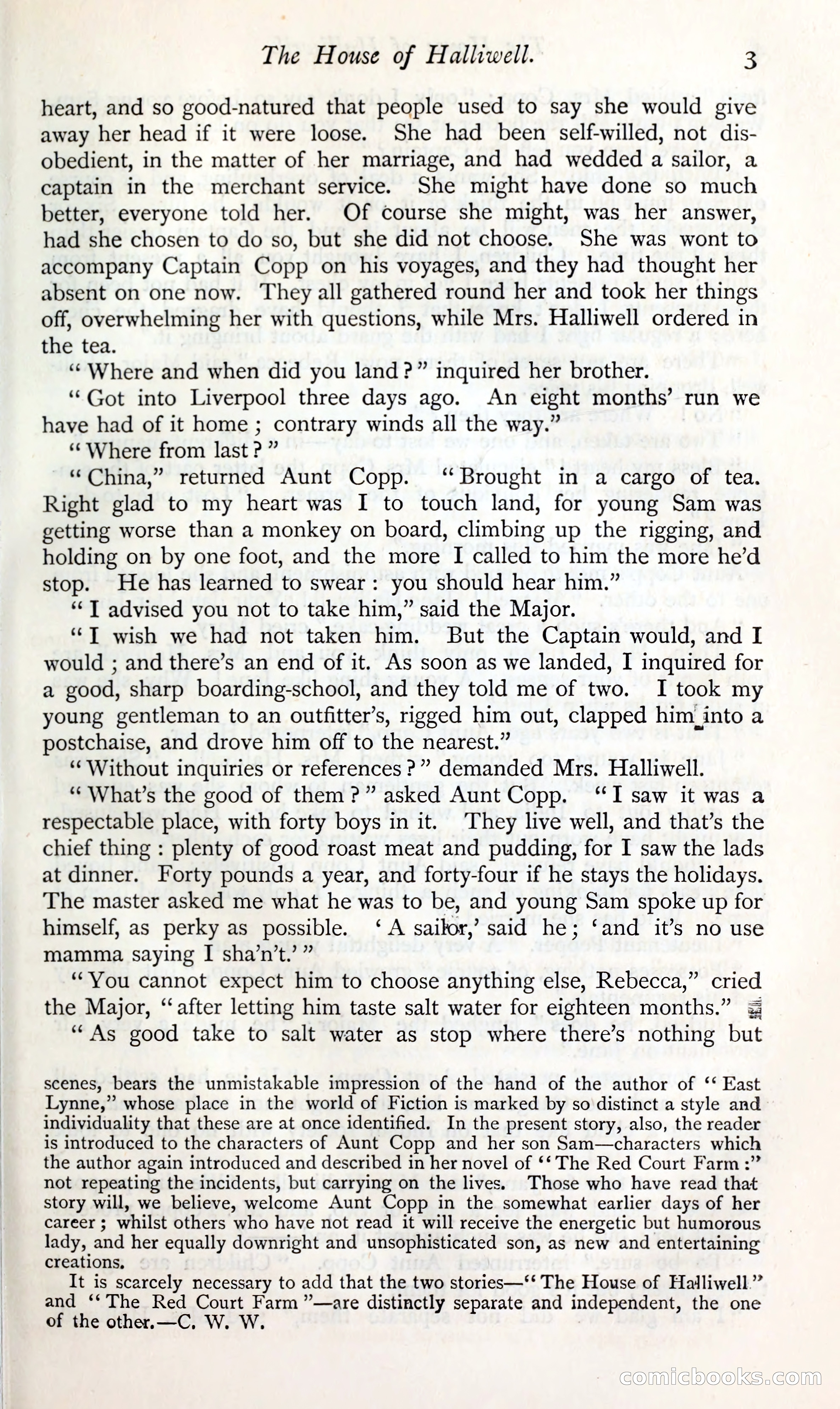
A restored page from Pulp Fiction, 1865. Page through the whole issue in the reader above.
📄 Transcribed text from this page (OCR, searchable)
Machine-transcribed from the original scan — historical spelling and the odd misread are preserved.
The House of Halliwell. 3 heart, and so good-natured that people used to say she would give away her head if it were loose. She had been self-willed, not dis- obedient, in the matter of her marriage, and had wedded a sailor, a captain in the merchant service. She might have done so much better, everyone told her. Of course she might, was her answer, had she chosen to do so, but she did not choose. She was wont to accompany Captain Copp on his voyages, and they had thought her absent on one now. They all gathered round her and took her things off, overwhelming her with questions, while Mrs. Halliwell ordered in the tea. ‘Where and when did you land ?” inquired her brother. ‘Got into Liverpool three days ago. An eight months’ run we have had of it home ; contrary winds all the way.” ‘‘Where from last?” “China,” returned Aunt Copp. ‘Brought in a cargo of tea. Right glad to my heart was I to touch land, for young Sam was getting worse than a monkey on board, climbing up the rigging, and holding on by one foot, and the more I called to him the more he’d stop. He has learned to swear: you should hear him.” “T advised you not to take him,” said the Major. ‘T wish we had not taken him. SBut the Captain would, and I would ; and there’s an end of it. As soon as we landed, I inquired for a good, sharp boarding-school, and they told me of two. I took my young gentleman to an outfitter’s, rigged him out, clapped him into a postchaise, and drove him off to the nearest.” ‘Without inquiries or references ?” demanded Mrs. Halliwell. ‘“ What’s the good of them?” asked Aunt Copp. “I saw it was a respectable place, with forty boys in it. They live well, and that’s the chief thing : plenty of good roast meat and pudding, for I saw the lads at dinner. Forty pounds a year, and forty-four if he stays the holidays. The master asked me what he was to be, and young Sam spoke up for himself, as perky as possible. ‘A sailor,’ said he; ‘and it’s no use mamma saying I sha’n’t.’ ” “You cannot expect him to choose anything else, Rebecca,” cried the Major, ‘‘after letting him taste salt water for eighteen months.” & “As good take to salt water as stop where there’s nothing but scenes, bears the unmistakable impression of the hand of the author of ‘‘ East Lynne,” whose place in the world of Fiction is marked by so distinct a style and individuality that these are at once identified. In the present story, also, the reader is introduced to the characters of Aunt Copp and her son Sam—characters which the author again introduced and described in her novel of ‘‘ The Red Court Farm :” not repeating the incidents, but carrying on the lives. Those who have read that story will, we believe, welcome Aunt Copp in the somewhat earlier days of her career ; whilst others who have not read it will receive the energetic but humorous lady, and her equally downright and unsophisticated son, as new and entertaining creations, It is scarcely necessary to add that the two stories—‘‘ The House of Halliwell.” and ‘‘ The Red Court Farm ”—are distinctly separate and independent, the one of the other.—C, W. W. COMICcooolKxs ) im