
Pulp Fiction, 1865 · page 128 of 399
The Argosy — page 128: what you’re looking at
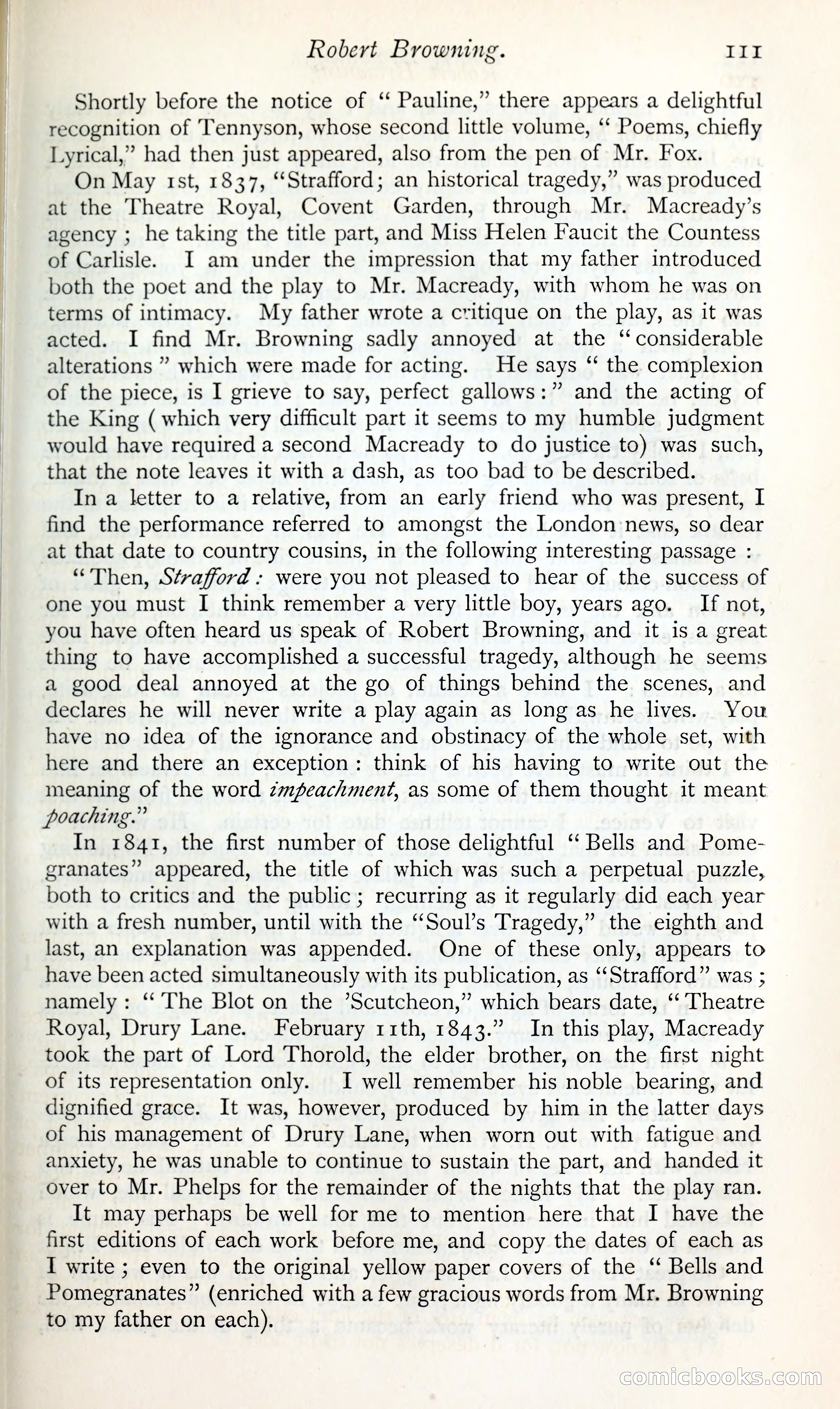
A restored page from Pulp Fiction, 1865. Page through the whole issue in the reader above.
📄 Transcribed text from this page (OCR, searchable)
Machine-transcribed from the original scan — historical spelling and the odd misread are preserved.
Robert Browning. III Shortly before the notice of ‘ Pauline,” there appears a delightful recognition of Tennyson, whose second little volume, “‘ Poems, chiefly Lyrical,” had then just appeared, also from the pen of Mr. Fox. On May rst, 1837, ‘‘Strafford; an historical tragedy,” was produced at the Theatre Royal, Covent Garden, through Mr. Macready’s agency ; he taking the title part, and Miss Helen Faucit the Countess of Carlisle. I am under the impression that my father introduced both the poet and the play to Mr. Macready, with whom he was on terms of intimacy. My father wrote a critique on the play, as it was acted. I find Mr. Browning sadly annoyed at the ‘considerable alterations ” which were made for acting. He says “* the complexion of the piece, is I grieve to say, perfect gallows:” and the acting of the King ( which very difficult part it seems to my humble judgment would have required a second Macready to do justice to) was such, that the note leaves it with a dash, as too bad to be described. In a letter to a relative, from an early friend who was present, I find the performance referred to amongst the London news, so dear at that date to country cousins, 1n the following interesting passage : “Then, Strafford : were you not pleased to hear of the success of one you must I think remember a very little boy, years ago. If not, you have often heard us speak of Robert Browning, and it is a great thing to have accomplished a successful tragedy, although he seems a good deal annoyed at the go of things behind the scenes, and declares he will never write a play again as long as he lives. You have no idea of the ignorance and obstinacy of the whole set, with here and there an exception: think of his having to write out the meaning of the word zmpeachment, as some of them thought it meant poaching.” In 1841, the first number of those delightful ‘‘ Bells and Pome- granates” appeared, the title of which was such a perpetual puzzle, both to critics and the public; recurring as it regularly did each year with a fresh number, until with the ‘‘Soul’s Tragedy,” the eighth and last, an explanation was appended. One of these only, appears to have been acted simultaneously with its publication, as “‘Strafford” was ; namely: ‘‘ ‘The Blot on the ’Scutcheon,” which bears date, ‘‘ Theatre Royal, Drury Lane. February 11th, 1843.” In this play, Macready took the part of Lord Thorold, the elder brother, on the first night of its representation only. I well remember his noble bearing, and dignified grace. It was, however, produced by him in the latter days of his management of Drury Lane, when worn out with fatigue and anxiety, he was unable to continue to sustain the part, and handed it over to Mr. Phelps for the remainder of the nights that the play ran. It may perhaps be well for me to mention here that I have the first editions of each work before me, and copy the dates of each as I write ; even to the original yellow paper covers of the “ Bells and Pomegranates” (enriched with a few gracious words from Mr. Browning to my father on each). Connicloooks am