
Pulp Fiction, 1865 · page 129 of 399
The Argosy — page 129: what you’re looking at
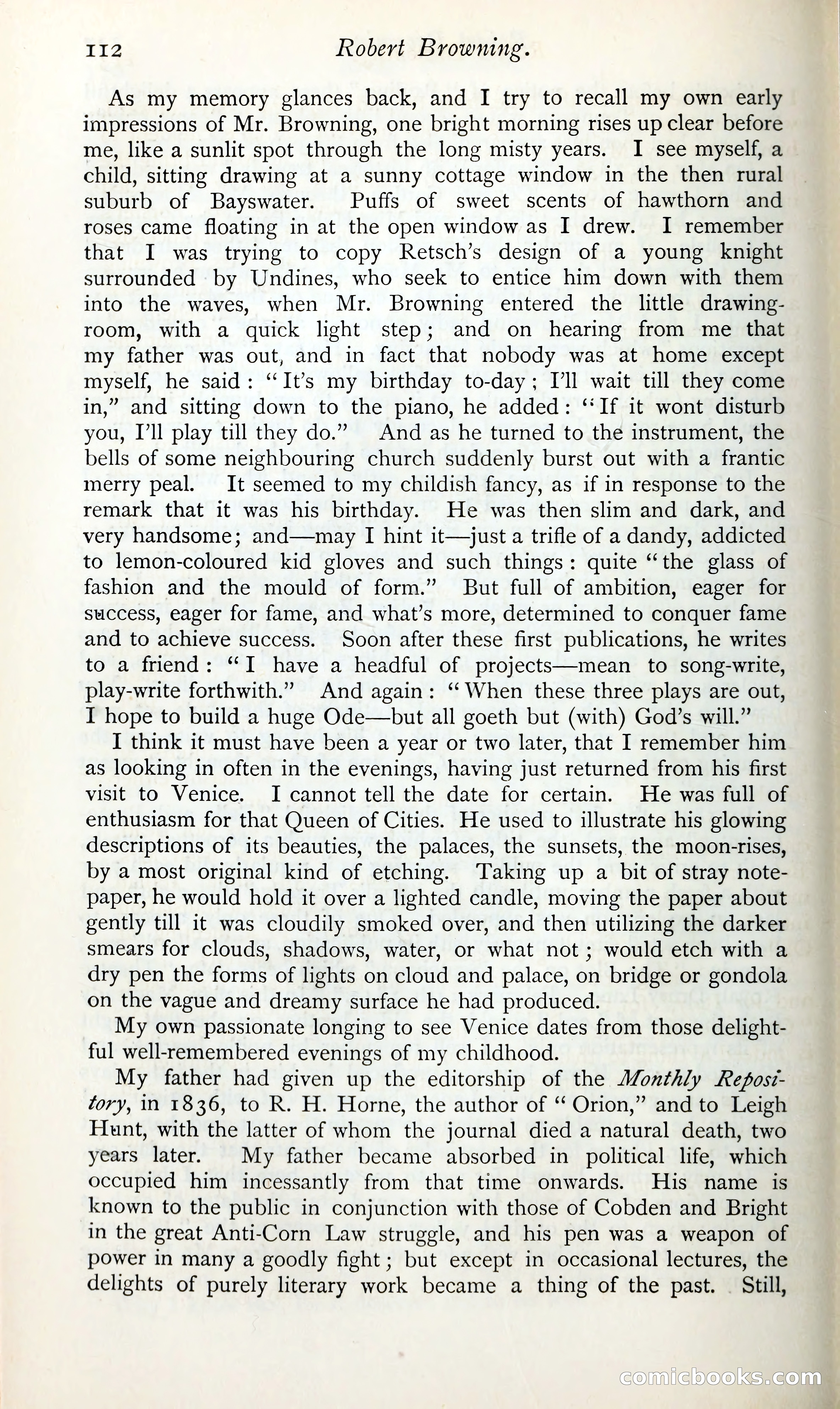
A restored page from Pulp Fiction, 1865. Page through the whole issue in the reader above.
📄 Transcribed text from this page (OCR, searchable)
Machine-transcribed from the original scan — historical spelling and the odd misread are preserved.
112 Robert Browning. As my memory glances back, and I try to recall my own early impressions of Mr. Browning, one bright morning rises up clear before me, like a sunlit spot through the long misty years. I see myself, a child, sitting drawing at a sunny cottage window in the then rural suburb of Bayswater. Puffs of sweet scents of hawthorn and roses came floating in at the open window as I drew. I remember that I was trying to copy Retsch’s design of a young knight surrounded by Undines, who seek to entice him down with them into the waves, when Mr. Browning entered the little drawing- room, with a quick light step; and on hearing from me that my father was out, and in fact that nobody was at home except myself, he said: “It’s my birthday to-day; TV’ll wait till they come in,” and sitting down to the piano, he added: ‘‘If it wont disturb you, I’ll play till they do.” And as he turned to the instrument, the bells of some neighbouring church suddenly burst out with a frantic merry peal. It seemed to my childish fancy, as if in response to the remark that it was his birthday. He was then slim and dark, and very handsome; and—may I hint it—ust a trifle of a dandy, addicted to lemon-coloured kid gloves and such things: quite “the glass of fashion and the mould of form.” But full of ambition, eager for success, eager for fame, and what’s more, determined to conquer fame and to achieve success. Soon after these first publications, he writes to a friend: “I have a headful of projects—mean to song-write, play-write forthwith.” And again: ‘‘ When these three plays are out, I hope to build a huge Ode—but all goeth but (with) God’s will.” I think it must have been a year or two later, that I remember him as looking in often in the evenings, having just returned from his first visit to Venice. I cannot tell the date for certain. He was full of enthusiasm for that Queen of Cities. He used to illustrate his glowing descriptions of its beauties, the palaces, the sunsets, the moon-rises, by a most original kind of etching. Taking up a bit of stray note- paper, he would hold it over a lighted candle, moving the paper about gently till it was cloudily smoked over, and then utilizing the darker smears for clouds, shadows, water, or what not; would etch with a dry pen the forms of lights on cloud and palace, on bridge or gondola on the vague and dreamy surface he had produced. My own passionate longing to see Venice dates from those delight- ful well-remembered evenings of my childhood. My father had given up the editorship of the Monthly Refost- tory, in 1836, to R. H. Horne, the author of “ Orion,” and to Leigh Hunt, with the latter of whom the journal died a natural death, two years later. My father became absorbed in political life, which occupied him incessantly from that time onwards. His name is known to the public in conjunction with those of Cobden and Bright in the great Anti-Corn Law struggle, and his pen was a weapon of power in many a goodly fight; but except in occasional lectures, the delights of purely literary work became a thing of the past. — Still, Gomilcbooks. co