
Pulp Fiction, 1865 · page 127 of 399
The Argosy — page 127: what you’re looking at
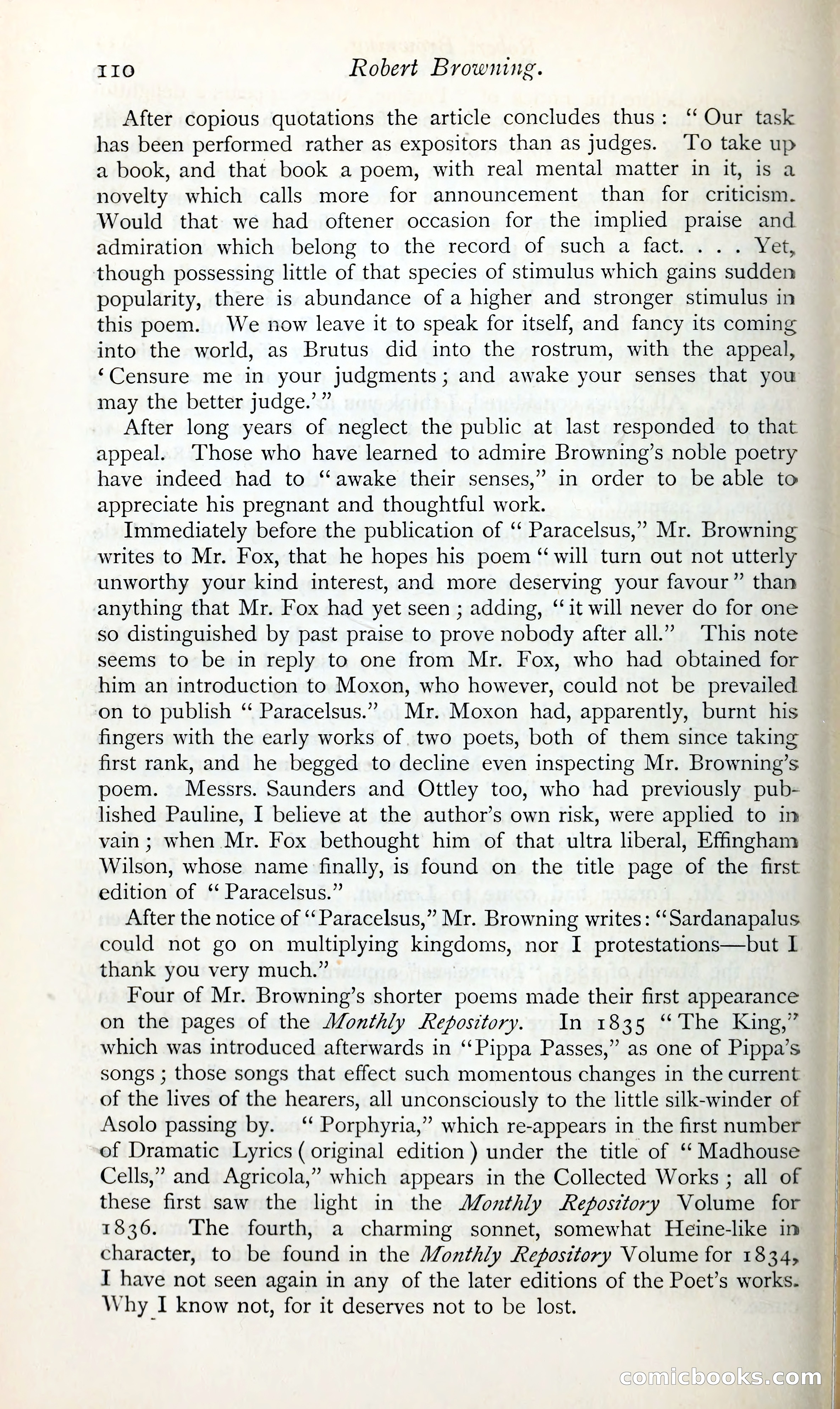
A restored page from Pulp Fiction, 1865. Page through the whole issue in the reader above.
📄 Transcribed text from this page (OCR, searchable)
Machine-transcribed from the original scan — historical spelling and the odd misread are preserved.
110 Robert Browning. After copious quotations the article concludes thus: ‘“ Our task has been performed rather as expositors than as judges. ‘To take up a book, and that book a poem, with real mental matter in it, is a novelty which calls more for announcement than for criticism. Would that we had oftener occasion for the implied praise and admiration which belong to the record of such a fact... . Yet, though possessing little of that species of stimulus which gains sudden popularity, there is abundance of a higher and stronger stimulus in this poem. We now leave it to speak for itself, and fancy its coming into the world, as Brutus did into the rostrum, with the appeal, ‘Censure me in your judgments; and awake your senses that you may the better judge.’ ” After long years of neglect the public at last responded to that appeal. Those who have learned to admire Browning’s noble poetry have indeed had to ‘‘ awake their senses,” in order to be able to appreciate his pregnant and thoughtful work. Immediately before the publication of ‘‘ Paracelsus,” Mr. Browning writes to Mr. Fox, that he hopes his poem “‘ will turn out not utterly unworthy your kind interest, and more deserving your favour” than anything that Mr. Fox had yet seen ; adding, ‘‘it will never do for one so distinguished by past praise to prove nobody after all.” ‘This note seems to be in reply to one from Mr. Fox, who had obtained for him an introduction to Moxon, who however, could not be prevailed on to publish “ Paracelsus.” Mr. Moxon had, apparently, burnt his fingers with the early works of two poets, both of them since taking first rank, and he begged to decline even inspecting Mr. Browning’s poem. Messrs. Saunders and Ottley too, who had previously pub- lished Pauline, I believe at the author’s own risk, were applied to in vain; when Mr. Fox bethought him of that ultra liberal, Effingham Wilson, whose name finally, is found on the title page of the first edition of ‘‘ Paracelsus.” After the notice of ‘‘ Paracelsus,” Mr. Browning writes: “‘Sardanapalus could not go on multiplying kingdoms, nor I protestations—but I thank you very much.” Four of Mr. Browning’s shorter poems made their first appearance on the pages of the Monthly Repository. In 1835 ‘The King,” which was introduced afterwards in ‘“‘Pippa Passes,” as one of Pippa’s songs ; those songs that effect such momentous changes in the current of the lives of the hearers, all unconsciously to the little silk-winder of Asolo passing by. ‘“‘ Porphyria,” which re-appears in the first number of Dramatic Lyrics ( original edition ) under the title of ‘‘ Madhouse Cells,” and Agricola,” which appears in the Collected Works ; all of these first saw the light in the Monthly Reposttory Volume for 1836. The fourth, a charming sonnet, somewhat Heine-like in character, to be found in the Monthly Repository Volume for 1834, I have not seen again in any of the later editions of the Poet’s works. Why I know not, for it deserves not to be lost. ECORNIELOOL Spree)