
Pulp Fiction, 1865 · page 219 of 399
The Argosy — page 219: what you’re looking at
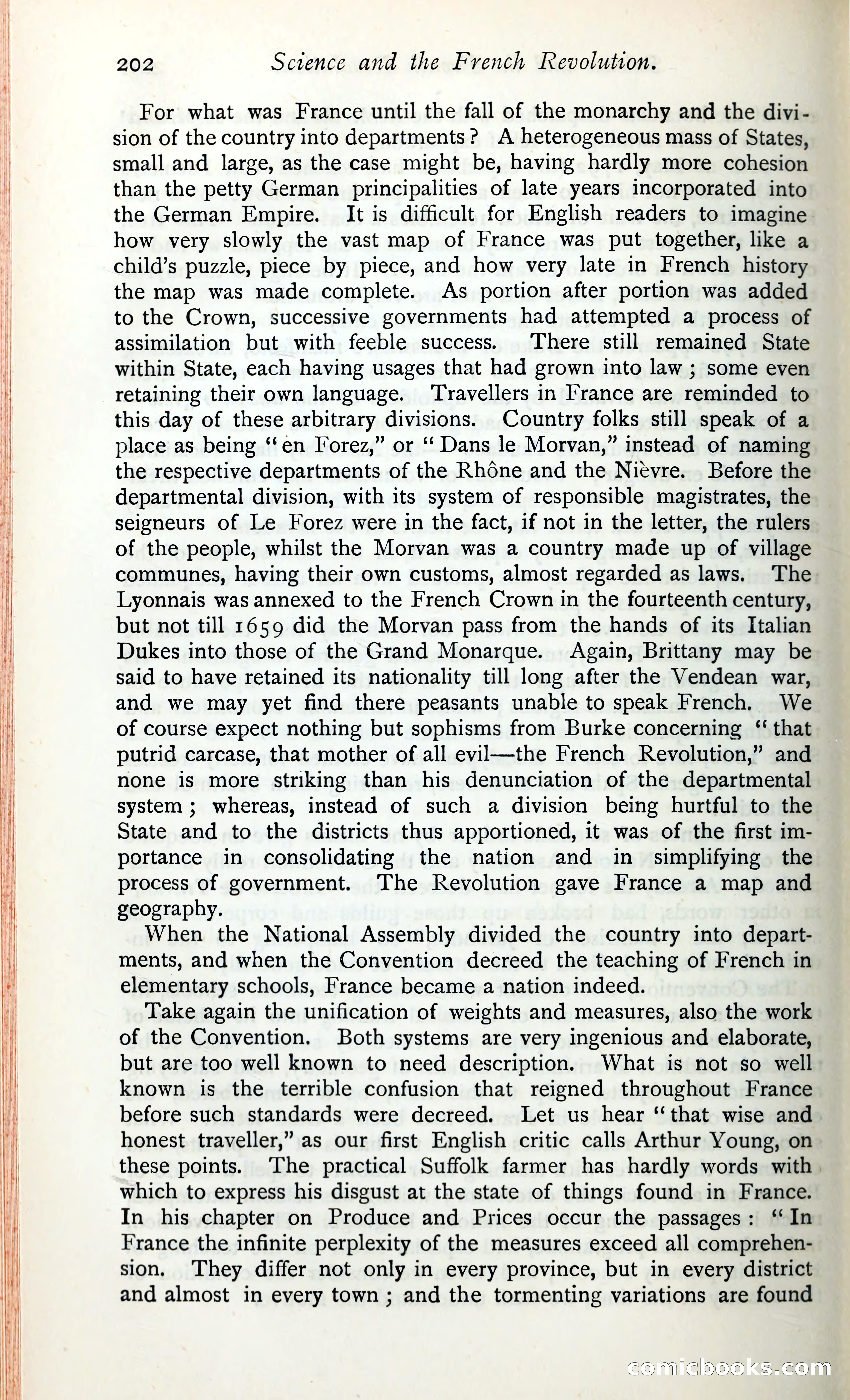
A restored page from Pulp Fiction, 1865. Page through the whole issue in the reader above.
📄 Transcribed text from this page (OCR, searchable)
Machine-transcribed from the original scan — historical spelling and the odd misread are preserved.
202 Science and the French Revolution. For what was France until the fall of the monarchy and the divi- sion of the country into departments? A heterogeneous mass of States, small and large, as the case might be, having hardly more cohesion than the petty German principalities of late years incorporated into the German Empire. It is difficult for English readers to imagine how very slowly the vast map of France was put together, like a child’s puzzle, piece by piece, and how very late in French history the map was made complete. As portion after portion was added to the Crown, successive governments had attempted a process of assimilation but with feeble success. There still remained State within State, each having usages that had grown into law ; some even retaining their own language. Travellers in France are reminded to this day of these arbitrary divisions. Country folks still speak of a place as being ‘‘en Forez,” or “‘ Dans le Morvan,” instead of naming the respective departments of the Rhone and the Nievre. Before the departmental division, with its system of responsible magistrates, the seigneurs of Le Forez were in the fact, if not in the letter, the rulers of the people, whilst the Morvan was a country made up of village communes, having their own customs, almost regarded as laws. ‘The Lyonnais was annexed to the French Crown in the fourteenth century, but not till 1659 did the Morvan pass from the hands of its Italian Dukes into those of the Grand Monarque. Again, Brittany may be said to have retained its nationality till long after the Vendean war, and we may yet find there peasants unable to speak French. We of course expect nothing but sophisms from Burke concerning ‘‘ that putrid carcase, that mother of all evil—the French Revolution,” and none is more striking than his denunciation of the departmental system ; whereas, instead of such a division being hurtful to the State and to the districts thus apportioned, it was of the first im- portance in consolidating the nation and in simplifying the process of government. The Revolution gave France a map and geography. When the National Assembly divided the country into depart- ments, and when the Convention decreed the teaching of French in elementary schools, France became a nation indeed. Take again the unification of weights and measures, also the work of the Convention. Both systems are very ingenious and elaborate, but are too well known to need description. What is not so well known is the terrible confusion that reigned throughout France before such standards were decreed. Let us hear ‘that wise and honest traveller,” as our first English critic calls Arthur Young, on these points. ‘The practical Suffolk farmer has hardly words with. which to express his disgust at the state of things found in France. In his chapter on Produce and Prices occur the passages: ‘In France the infinite perplexity of the measures exceed all comprehen- sion. ‘They differ not only in every province, but in every district and almost in every town ; and the tormenting variations are found CORNIELIOOL KS a(eo)