
Pulp Fiction, 1865 · page 220 of 399
The Argosy — page 220: what you’re looking at
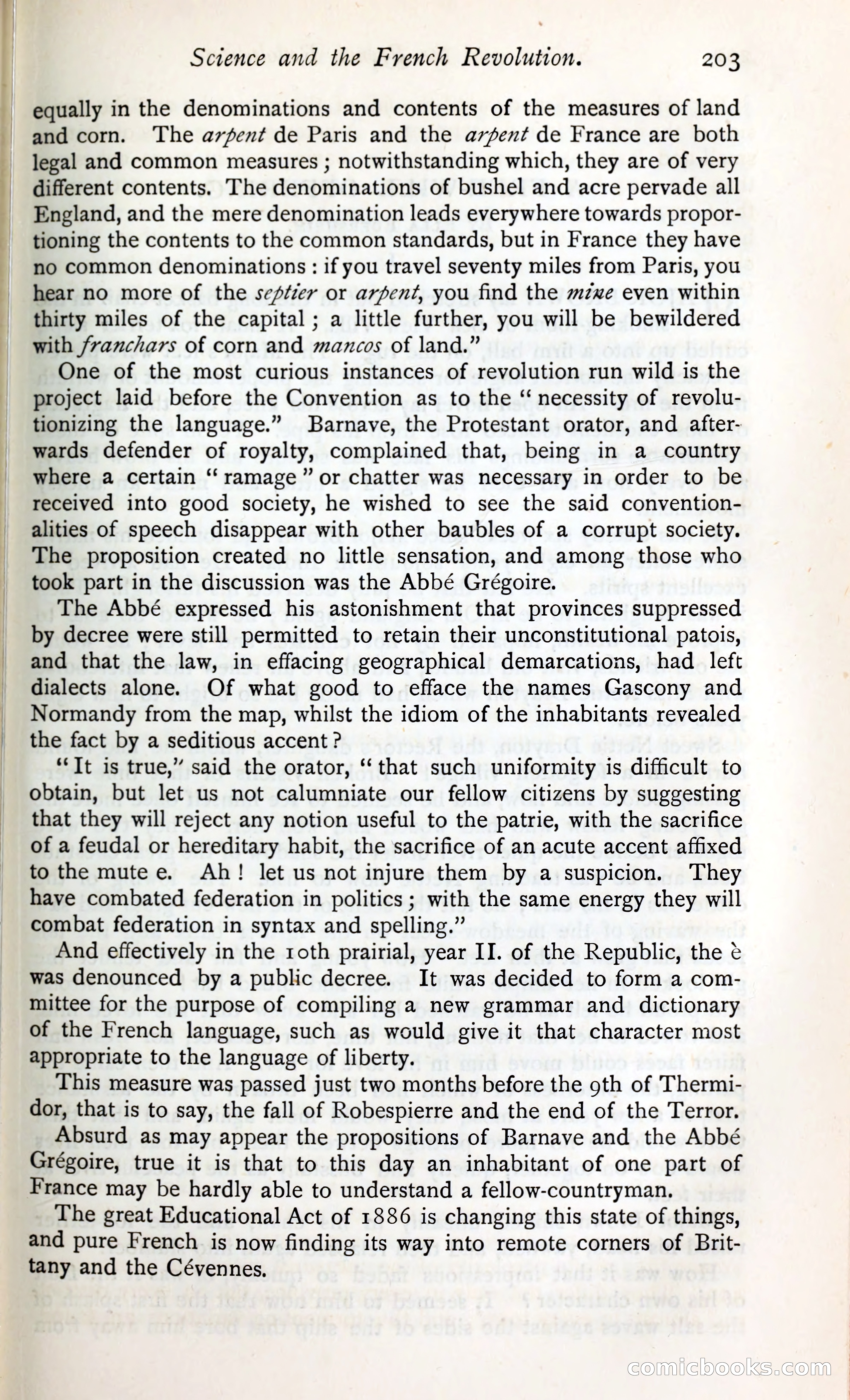
A restored page from Pulp Fiction, 1865. Page through the whole issue in the reader above.
📄 Transcribed text from this page (OCR, searchable)
Machine-transcribed from the original scan — historical spelling and the odd misread are preserved.
——— ee Engen - a aaa ~ © Science and the French Revolution. 203 equally in the denominations and contents of the measures of land and corn. The arfent de Paris and the arent de France are both legal and common measures ; notwithstanding which, they are of very different contents. The denominations of bushel and acre pervade all England, and the mere denomination leads everywhere towards propor- tioning the contents to the common standards, but in France they have no common denominations : if you travel seventy miles from Paris, you hear no more of the septzer or arpent, you find the mzxe even within thirty miles of the capital; a little further, you will be bewildered with franchars of corn and mancos of land.” One of the most curious instances of revolution run wild is the project laid before the Convention as to the ‘‘ necessity of revolu- tionizing the language.” Barnave, the Protestant orator, and after- wards defender of royalty, complained that, being in a country where a certain ‘‘ramage” or chatter was necessary in order to be received into good society, he wished to see the said convention- alities of speech disappear with other baubles of a corrupt society. The proposition created no little sensation, and among those who took part in the discussion was the Abbé Grégoire. The Abbé expressed his astonishment that provinces suppressed by decree were still permitted to retain their unconstitutional patois, and that the law, in effacing geographical demarcations, had left dialects alone. Of what good to efface the names Gascony and Normandy from the map, whilst the idiom of the inhabitants revealed the fact by a seditious accent? ‘It is true,” said the orator, ‘‘ that such uniformity is difficult to obtain, but let us not calumniate our fellow citizens by suggesting that they will reject any notion useful to the patrie, with the sacrifice of a feudal or hereditary habit, the sacrifice of an acute accent affixed to the mute e. Ah! let us not injure them by a suspicion. They have combated federation in politics; with the same energy they will combat federation in syntax and spelling.” And effectively in the roth prairial, year II. of the Republic, the e was denounced by a public decree. It was decided to form a com- mittee for the purpose of compiling a new grammar and dictionary of the French language, such as would give it that character most appropriate to the language of liberty. This measure was passed just two months before the oth of Thermi- dor, that is to say, the fall of Robespierre and the end of the Terror. Absurd as may appear the propositions of Barnave and the Abbé Grégoire, true it is that to this day an inhabitant of one part of France may be hardly able to understand a fellow-countryman. The great Educational Act of 1886 is changing this state of things, and pure French is now finding its way into remote corners of Brit- tany and the Cévennes. CORNICELO© ©) cS Co