
Pulp Fiction, 1865 · page 218 of 399
The Argosy — page 218: what you’re looking at
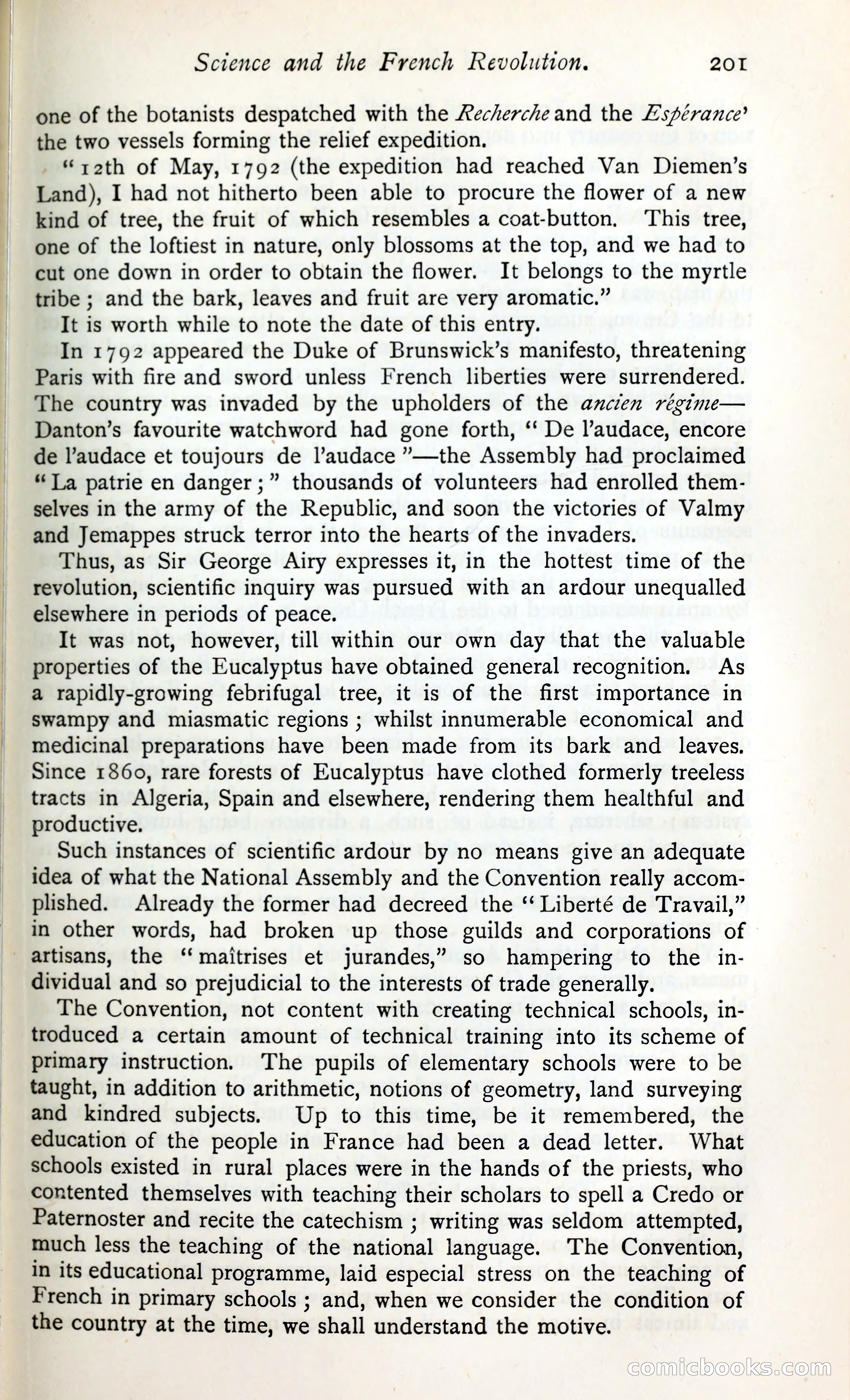
A restored page from Pulp Fiction, 1865. Page through the whole issue in the reader above.
📄 Transcribed text from this page (OCR, searchable)
Machine-transcribed from the original scan — historical spelling and the odd misread are preserved.
Science and the French Revolution. 201 one of the botanists despatched with the Recherche and the Lspérance’ the two vessels forming the relief expedition. _“ze2th of May, 1792 (the expedition had reached Van Diemen’s Land), I had not hitherto been able to procure the flower of a new kind of tree, the fruit of which resembles a coat-button. This tree, one of the loftiest in nature, only blossoms at the top, and we had to cut one down in order to obtain the flower. It belongs to the myrtle tribe ; and the bark, leaves and fruit are very aromatic.” It is worth while to note the date of this entry. In 1792 appeared the Duke of Brunswick’s manifesto, threatening Paris with fire and sword unless French liberties were surrendered. The country was invaded by the upholders of the ancien régime— Danton’s favourite watchword had gone forth, ‘‘ De l’audace, encore de l’audace et toujours de l’audace ”—the Assembly had proclaimed “Ta patrie en danger ;” thousands of volunteers had enrolled them- selves in the army of the Republic, and soon the victories of Valmy and Jemappes struck terror into the hearts of the invaders. Thus, as Sir George Airy expresses it, in the hottest time of the revolution, scientific inquiry was pursued with an ardour unequalled elsewhere in periods of peace. It was not, however, till within our own day that the valuable properties of the Eucalyptus have obtained general recognition. As a rapidly-growing febrifugal tree, it is of the first importance in swampy and miasmatic regions ; whilst innumerable economical and medicinal preparations have been made from its bark and _ leaves, Since 1860, rare forests of Eucalyptus have clothed formerly treeless tracts in Algeria, Spain and elsewhere, rendering them healthful and productive. Such instances of scientific ardour by no means give an adequate idea of what the National Assembly and the Convention really accom- plished. Already the former had decreed the “ Liberté de Travail,” in other words, had broken up those guilds and corporations of artisans, the ‘“‘maitrises et jurandes,” so hampering to the in- dividual and so prejudicial to the interests of trade generally. The Convention, not content with creating technical schools, in- troduced a certain amount of technical training into its scheme of primary instruction. The pupils of elementary schools were to be taught, in addition to arithmetic, notions of geometry, land surveying and kindred subjects. Up to this time, be it remembered, the education of the people in France had been a dead letter. What schools existed in rural places were in the hands of the priests, who contented themselves with teaching their scholars to spell a Credo or Paternoster and recite the catechism ; writing was seldom attempted, much less the teaching of the national language. The Convention, in its educational programme, laid especial stress on the teaching of French in primary schools ; and, when we consider the condition of the country at the time, we shall understand the motive. CONNIELOO© a <S (C(O)