
Pulp Fiction, 1865 · page 217 of 399
The Argosy — page 217: what you’re looking at
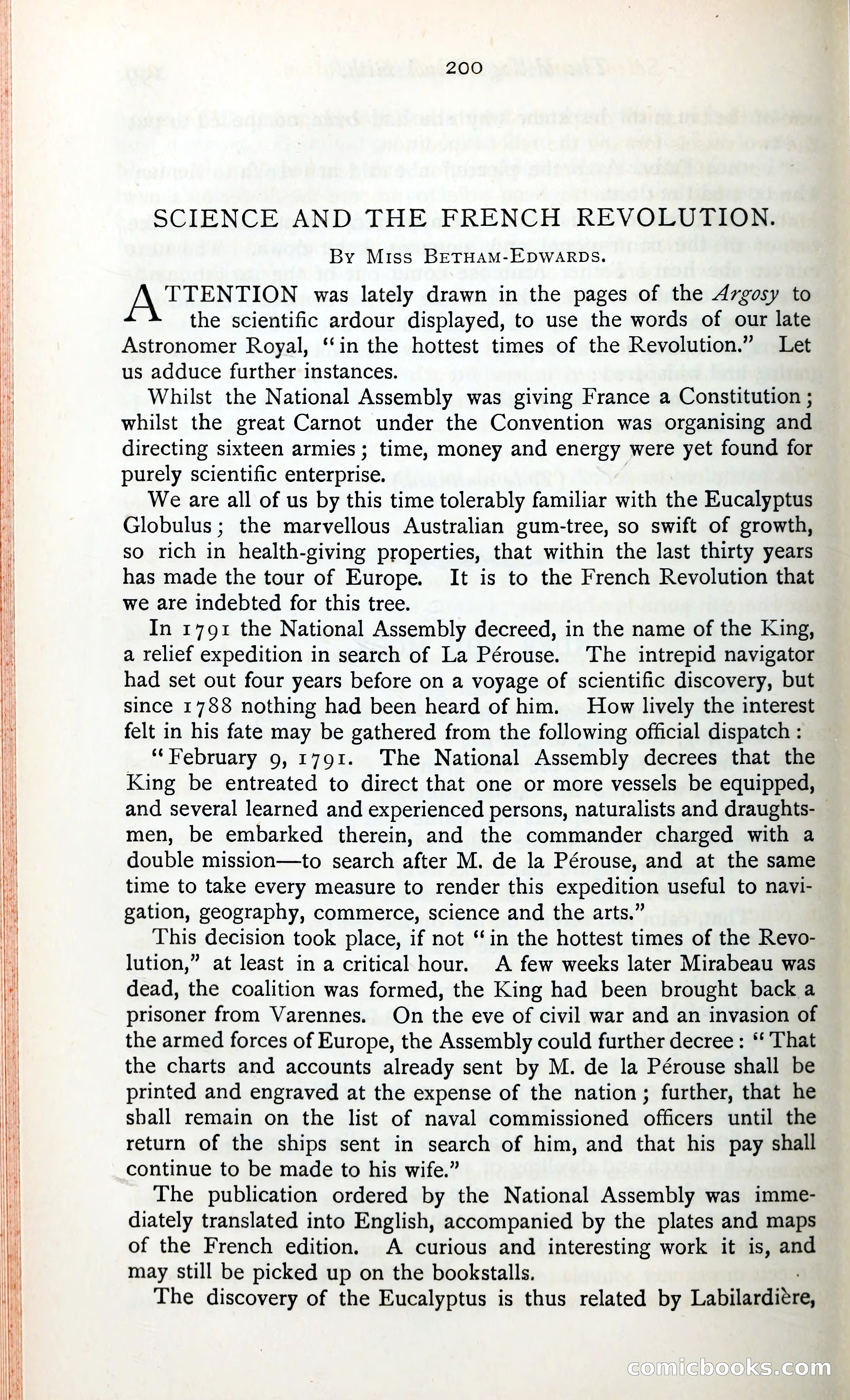
A restored page from Pulp Fiction, 1865. Page through the whole issue in the reader above.
📄 Transcribed text from this page (OCR, searchable)
Machine-transcribed from the original scan — historical spelling and the odd misread are preserved.
200 SCIENCE AND THE FRENCH REVOLUTION. By Miss BETHAM-EDWARDS. TTENTION was lately drawn in the pages of the Azgosy to the scientific ardour displayed, to use the words of our late Astronomer Royal, ‘‘in the hottest times of the Revolution.” Let us adduce further instances. Whilst the National Assembly was giving France a Constitution ; whilst the great Carnot under the Convention was organising and directing sixteen armies; time, money and energy were yet found for purely scientific enterprise. We are all of us by this time tolerably familiar with the Eucalyptus Globulus ; the marvellous Australian gum-tree, so swift of growth, so rich in health-giving properties, that within the last thirty years has made the tour of Europe. It is to the French Revolution that we are indebted for this tree. In 1791 the National Assembly decreed, in the name of the King, a relief expedition in search of La Pérouse. The intrepid navigator had set out four years before on a voyage of scientific discovery, but since 1788 nothing had been heard of him. How lively the interest felt in his fate may be gathered from the following official dispatch : ““Webruary 9, 1791. The National Assembly decrees that the King be entreated to direct that one or more vessels be equipped, and several learned and experienced persons, naturalists and draughts- men, be embarked therein, and the commander charged with a double mission—to search after M. de la Pérouse, and at the same time to take every measure to render this expedition useful to navi- gation, geography, commerce, science and the arts.” This decision took place, if not “in the hottest times of the Revo- lution,” at least in a critical hour. A few weeks later Mirabeau was dead, the coalition was formed, the King had been brought back a prisoner from Varennes. On the eve of civil war and an invasion of the armed forces of Europe, the Assembly could further decree : ‘f That the charts and accounts already sent by M. de la Pérouse shall be printed and engraved at the expense of the nation; further, that he shall remain on the list of naval commissioned officers until the return of the ships sent in search of him, and that his pay shall continue to be made to his wife.” The publication ordered by the National Assembly was imme- diately translated into English, accompanied by the plates and maps of the French edition. A curious and interesting work it is, and may still be picked up on the bookstalls. The discovery of the Eucalyptus is thus related by Labilarditre, CONNIE OO <Sn(eorna