
Pulp Fiction, 1865 · page 204 of 399
The Argosy — page 204: what you’re looking at
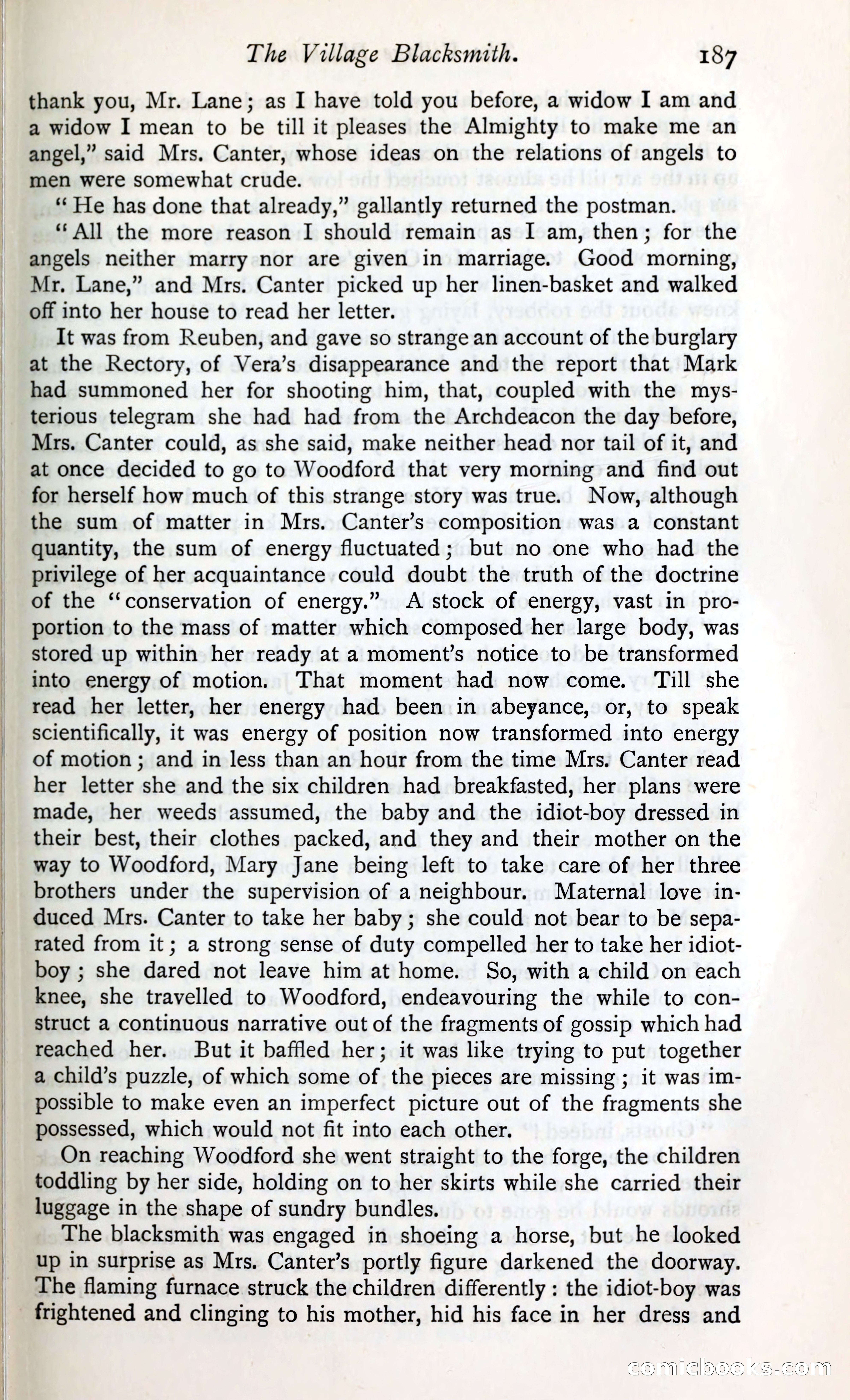
A restored page from Pulp Fiction, 1865. Page through the whole issue in the reader above.
📄 Transcribed text from this page (OCR, searchable)
Machine-transcribed from the original scan — historical spelling and the odd misread are preserved.
The Village Blacksmith. 187 thank you, Mr. Lane; as I have told you before, a widow I am and a widow I mean to be till it pleases the Almighty to make me an angel,” said Mrs. Canter, whose ideas on the relations of angels to men were somewhat crude. ‘He has done that already,” gallantly returned the postman. *‘ All the more reason I should remain as I am, then; for the angels neither marry nor are given in marriage. Good morning, Mr. Lane,” and Mrs. Canter picked up her linen-basket and walked off into her house to read her letter. It was from Reuben, and gave so strange an account of the burglary at the Rectory, of Vera’s disappearance and the report that Mark had summoned her for shooting him, that, coupled with the mys- terious telegram she had had from the Archdeacon the day before, Mrs. Canter could, as she said, make neither head nor tail of it, and at once decided to go to Woodford that very morning and find out for herself how much of this strange story was true. Now, although the sum of matter in Mrs. Canter’s composition was a constant quantity, the sum of energy fluctuated; but no one who had the privilege of her acquaintance could doubt the truth of the doctrine of the ‘‘conservation of energy.” A stock of energy, vast in pro- portion to the mass of matter which composed her large body, was stored up within her ready at a moment’s notice to be transformed into energy of motion. That moment had now come. Till she read her letter, her energy had been in abeyance, or, to speak scientifically, it was energy of position now transformed into energy of motion; and in less than an hour from the time Mrs. Canter read her letter she and the six children had breakfasted, her plans were made, her weeds assumed, the baby and the idiot-boy dressed in their best, their clothes packed, and they and their mother on the way to Woodford, Mary Jane being left to take care of her three brothers under the supervision of a neighbour. Maternal love in- duced Mrs. Canter to take her baby; she could not bear to be sepa- rated from it; a strong sense of duty compelled her to take her idiot- boy ; she dared not leave him at home. So, with a child on each knee, she travelled to Woodford, endeavouring the while to con- struct a continuous narrative out of the fragments of gossip which had reached her. But it baffled her; it was like trying to put together a child’s puzzle, of which some of the pieces are missing ; it was im- possible to make even an imperfect picture out of the fragments she possessed, which would not fit into each other. On reaching Woodford she went straight to the forge, the children toddling by her side, holding on to her skirts while she carried their luggage in the shape of sundry bundles. The blacksmith was engaged in shoeing a horse, but he looked up in surprise as Mrs. Canter’s portly figure darkened the doorway. The flaming furnace struck the children differently : the idiot-boy was frightened and clinging to his mother, hid his face in her dress and CORNICLIOO <S (SO