
Pulp Fiction, 1865 · page 203 of 399
The Argosy — page 203: what you’re looking at
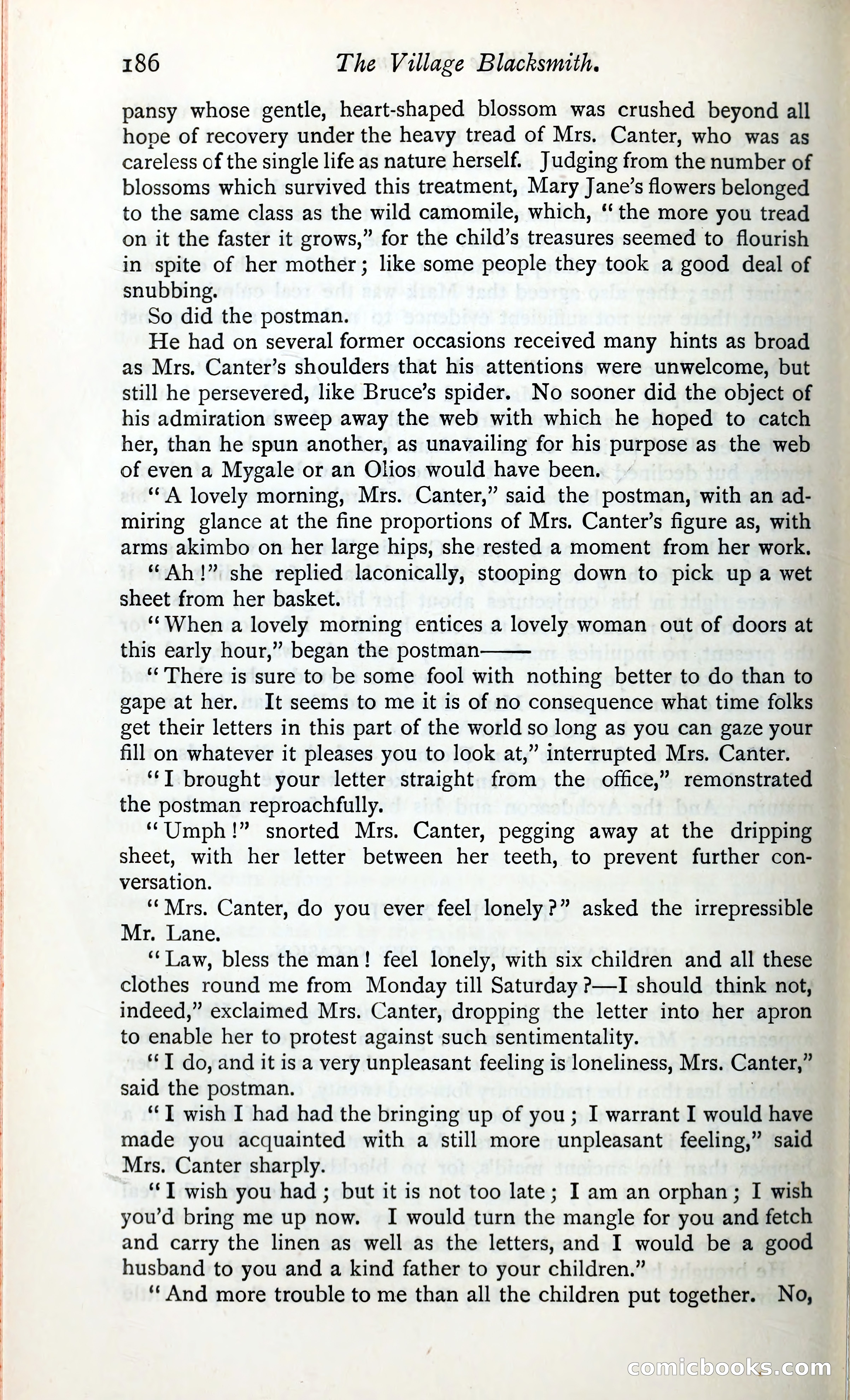
A restored page from Pulp Fiction, 1865. Page through the whole issue in the reader above.
📄 Transcribed text from this page (OCR, searchable)
Machine-transcribed from the original scan — historical spelling and the odd misread are preserved.
186 The Village Blacksmith. pansy whose gentle, heart-shaped blossom was crushed beyond all hope of recovery under the heavy tread of Mrs. Canter, who was as careless of the single life as nature herself. Judging from the number of blossoms which survived this treatment, Mary Jane’s flowers belonged to the same class as the wild camomile, which, ‘the more you tread on it the faster it grows,” for the child’s treasures seemed to flourish in spite of her mother; like some people they took a good deal of snubbing. So did the postman. He had on several former occasions received many hints as broad as Mrs. Canter’s shoulders that his attentions were unwelcome, but still he persevered, like Bruce’s spider. No sooner did the object of his admiration sweep away the web with which he hoped to catch her, than he spun another, as unavailing for his purpose as the web of even a Mygale or an Olios would have been. ‘A lovely morning, Mrs. Canter,” said the postman, with an ad- miring glance at the fine proportions of Mrs. Canter’s figure as, with arms akimbo on her large hips, she rested a moment from her work. “Ah!” she replied laconically, stooping down to pick up a wet sheet from her basket. ‘“When a lovely morning entices a lovely woman out of doors at this early hour,” began the postman ‘There is sure to be some fool with nothing better to do than to gape at her. It seems to me it is of no consequence what time folks get their letters in this part of the world so long as you can gaze your fill on whatever it pleases you to look at,” interrupted Mrs. Canter. “JT brought your letter straight from the office,” remonstrated the postman reproachfully. ‘Umph!” snorted Mrs. Canter, pegging away at the dripping sheet, with her letter between her teeth, to prevent further con- versation. “Mrs. Canter, do you ever feel lonely?” asked the irrepressible Mr. Lane. ‘“‘ Law, bless the man! feel lonely, with six children and all these clothes round me from Monday till Saturday Pp—I should think not, indeed,” exclaimed Mrs. Canter, dropping the letter into her apron to enable her to protest against such sentimentality. ‘*T do, and it is a very unpleasant feeling is loneliness, Mrs. Canter,” said the postman. “‘] wish I had had the bringing up of you; I warrant I would have made you acquainted with a still more unpleasant feeling,” said Mrs. Canter sharply. ‘‘T wish you had ; but it is not too late; I am an orphan; I wish you’d bring me up now. I would turn the mangle for you and fetch and carry the linen as well as the letters, and I would be a good husband to you and a kind father to your children.” ‘‘And more trouble to me than all the children put toast No, Gomilcbooks).co