
Pulp Fiction, 1865 · page 162 of 399
The Argosy — page 162: what you’re looking at
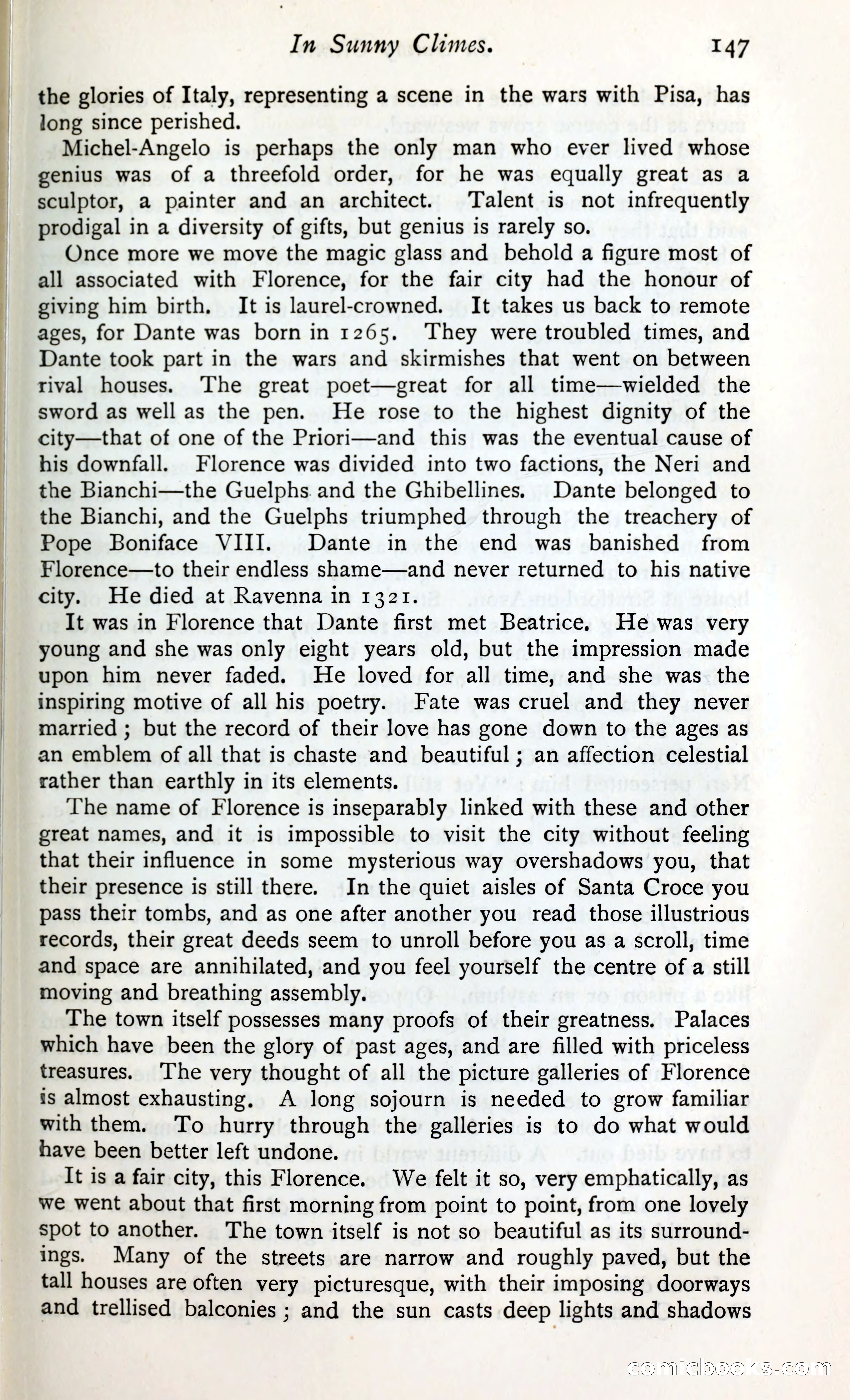
A restored page from Pulp Fiction, 1865. Page through the whole issue in the reader above.
📄 Transcribed text from this page (OCR, searchable)
Machine-transcribed from the original scan — historical spelling and the odd misread are preserved.
In Sunny Climes. 147 the glories of Italy, representing a scene in the wars with Pisa, has long since perished. Michel-Angelo is perhaps the only man who ever lived whose genius was of a threefold order, for he was equally great as a sculptor, a painter and an architect. Talent is not infrequently prodigal in a diversity of gifts, but genius is rarely so. Once more we move the magic glass and behold a figure most of all associated with Florence, for the fair city had the honour of giving him birth. It is laurel-crowned. It takes us back to remote ages, for Dante was born in 1265. ‘They were troubled times, and Dante took part in the wars and skirmishes that went on between rival houses. The great poet—great for all time—wielded the sword as well as the pen. He rose to the highest dignity of the city—that of one of the Priori—and this was the eventual cause of his downfall. Florence was divided into two factions, the Neri and the Bianchi—the Guelphs. and the Ghibellines. Dante belonged to the Bianchi, and the Guelphs triumphed through the treachery of Pope Boniface VIII. Dante in the end was banished from Florence—to their endless shame—and never returned to his native city. He died at Ravenna in 1321. It was in Florence that Dante first met Beatrice. He was very young and she was only eight years old, but the impression made upon him never faded. He loved for all time, and she was the inspiring motive of all his poetry. Fate was cruel and they never married ; but the record of their love has gone down to the ages as an emblem of all that is chaste and beautiful; an affection celestial rather than earthly in its elements. The name of Florence is inseparably linked with these and other great names, and it is impossible to visit the city without feeling that their influence in some mysterious way overshadows you, that their presence is still there. In the quiet aisles of Santa Croce you pass their tombs, and as one after another you read those illustrious records, their great deeds seem to unroll before you as a scroll, time and space are annihilated, and you feel yourself the centre of a still moving and breathing assembly. The town itself possesses many proofs of their greatness. Palaces which have been the glory of past ages, and are filled with priceless treasures. The very thought of all the picture galleries of Florence is almost exhausting. A long sojourn is needed to grow familiar with them. To hurry through the galleries is to do what would have been better left undone. It is a fair city, this Florence. We felt it so, very emphatically, as we went about that first morning from point to point, from one lovely spot to another. The town itself is not so beautiful as its surround- ings. Many of the streets are narrow and roughly paved, but the tall houses are often very picturesque, with their imposing doorways and trellised balconies ; and the sun casts deep lights and shadows CORNICAOO ‘S (SO)