
Pulp Fiction, 1865 · page 161 of 399
The Argosy — page 161: what you’re looking at
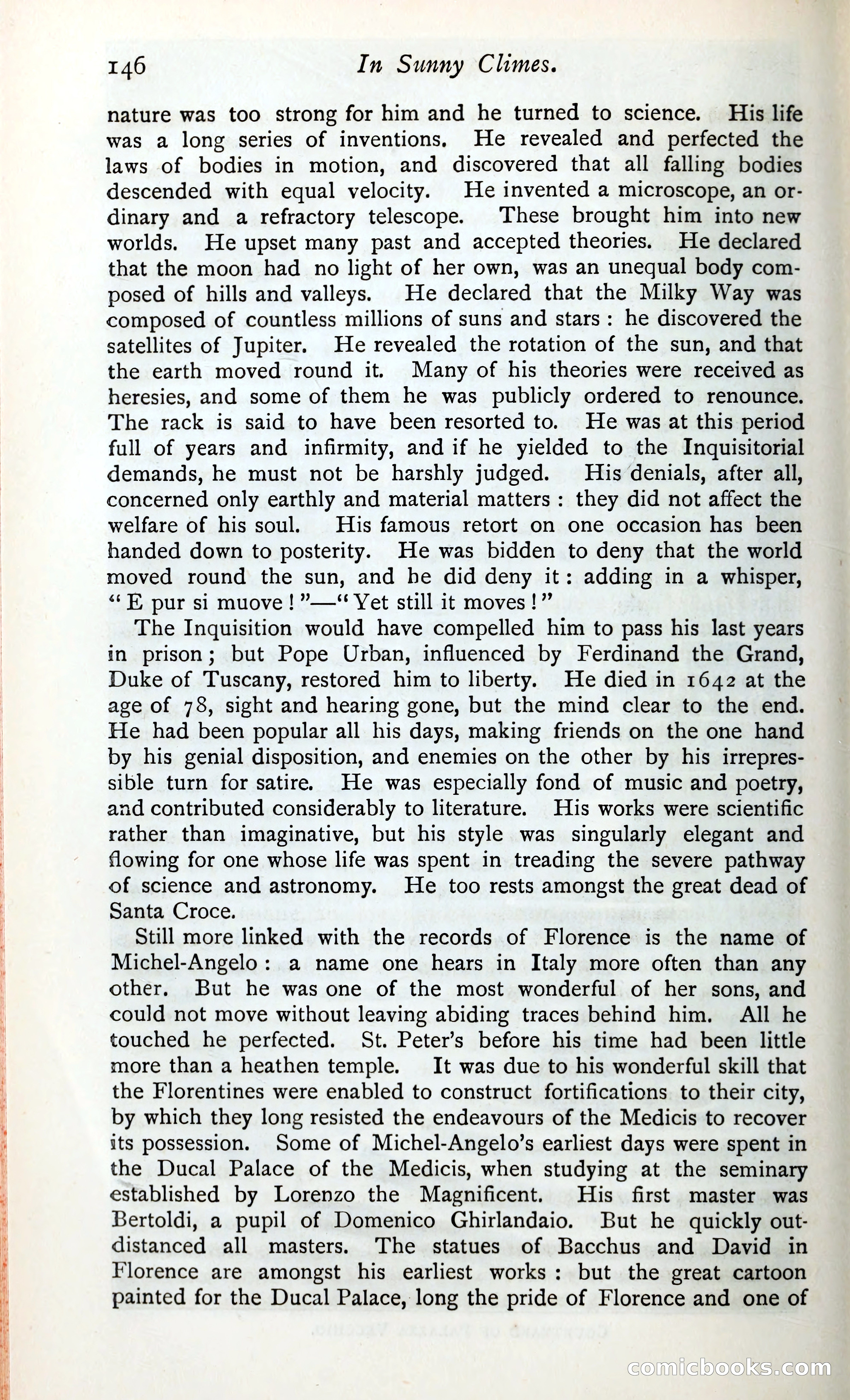
A restored page from Pulp Fiction, 1865. Page through the whole issue in the reader above.
📄 Transcribed text from this page (OCR, searchable)
Machine-transcribed from the original scan — historical spelling and the odd misread are preserved.
————— = ——= —— = Sa SS =s5 ———_ = 146 In Sunny Climes. nature was too strong for him and he turned to science. His life was a long series of inventions. He revealed and perfected the laws of bodies in motion, and discovered that all falling bodies descended with equal velocity. He invented a microscope, an or- dinary and a refractory telescope. These brought him into new worlds. He upset many past and accepted theories. He declared that the moon had no light of her own, was an unequal body com- posed of hills and valleys. He declared that the Milky Way was composed of countless millions of suns and stars: he discovered the satellites of Jupiter. He revealed the rotation of the sun, and that the earth moved round it. Many of his theories were received as heresies, and some of them he was publicly ordered to renounce. The rack is said to have been resorted to. He was at this period full of years and infirmity, and if he yielded to the Inquisitorial demands, he must not be harshly judged. His denials, after all, concerned only earthly and material matters: they did not affect the welfare of his soul. His famous retort on one occasion has been handed down to posterity. He was bidden to deny that the world moved round the sun, and he did deny it: adding in a whisper, ‘‘E, pur si muove! ”—“ Yet still it moves!” The Inquisition would have compelled him to pass his last years in prison; but Pope Urban, influenced by Ferdinand the Grand, Duke of Tuscany, restored him to liberty. He died in 1642 at the age of 78, sight and hearing gone, but the mind clear to the end. He had been popular all his days, making friends on the one hand by his genial disposition, and enemies on the other by his irrepres- sible turn for satire. He was especially fond of music and poetry, and contributed considerably to literature. His works were scientific rather than imaginative, but his style was singularly elegant and flowing for one whose life was spent in treading the severe pathway of science and astronomy. He too rests amongst the great dead of Santa Croce. Still more linked with the records of Florence is the name of Michel-Angelo: a name one hears in Italy more often than any other. But he was one of the most wonderful of her sons, and could not move without leaving abiding traces behind him. All he touched he perfected. St. Peter’s before his time had been little more than a heathen temple. It was due to his wonderful skill that the Florentines were enabled to construct fortifications to their city, by which they long resisted the endeavours of the Medicis to recover its possession. Some of Michel-Angelo’s earliest days were spent in the Ducal Palace of the Medicis, when studying at the seminary established by Lorenzo the Magnificent. His first master was Bertoldi, a pupil of Domenico Ghirlandaio. But he quickly out- distanced all masters. The statues of Bacchus and David in Florence are amongst his earliest works: but the great cartoon painted for the Ducal Palace, long the pride of Florence and one of COMIC OOS ne)