
Pulp Fiction, 1865 · page 306 of 400
The Argosy — page 306: what you’re looking at
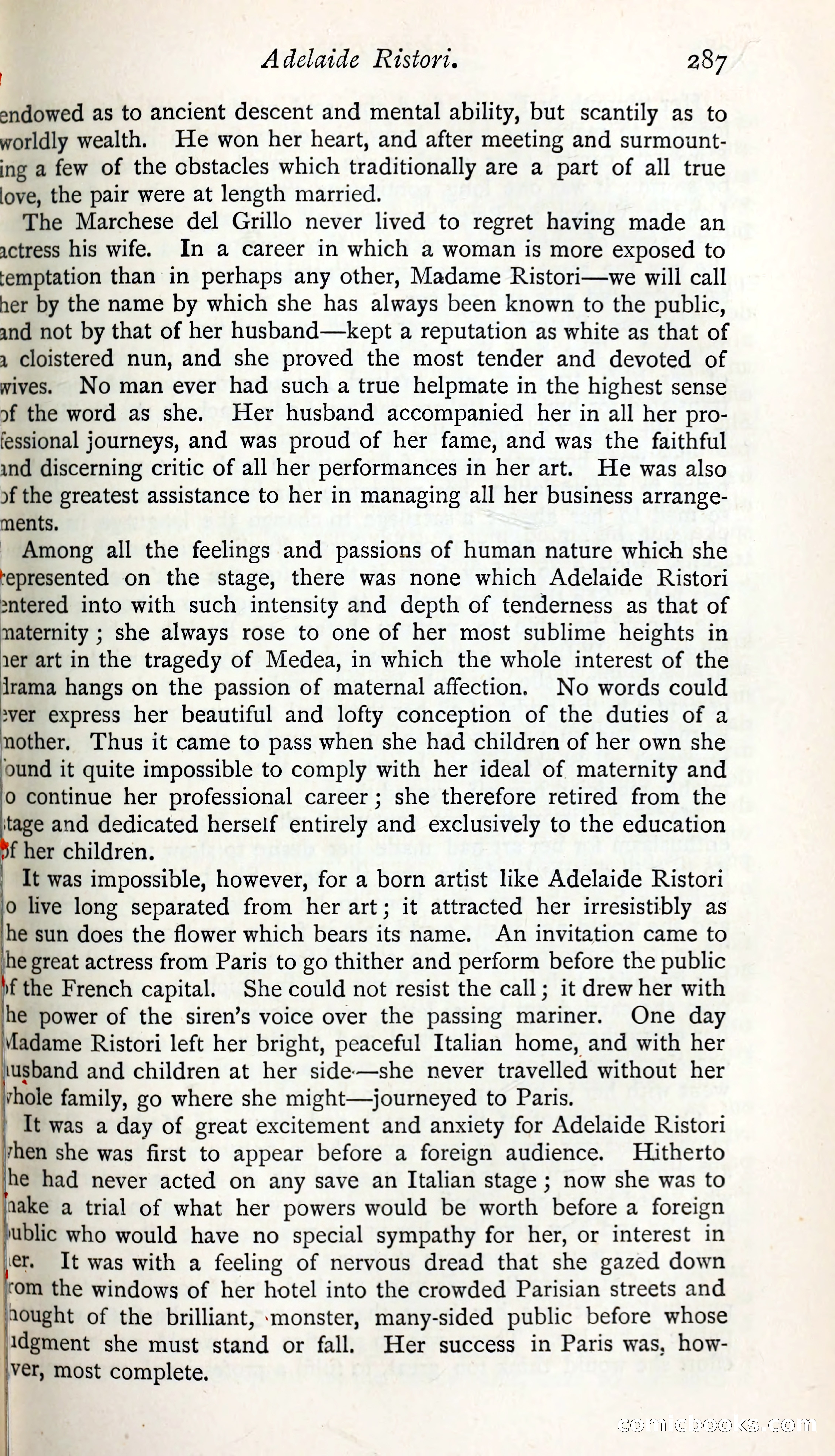
A restored page from Pulp Fiction, 1865. Page through the whole issue in the reader above.
📄 Transcribed text from this page (OCR, searchable)
Machine-transcribed from the original scan — historical spelling and the odd misread are preserved.
Adelaide Riston. 287 endowed as to ancient descent and mental ability, but scantily as to worldly wealth. He won her heart, and after meeting and surmount- ing a few of the obstacles which traditionally are a part of all true love, the pair were at length married. The Marchese del Grillo never lived to regret having made an actress his wife. In a career in which a woman is more exposed to temptation than in perhaps any other, Madame Ristori—we will call her by the name by which she has always been known to the public, and not by that of her husband—kept a reputation as white as that of 4 cloistered nun, and she proved the most tender and devoted of wives. No man ever had such a true helpmate in the highest sense of the word as she. Her husband accompanied her in all her pro- fessional journeys, and was proud of her fame, and was the faithful und discerning critic of all her performances in her art. He was also of the greatest assistance to her in managing all her business arrange- ments. _ Among all the feelings and passions of human nature which she represented on the stage, there was none which Adelaide Ristori entered into with such intensity and depth of tenderness as that of maternity ; she always rose to one of her most sublime heights in ler art in the tragedy of Medea, in which the whole interest of the lrama hangs on the passion of maternal affection. No words could sver express her beautiful and lofty conception of the duties of a nother. Thus it came to pass when she had children of her own she ound it quite impossible to comply with her ideal of maternity and 0 continue her professional career; she therefore retired from the tage and dedicated herself entirely and exclusively to the education f her children. It was impossible, however, for a born artist like Adelaide Ristori 0 live long separated from her art; it attracted her irresistibly as he sun does the flower which bears its name. An invitation came to e great actress from Paris to go thither and perform before the public f the French capital. She could not resist the call; it drew her with he power of the siren’s voice over the passing mariner. One day Madame Ristori left her bright, peaceful Italian home, and with her iusband and children at her side—she never travelled without her rhole family, go where she might—journeyed to Paris. ) It was a day of great excitement and anxiety for Adelaide Ristori when she was first to appear before a foreign audience. Hitherto jhe had never acted on any save an Italian stage ; now she was to jaake a trial of what her powers would be worth before a foreign public who would have no special sympathy for her, or interest in er. It was with a feeling of nervous dread that she gazed down om the windows of her hotel into the crowded Parisian streets and ‘ought of the brilliant, monster, many-sided public before whose ldgment she must stand or fall. Her success in Paris was, how- iver, most complete. oe ECORNICLOO@ S (CO)