
Pulp Fiction, 1865 · page 307 of 400
The Argosy — page 307: what you’re looking at
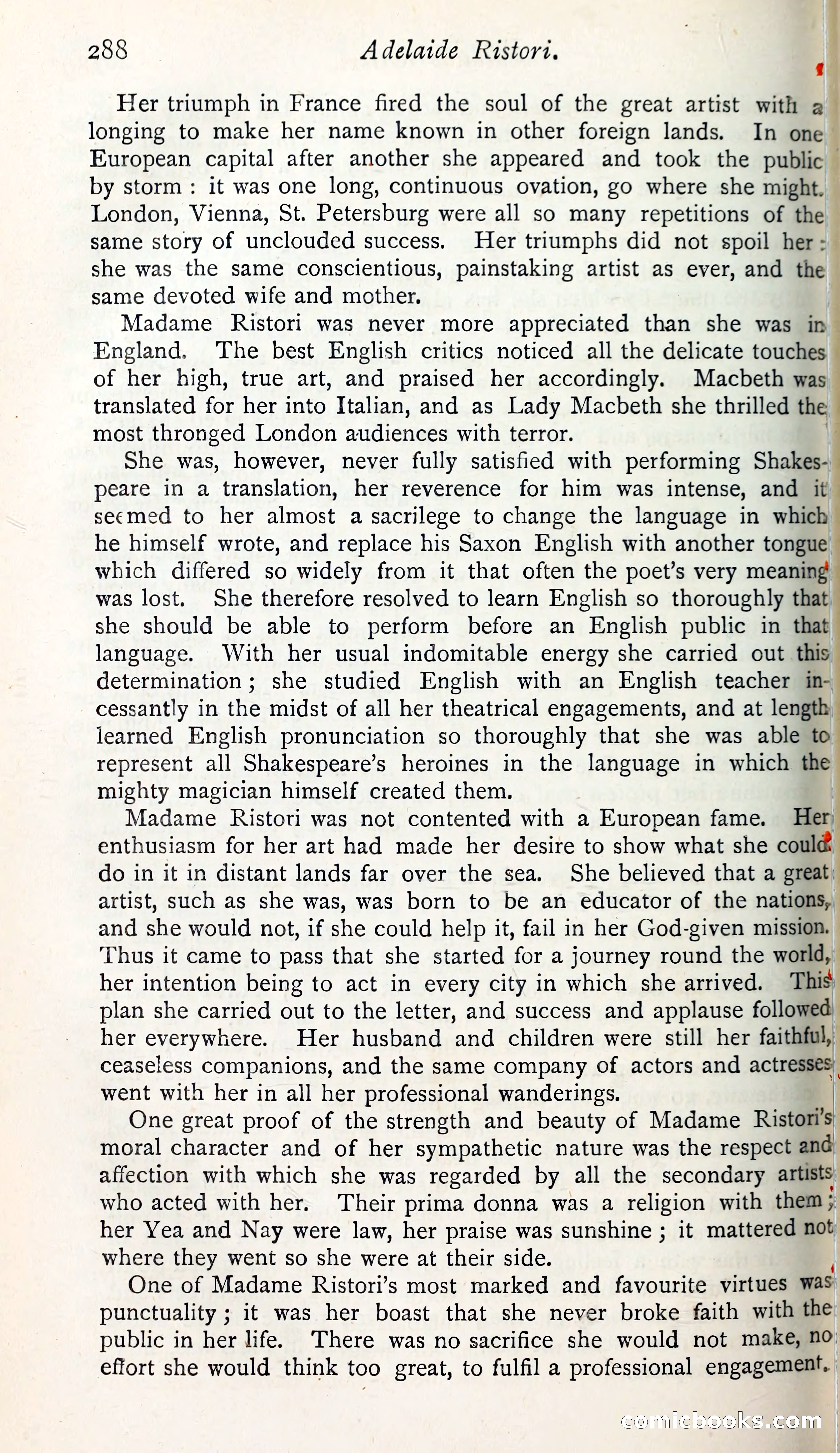
A restored page from Pulp Fiction, 1865. Page through the whole issue in the reader above.
📄 Transcribed text from this page (OCR, searchable)
Machine-transcribed from the original scan — historical spelling and the odd misread are preserved.
288 Adelaide Ristori. 4 Her triumph in France fired the soul of the great artist with a longing to make her name known in other foreign lands. In one European capital after another she appeared and took the public by storm : it was one long, continuous ovation, go where she might. © London, Vienna, St. Petersburg were all so many repetitions of the same story of unclouded success. Her triumphs did not spoil her: she was the same conscientious, painstaking artist as ever, and the same devoted wife and mother, | Madame Ristori was never more appreciated than she was in England, The best English critics noticed all the delicate touches of her high, true art, and praised her accordingly. Macbeth was translated for her into Italian, and as Lady Macbeth she thrilled the most thronged London audiences with terror. She was, however, never fully satisfied with performing Shakes- peare in a translation, her reverence for him was intense, and it seemed to her almost a sacrilege to change the language in which he himself wrote, and replace his Saxon English with another tongue which differed so widely from it that often the poet’s very meaning was lost. She therefore resolved to learn English so thoroughly that she should be able to perform before an English public in that language. With her usual indomitable energy she carried out this determination; she studied English with an English teacher in- cessantly in the midst of all her theatrical engagements, and at length learned English pronunciation so thoroughly that she was able to represent all Shakespeare’s heroines in the language in which the mighty magician himself created them. 3 Madame Ristori was not contented with a European fame. Her) enthusiasm for her art had made her desire to show what she coulé do in it in distant lands far over the sea. She believed that a great: artist, such as she was, was born to be an educator of the nations, and she would not, if she could help it, fail in her God-given mission. Thus it came to pass that she started for a journey round the world, her intention being to act in every city in which she arrived. This plan she carried out to the letter, and success and applause followed her everywhere. Her husband and children were still her faithful, ceaseless companions, and the same company of actors and i ‘f went with her in all her professional wanderings. One great proof of the strength and beauty of Madame Ristori’s moral character and of her sympathetic nature was the respect and affection with which she was regarded by all the secondary artists: who acted with her. Their prima donna was a religion with them; her Yea and Nay were law, her praise was sunshine ; it mattered not where they went so she were at their side. One of Madame Ristori’s most marked and favourite virtues was punctuality ; it was her boast that she never broke faith with the public in her life. There was no sacrifice she would not make, no effort she would think too great, to fulfil a professional engagement. Gomicbooks.com |