
Pulp Fiction, 1865 · page 305 of 400
The Argosy — page 305: what you’re looking at
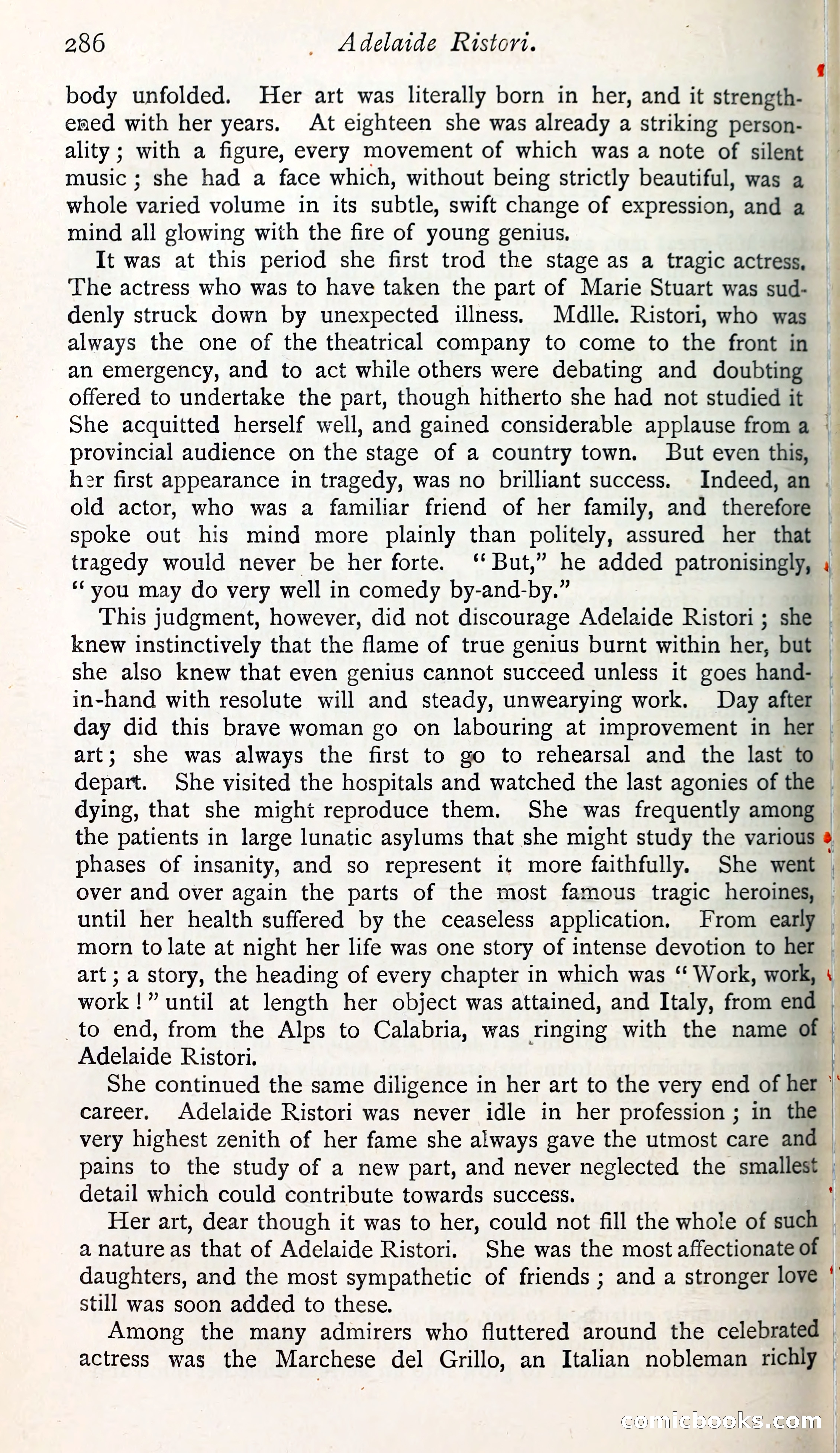
A restored page from Pulp Fiction, 1865. Page through the whole issue in the reader above.
📄 Transcribed text from this page (OCR, searchable)
Machine-transcribed from the original scan — historical spelling and the odd misread are preserved.
286 Adelaide Risto. body unfolded. Her art was literally born in her, and it strength- ened with her years. At eighteen she was already a striking person- ality; with a figure, every movement of which was a note of silent music ; she had a face which, without being strictly beautiful, was a whole varied volume in its subtle, swift change of expression, and a mind all glowing with the fire of young genius. It was at this period she first trod the stage as a tragic actress, The actress who was to have taken the part of Marie Stuart was sud- denly struck down by unexpected illness. Mdlle. Ristori, who was — always the one of the theatrical company to come to the front in an emergency, and to act while others were debating and doubting offered to undertake the part, though hitherto she had not studied it She acquitted herself well, and gained considerable applause from a provincial audience on the stage of a country town. But even this, © her first appearance in tragedy, was no brilliant success. Indeed, an . old actor, who was a familiar friend of her family, and therefore — spoke out his mind more plainly than politely, assured her that — tragedy would never be her forte. ‘‘ But,” he added patronisingly, , ““you may do very well in comedy by-and-by.” This judgment, however, did not discourage Adelaide Ristori ; she knew instinctively that the flame of true genius burnt within her, but she also knew that even genius cannot succeed unless it goes hand- in-hand with resolute will and steady, unwearying work. Day after day did this brave woman go on labouring at improvement in her — art; she was always the first to go to rehearsal and the last to depart. She visited the hospitals and watched the last agonies of the . dying, that she might reproduce them. She was frequently among _ the patients in large lunatic asylums that she might study the various , phases of insanity, and so represent it more faithfully. She went | over and over again the parts of the most famous tragic heroines, - until her health suffered by the ceaseless application. From early | morn to late at night her life was one story of intense devotion to her | art ; a story, the heading of every chapter in which was ‘‘ Work, work, \ work !” until at length her object was attained, and Italy, from end | to end, from the Alps to Calabria, was ringing with the name of | Adelaide Ristori. She continued the same diligence in her art to the very end of her * career. Adelaide Ristori was never idle in her profession ; in the very highest zenith of her fame she always gave the utmost care and — pains to the study of a new part, and never neglected the smallest detail which could contribute towards success. Her art, dear though it was to her, could not fill the whole of such | a nature as that of Adelaide Ristori. She was the most affectionate of daughters, and the most sympathetic of friends ; and a stronger love * still was soon added to these. Among the many admirers who fluttered around the celebrated — actress was the Marchese del Grillo, an Italian nobleman richly | tl tall CORNIELOOO! KS ,Ceoyany |