
Pulp Fiction, 1865 · page 76 of 400
The Argosy — page 76: what you’re looking at
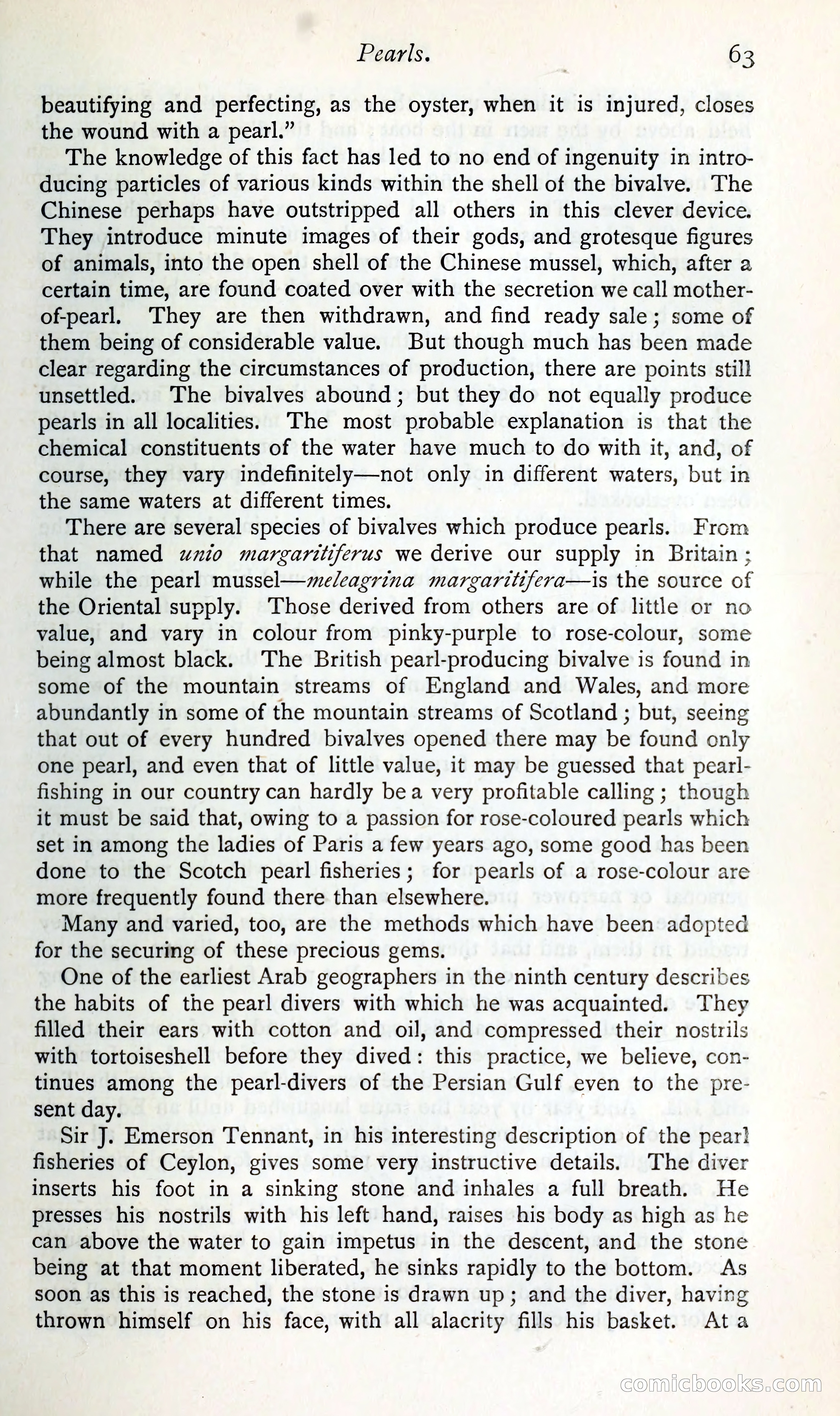
A restored page from Pulp Fiction, 1865. Page through the whole issue in the reader above.
📄 Transcribed text from this page (OCR, searchable)
Machine-transcribed from the original scan — historical spelling and the odd misread are preserved.
Pearls, | 63 beautifying and perfecting, as the oyster, when it is injured, closes the wound with a pearl.” The knowledge of this fact has led to no end of ingenuity in intro- ducing particles of various kinds within the shell of the bivalve. The Chinese perhaps have outstripped all others in this clever device. They introduce minute images of their gods, and grotesque figures of animals, into the open shell of the Chinese mussel, which, after a certain time, are found coated over with the secretion we call mother- of-pearl. They are then withdrawn, and find ready sale; some of them being of considerable value. But though much has been made clear regarding the circumstances of production, there are points still unsettled. The bivalves abound; but they do not equally produce pearls in all localities. The most probable explanation is that the chemical constituents of the water have much to do with it, and, of course, they vary indefinitely—not only in different waters, but in the same waters at different times. There are several species of bivalves which produce pearls. From that named wz20 margaritiferus we derive our supply in Britain; while the pearl mussel—meleagrina margaritsfera—is the source of the Oriental supply. Those derived from others are of little or no value, and vary in colour from pinky-purple to rose-colour, some being almost black. The British pearl-producing bivalve is found in some of the mountain streams of England and Wales, and more abundantly in some of the mountain streams of Scotland ; but, seeing that out of every hundred bivalves opened there may be found only one pearl, and even that of little value, it may be guessed that pearl- fishing in our country can hardly bea very profitable calling ; though it must be said that, owing to a passion for rose-coloured pearls which set in among the ladies of Paris a few years ago, some good has been done to the Scotch pearl fisheries; for pearls of a rose-colour are more frequently found there than elsewhere. Many and varied, too, are the methods which have been adopted for the securing of these precious gems. One of the earliest Arab geographers in the ninth century describes the habits of the pearl divers with which he was acquainted. They filled their ears with cotton and oil, and compressed their nostrils with tortoiseshell before they dived: this practice, we believe, con- tinues among the pearl-divers of the Persian Gulf even to the pre- sent day. Sir J. Emerson Tennant, in his interesting description of the pear! fisheries of Ceylon, gives some very instructive details. The diver inserts his foot in a sinking stone and inhales a full breath. He presses his nostrils with his left hand, raises his body as high as he can above the water to gain impetus in the descent, and the stone being at that moment liberated, he sinks rapidly to the bottom. As soon as this is reached, the stone is drawn up; and the diver, having thrown himself on his face, with all alacrity fills his basket. Ata conniclooolkks (C(O) im