
Pulp Fiction, 1865 · page 75 of 400
The Argosy — page 75: what you’re looking at
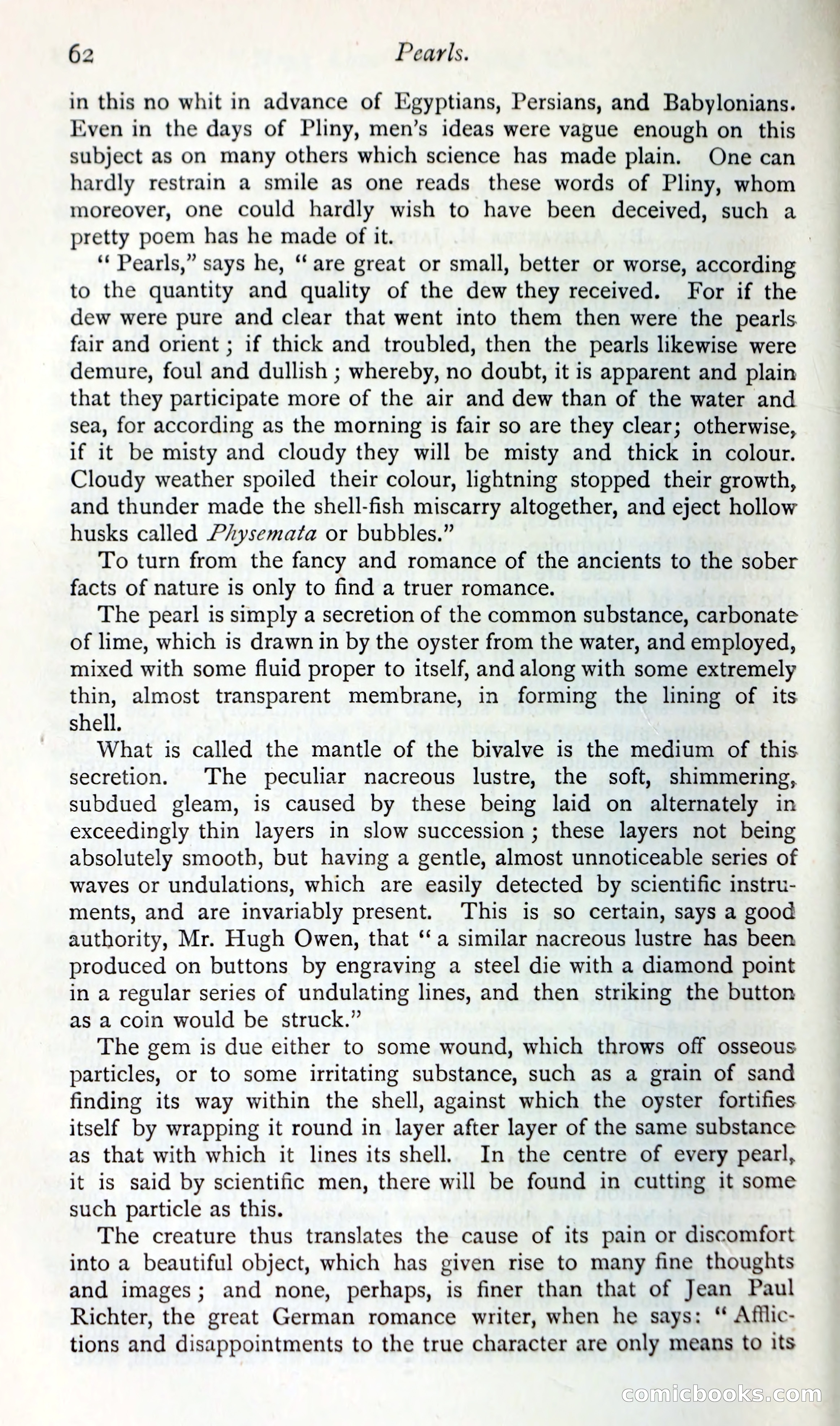
A restored page from Pulp Fiction, 1865. Page through the whole issue in the reader above.
📄 Transcribed text from this page (OCR, searchable)
Machine-transcribed from the original scan — historical spelling and the odd misread are preserved.
62 Pearls. in this no whit in advance of Egyptians, Persians, and Babylonians. Even in the days of Pliny, men’s ideas were vague enough on this subject as on many others which science has made plain. One can hardly restrain a smile as one reads these words of Pliny, whom moreover, one could hardly wish to have been deceived, such a pretty poem has he made of it. ‘* Pearls,” says he, “ are great or small, better or worse, according to the quantity and quality of the dew they received. For if the dew were pure and clear that went into them then were the pearls. fair and orient ; if thick and troubled, then the pearls likewise were demure, foul and dullish ; whereby, no doubt, it is apparent and plain that they participate more of the air and dew than of the water and sea, for according as the morning is fair so are they clear; otherwise, if it be misty and cloudy they will be misty and thick in colour. Cloudy weather spoiled their colour, lightning stopped their growth, and thunder made the shell-fish miscarry altogether, and eject hollow husks called Physemata or bubbles.” To turn from the fancy and romance of the ancients to the sober facts of nature is only to find a truer romance. The pearl is simply a secretion of the common substance, carbonate of lime, which is drawn in by the oyster from the water, and employed, mixed with some fluid proper to itself, and along with some extremely thin, almost transparent membrane, in forming the lining of its shell. What is called the mantle of the bivalve is the medium of this secretion. The peculiar nacreous lustre, the soft, shimmering, subdued gleam, is caused by these being laid on alternately in exceedingly thin layers in slow succession ; these layers not being absolutely smooth, but having a gentle, almost unnoticeable series of waves or undulations, which are easily detected by scientific instru- ments, and are invariably present. This is so certain, says a good authority, Mr. Hugh Owen, that ‘‘a similar nacreous lustre has been produced on buttons by engraving a steel die with a diamond point in a regular series of undulating lines, and then striking the button as a coin would be struck.” The gem is due either to some wound, which throws off osseous particles, or to some irritating substance, such as a grain of sand finding its way within the shell, against which the oyster fortifies itself by wrapping it round in layer after layer of the same substance as that with which it lines its shell. In the centre of every pearl, it is said by scientific men, there will be found in cutting it some such particle as this. The creature thus translates the cause of its pain or discomfort into a beautiful object, which has given rise to many fine thoughts and images; and none, perhaps, is finer than that of Jean Paul Richter, the great German romance writer, when he says: “ Afilic- tions and disappointments to the true character are only means to its COPMIECOIOO KS. Eo