
Pulp Fiction, 1865 · page 77 of 400
The Argosy — page 77: what you’re looking at
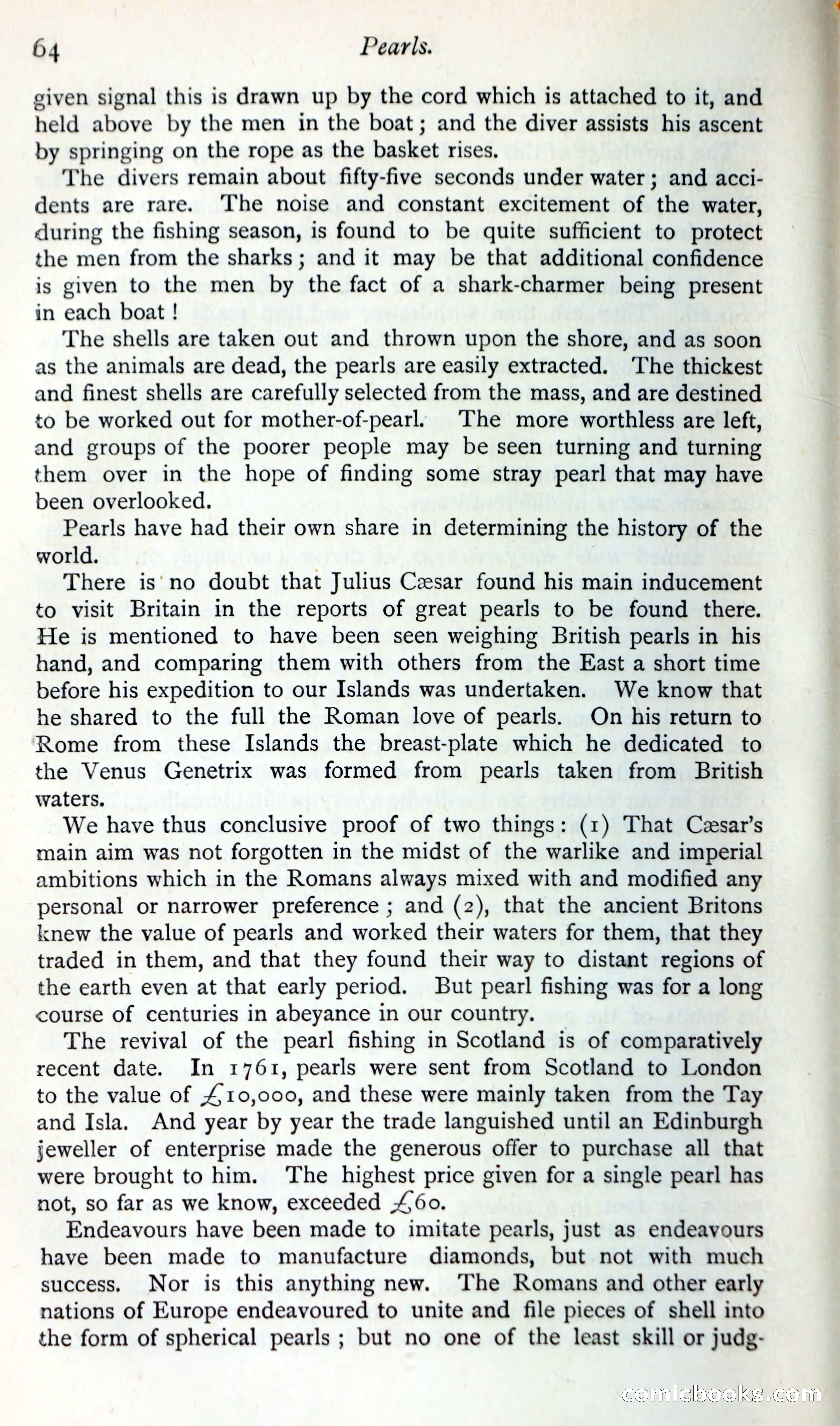
A restored page from Pulp Fiction, 1865. Page through the whole issue in the reader above.
📄 Transcribed text from this page (OCR, searchable)
Machine-transcribed from the original scan — historical spelling and the odd misread are preserved.
04 Pearls. siven signal this is drawn up by the cord which is attached to it, and held above by the men in the boat; and the diver assists his ascent by springing on the rope as the basket rises. The divers remain about fifty-five seconds under water; and acci- dents are rare. ‘The noise and constant excitement of the water, during the fishing season, is found to be quite sufficient to protect the men from the sharks; and it may be that additional confidence is given to the men by the fact of a shark-charmer being present in each boat ! The shells are taken out and thrown upon the shore, and as soon as the animals are dead, the pearls are easily extracted. ‘The thickest and finest shells are carefully selected from the mass, and are destined to be worked out for mother-of-pearl. The more worthless are left, and groups of the poorer people may be seen turning and turning them over in the hope of finding some stray pearl that may have been overlooked. Pearls have had their own share in determining the history of the world. There is'no doubt that Julius Czesar found his main inducement to visit Britain in the reports of great pearls to be found there. He is mentioned to have been seen weighing British pearls in his hand, and comparing them with others from the East a short time before his expedition to our Islands was undertaken. We know that he shared to the full the Roman love of pearls. On his return to Rome from these Islands the breast-plate which he dedicated to the Venus Genetrix was formed from pearls taken from British waters. We have thus conclusive proof of two things: (1) That Cesar’s main aim was not forgotten in the midst of the warlike and imperial ambitions which in the Romans always mixed with and modified any personal or narrower preference ; and (2), that the ancient Britons knew the value of pearls and worked their waters for them, that they traded in them, and that they found their way to distant regions of the earth even at that early period. But pearl fishing was for a long course of centuries in abeyance in our country. The revival of the pearl fishing in Scotland is of comparatively recent date. In 1761, pearls were sent from Scotland to London to the value of 410,000, and these were mainly taken from the Tay and Isla. And year by year the trade languished until an Edinburgh jeweller of enterprise made the generous offer to purchase all that were brought to him. The highest price given for a single pearl has not, so far as we know, exceeded +460. Endeavours have been made to imitate pearls, just as endeavours have been made to manufacture diamonds, but not with much success. Nor is this anything new. ‘The Romans and other early nations of Europe endeavoured to unite and file pieces of shell into the form of spherical pearls ; but no one of the least skill or judg- CORNICE OOO KS (E)