
Pulp Fiction, 1865 · page 67 of 400
The Argosy — page 67: what you’re looking at
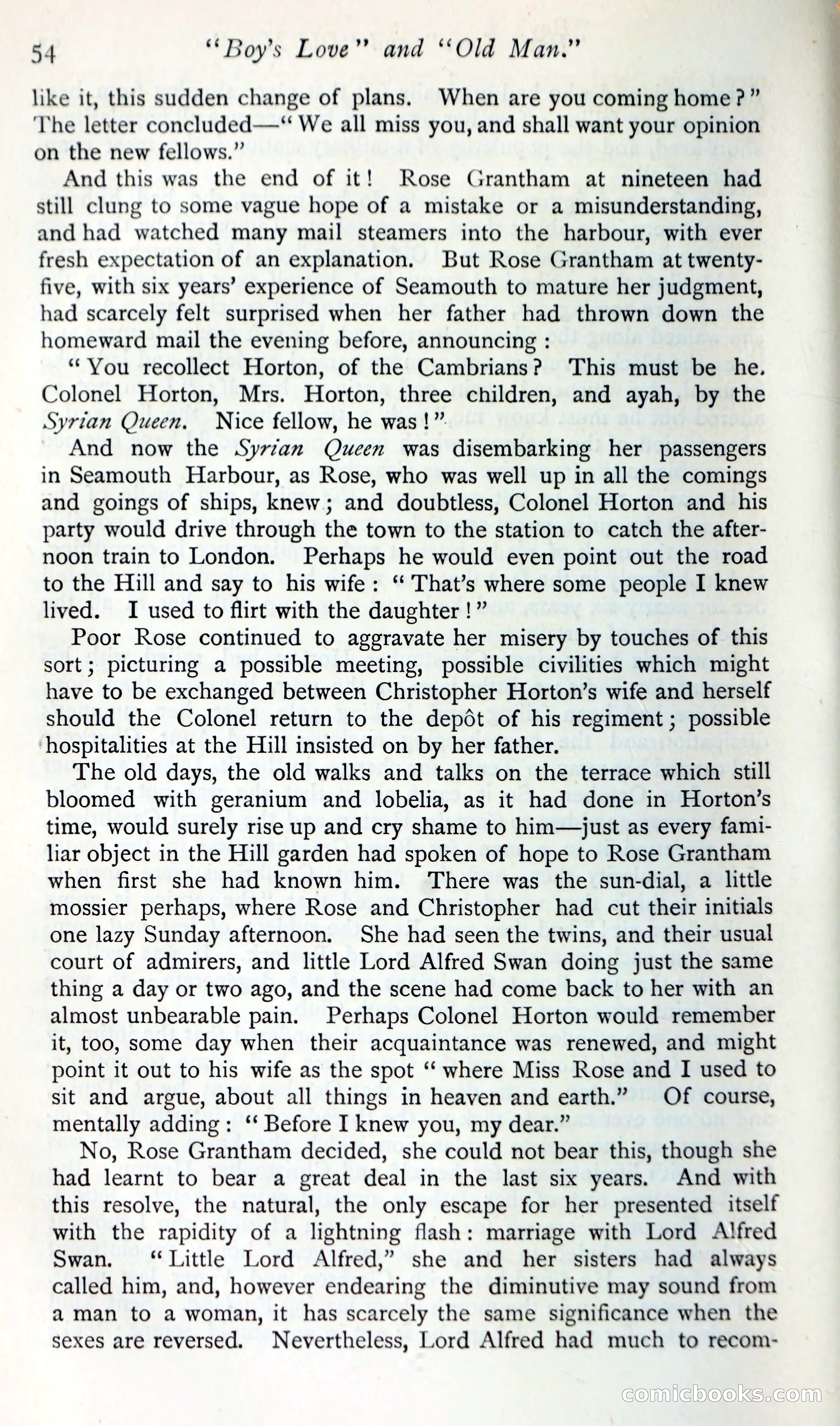
A restored page from Pulp Fiction, 1865. Page through the whole issue in the reader above.
📄 Transcribed text from this page (OCR, searchable)
Machine-transcribed from the original scan — historical spelling and the odd misread are preserved.
54 ‘“Boy’s Love” and ‘Old Man.” like it, this sudden change of plans. When are you coming home ?” The letter concluded—“ We all miss you, and shall want your opinion on the new fellows.” And this was the end of it! Rose Grantham at nineteen had still clung to some vague hope of a mistake or a misunderstanding, and had watched many mail steamers into the harbour, with ever fresh expectation of an explanation. But Rose Grantham at twenty- five, with six years’ experience of Seamouth to mature her judgment, had scarcely felt surprised when her father had thrown down the homeward mail the evening before, announcing : ‘You recollect Horton, of the Cambrians? This must be he. Colonel Horton, Mrs. Horton, three children, and ayah, by the Syrian Queen. Nice fellow, he was!” And now the Syrian Queen was disembarking her passengers in Seamouth Harbour, as Rose, who was well up in all the comings and goings of ships, knew; and doubtless, Colonel Horton and his party would drive through the town to the station to catch the after- noon train to London. Perhaps he would even point out the road to the Hill and say to his wife: “‘ That’s where some people I knew lived. I used to flirt with the daughter !” Poor Rose continued to aggravate her misery by touches of this sort; picturing a possible meeting, possible civilities which might have to be exchanged between Christopher Horton’s wife and herself should the Colonel return to the depdt of his regiment; possible hospitalities at the Hill insisted on by her father. The old days, the old walks and talks on the terrace which still bloomed with geranium and lobelia, as it had done in Horton’s time, would surely rise up and cry shame to him—just as every fami- liar object in the Hill garden had spoken of hope to Rose Grantham when first she had known him. There was the sun-dial, a little mossier perhaps, where Rose and Christopher had cut their initials one lazy Sunday afternoon. She had seen the twins, and their usual court of admirers, and little Lord Alfred Swan doing just the same thing a day or two ago, and the scene had come back to her with an almost unbearable pain. Perhaps Colonel Horton would remember it, too, some day when their acquaintance was renewed, and might point it out to his wife as the spot ‘“‘ where Miss Rose and I used to sit and argue, about all things in heaven and earth.” Of course, mentally adding: ‘‘ Before I knew you, my dear.” No, Rose Grantham decided, she could not bear this, though she had learnt to bear a great deal in the last six years. And with this resolve, the natural, the only escape for her presented itself with the rapidity of a lightning flash: marriage with Lord Alfred Swan, ‘Little Lord Alfred,” she and her sisters had always called him, and, however endearing the diminutive may sound from a man to a woman, it has scarcely the same significance when the sexes are reversed. Nevertheless, Lord Alfred had much to recom- COMICMOOKS. EO