
Pulp Fiction, 1865 · page 66 of 400
The Argosy — page 66: what you’re looking at
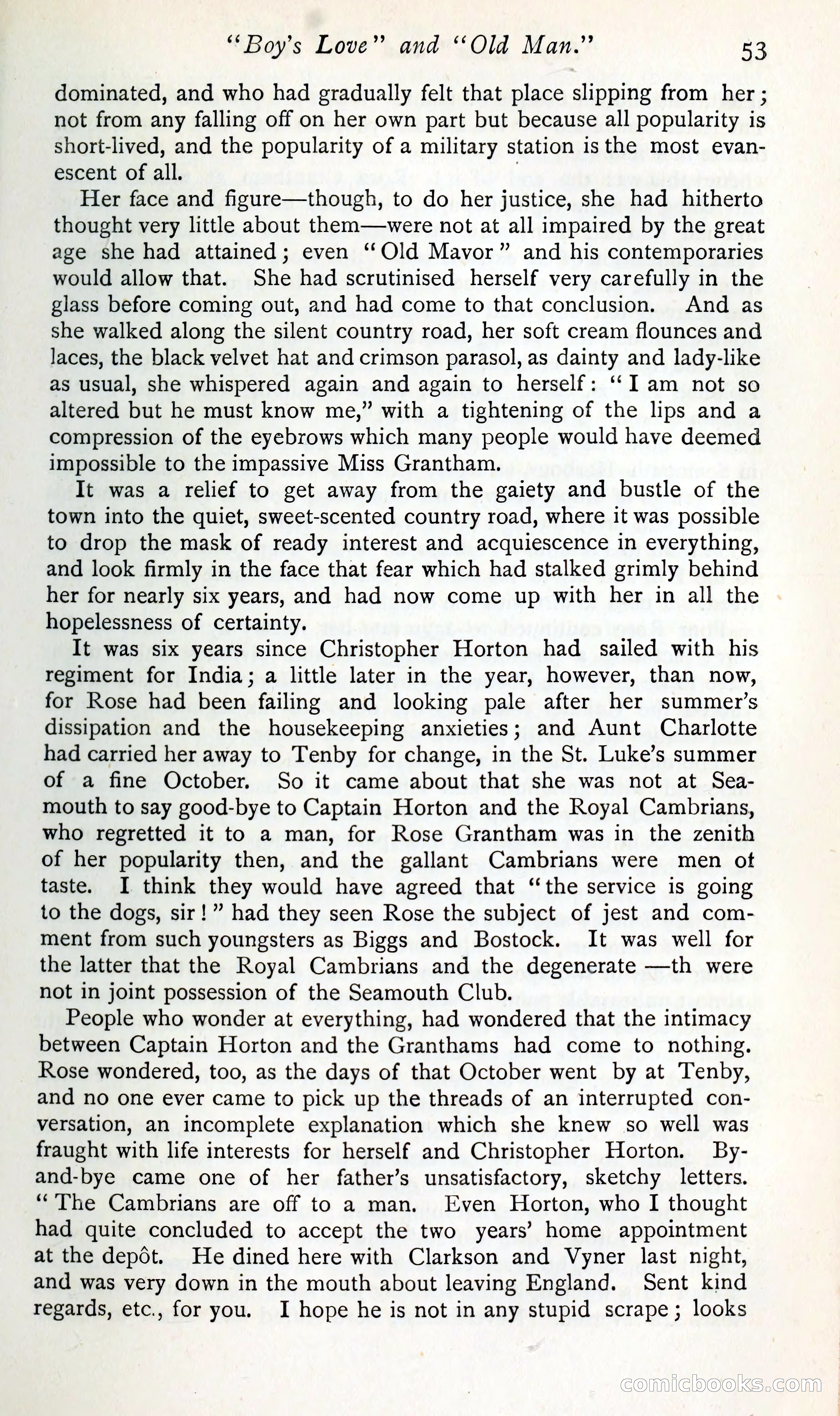
A restored page from Pulp Fiction, 1865. Page through the whole issue in the reader above.
📄 Transcribed text from this page (OCR, searchable)
Machine-transcribed from the original scan — historical spelling and the odd misread are preserved.
“Boy's Love” and “Old Man.” 53 dominated, and who had gradually felt that place slipping from her ; not from any falling off on her own part but because all popularity is short-lived, and the popularity of a military station isthe most evan- escent of all. | Her face and figure—though, to do her justice, she had hitherto thought very little about them—were not at all impaired by the great age she had attained; even “Old Mavor” and his contemporaries would allow that. She had scrutinised herself very carefully in the glass before coming out, and had come to that conclusion. And as she walked along the silent country road, her soft cream flounces and laces, the black velvet hat and crimson parasol, as dainty and lady-like as usual, she whispered again and again to herself: ‘‘I am not so altered but he must know me,” with a tightening of the lips and a compression of the eyebrows which many people would have deemed impossible to the impassive Miss Grantham. It was a relief to get away from the gaiety and bustle of the town into the quiet, sweet-scented country road, where it was possible to drop the mask of ready interest and acquiescence in everything, and look firmly in the face that fear which had stalked grimly behind her for nearly six years, and had now come up with her in all the hopelessness of certainty. It was six years since Christopher Horton had sailed with his regiment for India; a little later in the year, however, than now, for Rose had been failing and looking pale after her summer’s dissipation and the housekeeping anxieties; and Aunt Charlotte had carried her away to Tenby for change, in the St. Luke’s summer of a fine October. So it came about that she was not at Sea- mouth to say good-bye to Captain Horton and the Royal Cambrians, who regretted it to a man, for Rose Grantham was in the zenith of her popularity then, and the gallant Cambrians were men oft taste. I think they would have agreed that ‘‘the service is going to the dogs, sir!” had they seen Rose the subject of jest and com- ment from such youngsters as Biggs and Bostock. It was well for the latter that the Royal Cambrians and the degenerate —th were not in joint possession of the Seamouth Club. People who wonder at everything, had wondered that the intimacy between Captain Horton and the Granthams had come to nothing. Rose wondered, too, as the days of that October went by at Tenby, and no one ever came to pick up the threads of an interrupted con- versation, an incomplete explanation which she knew so well was fraught with life interests for herself and Christopher Horton. By- and-bye came one of her father’s unsatisfactory, sketchy letters. “The Cambrians are off to a man. Even Horton, who I thought had quite concluded to accept the two years’ home appointment at the depot. He dined here with Clarkson and Vyner last night, and was very down in the mouth about leaving England. Sent kind regards, etc., for you. I hope he is not in any stupid scrape; looks Cconniclooolks (C(O)