
Pulp Fiction, 1865 · page 294 of 400
The Argosy — page 294: what you’re looking at
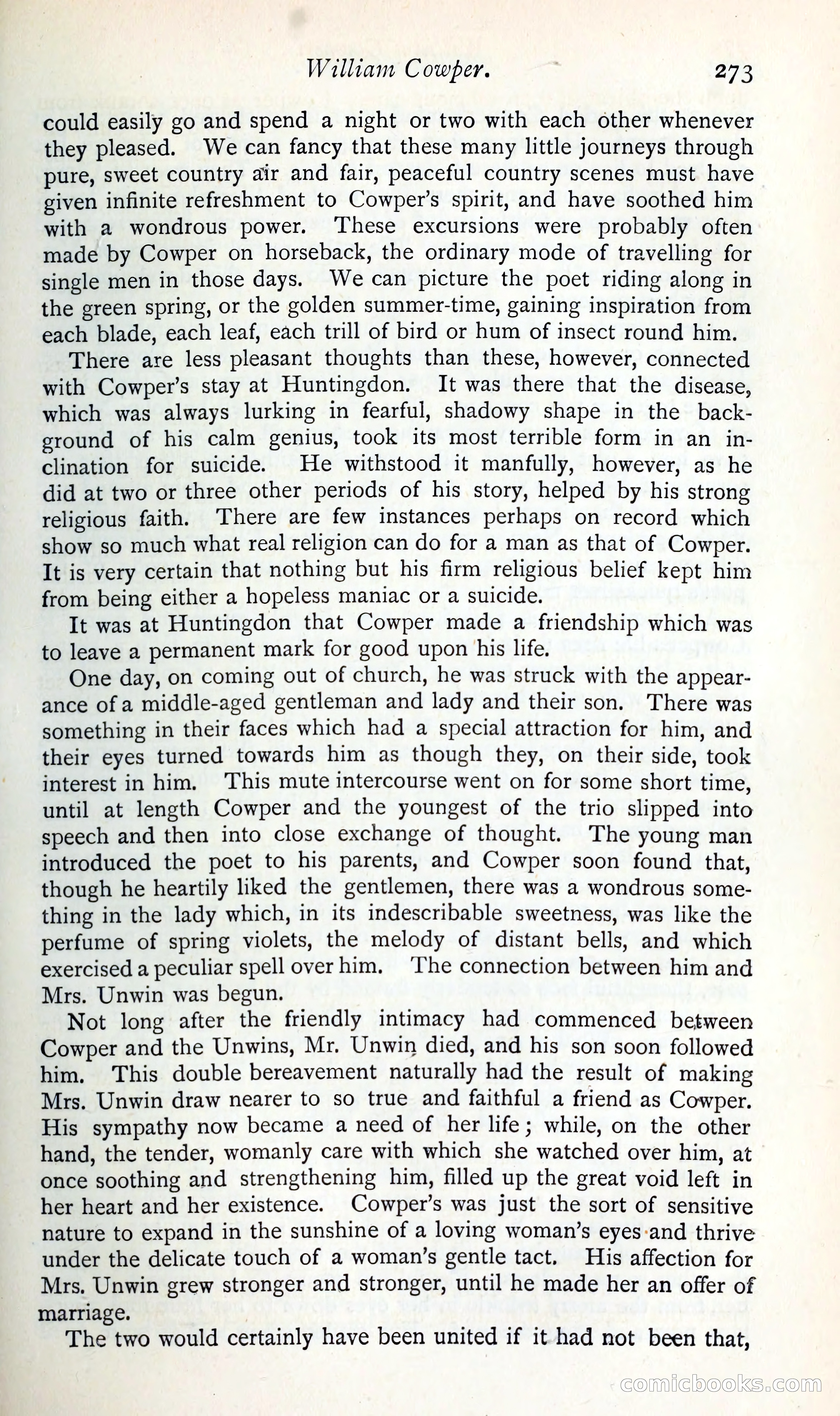
A restored page from Pulp Fiction, 1865. Page through the whole issue in the reader above.
📄 Transcribed text from this page (OCR, searchable)
Machine-transcribed from the original scan — historical spelling and the odd misread are preserved.
William Cowper. | 273 could easily go and spend a night or two with each other whenever they pleased. We can fancy that these many little journeys through pure, sweet country air and fair, peaceful country scenes must have given infinite refreshment to Cowper’s spirit, and have soothed him with a wondrous power. ‘These excursions were probably often made by Cowper on horseback, the ordinary mode of travelling for single men in those days. Wecan picture the poet riding along in the green spring, or the golden summer-time, gaining inspiration from each blade, each leaf, each trill of bird or hum of insect round him. There are less pleasant thoughts than these, however, connected with Cowper’s stay at Huntingdon. It was there that the disease, which was always lurking in fearful, shadowy shape in the back- eround of his calm genius, took its most terrible form in an in- clination for suicide. He withstood it manfully, however, as he did at two or three other periods of his story, helped by his strong religious faith, ‘There are few instances perhaps on record which show so much what real religion can do for a man as that of Cowper. It is very certain that nothing but his firm religious belief kept him from being either a hopeless maniac or a suicide. It was at Huntingdon that Cowper made a friendship which was to leave a permanent mark for good upon his life. One day, on coming out of church, he was struck with the appear- ance of a middle-aged gentleman and lady and their son. There was something in their faces which had a special attraction for him, and their eyes turned towards him as though they, on their side, took interest in him. This mute intercourse went on for some short time, until at length Cowper and the youngest of the trio slipped into speech and then into close exchange of thought. The young man introduced the poet to his parents, and Cowper soon found that, though he heartily liked the gentlemen, there was a wondrous some- thing in the lady which, in its indescribable sweetness, was like the perfume of spring violets, the melody of distant bells, and which exercised a peculiar spell overhim. ‘The connection between him and Mrs. Unwin was begun. Not long after the friendly intimacy had commenced between Cowper and the Unwins, Mr. Unwin died, and his son soon followed him. ‘This double bereavement naturally had the result of making Mrs. Unwin draw nearer to so true and faithful a friend as Cowper. His sympathy now became a need of her life; while, on the other hand, the tender, womanly care with which she watched over him, at once soothing and strengthening him, filled up the great void left in her heart and her existence. Cowper’s was just the sort of sensitive nature to expand in the sunshine of a loving woman’s eyes:and thrive under the delicate touch of a woman’s gentle tact. His affection for Mrs. Unwin grew stronger and stronger, until he made her an offer of marriage. The two would certainly have been united if it had not been that, connicloooks (CO)