
Pulp Fiction, 1865 · page 295 of 400
The Argosy — page 295: what you’re looking at
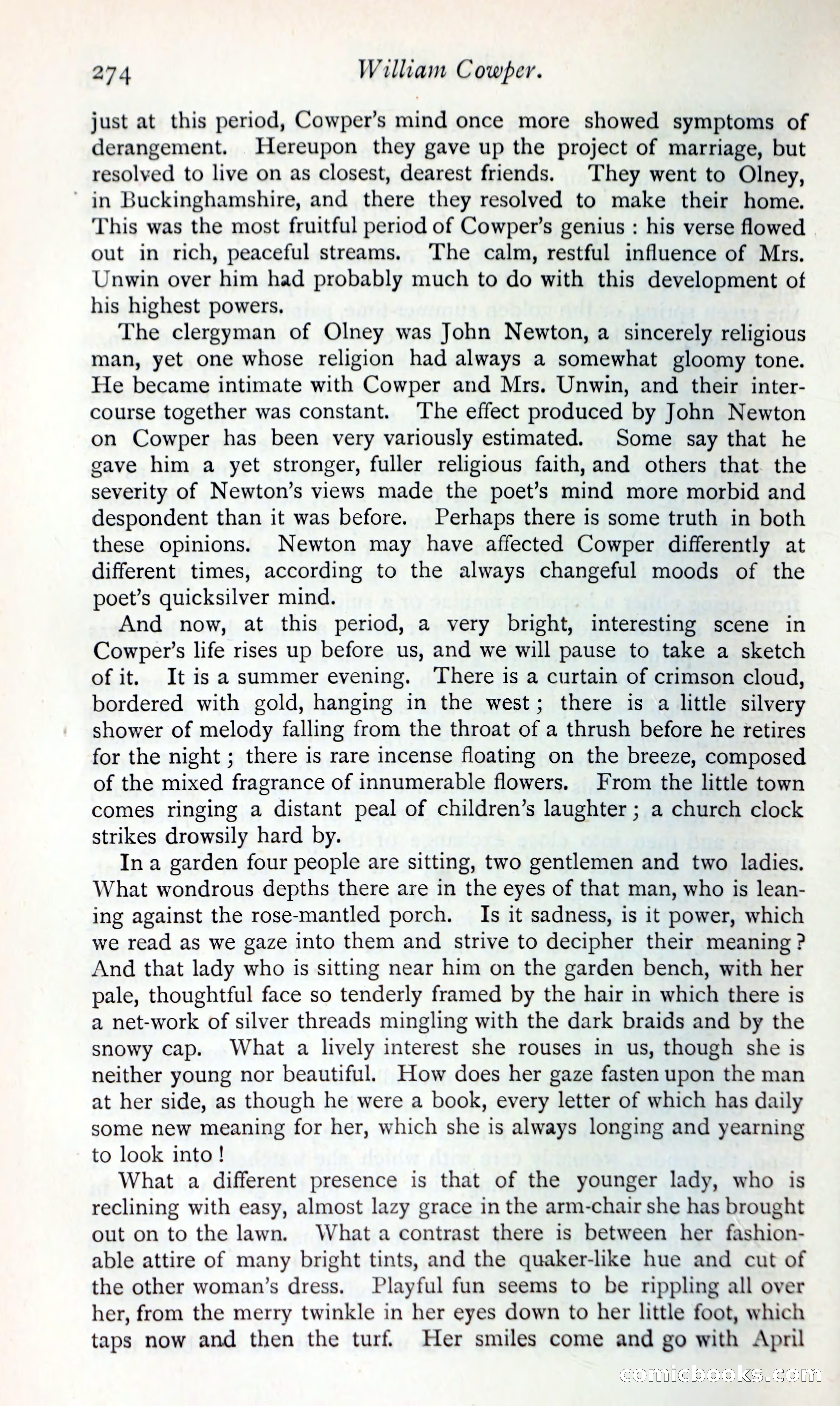
A restored page from Pulp Fiction, 1865. Page through the whole issue in the reader above.
📄 Transcribed text from this page (OCR, searchable)
Machine-transcribed from the original scan — historical spelling and the odd misread are preserved.
274 Wiliam Cowper. just at this period, Cowper’s mind once more showed symptoms of derangement. Hereupon they gave up the project of marriage, but resolved to live on as closest, dearest friends. They went to Olney, ~ in Buckinghamshire, and there they resolved to make their home. This was the most fruitful period of Cowper’s genius : his verse flowed | out in rich, peaceful streams. The calm, restful influence of Mrs. Unwin over him had probably much to do with this development of his highest powers. The clergyman of Olney was John Newton, a sincerely religious man, yet one whose religion had always a somewhat gloomy tone. He became intimate with Cowper and Mrs. Unwin, and their inter- course together was constant. The effect produced by John Newton on Cowper has been very variously estimated. Some say that he svave him a yet stronger, fuller religious faith,and others that the severity of Newton’s views made the poet’s mind more morbid and despondent than it was before. Perhaps there is some truth in both these opinions. Newton may have affected Cowper differently at different times, according to the always changeful moods of the poet’s quicksilver mind. And now, at this period, a very bright, interesting scene in Cowper’s life rises up before us, and we will pause to take a sketch of it. It is asummer evening. ‘There is a curtain of crimson cloud, bordered with gold, hanging in the west; there is a little silvery shower of melody falling from the throat of a thrush before he retires for the night ; there is rare incense floating on the breeze, composed of the mixed fragrance of innumerable flowers. From the little town comes ringing a distant peal of children’s laughter ; a church clock strikes drowsily hard by. In a garden four people are sitting, two gentlemen and two ladies. What wondrous depths there are in the eyes of that man, who is lean- ing against the rose-mantled porch. Is it sadness, is it power, which we read as we gaze into them and strive to decipher their meaning ? And that lady who is sitting near him on the garden bench, with her pale, thoughtful face so tenderly framed by the hair in which there is a net-work of silver threads mingling with the dark braids and by the snowy cap. What a lively interest she rouses in us, though she is neither young nor beautiful. How does her gaze fasten upon the man at her side, as though he were a book, every letter of which has daily some new meaning for her, which she is always longing and yearning to look into! What a different presence is that of the younger lady, who is reclining with easy, almost lazy grace in the arm-chair she has brought out on to the lawn. What a contrast there is between her fashion- able attire of many bright tints, and the quaker-like hue and cut of the other woman’s dress. Playful fun seems to be rippling all over her, from the merry twinkle in her eyes down to her little foot, which taps now and then the turf. Her smiles come and go with April ECORMMICEOOOKS COm