
Pulp Fiction, 1865 · page 150 of 400
The Argosy — page 150: what you’re looking at
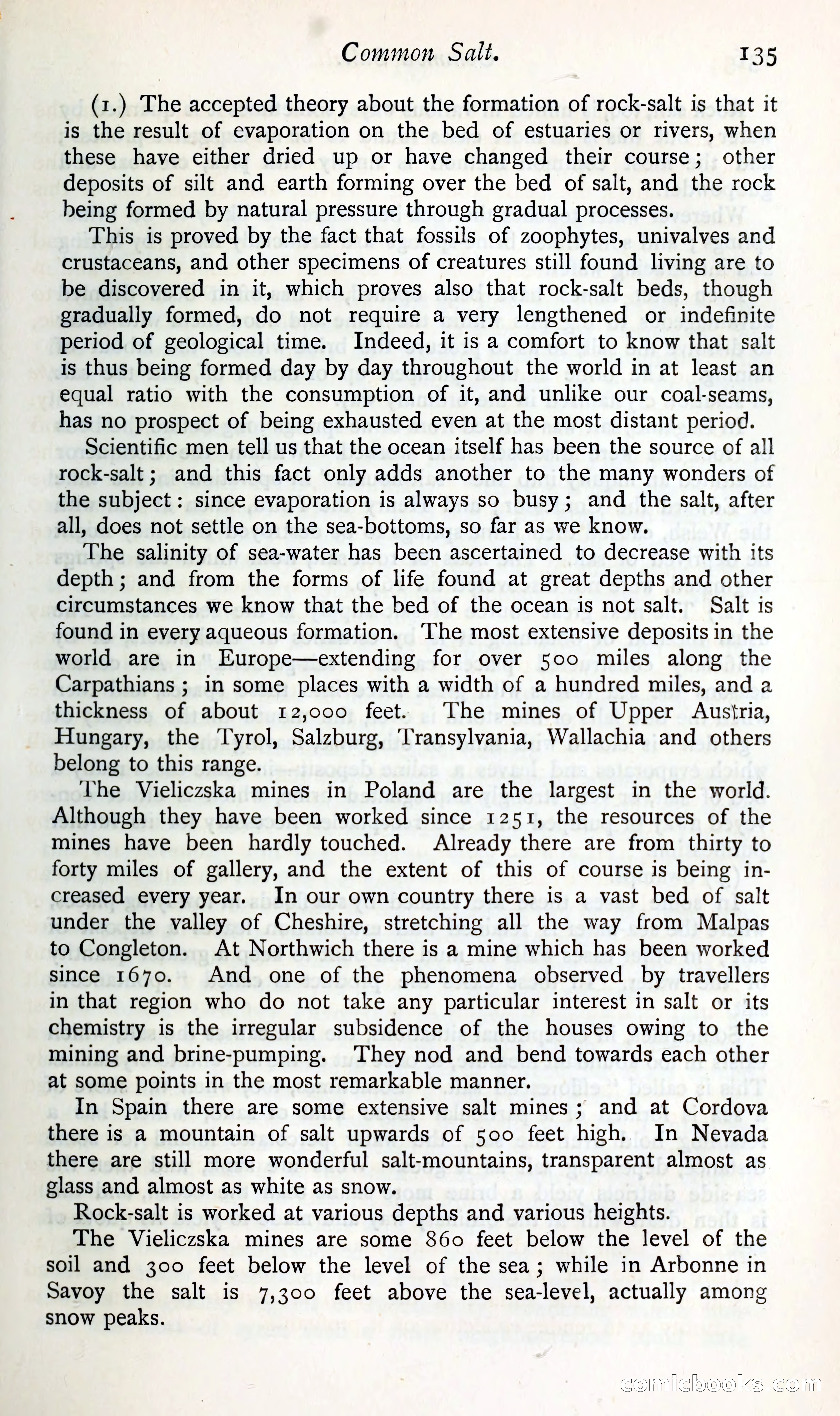
A restored page from Pulp Fiction, 1865. Page through the whole issue in the reader above.
📄 Transcribed text from this page (OCR, searchable)
Machine-transcribed from the original scan — historical spelling and the odd misread are preserved.
Common Salt. 135 (1.) The accepted theory about the formation of rock-salt is that it is the result of evaporation on the bed of estuaries or rivers, when these have either dried up or have changed their course; other deposits of silt and earth forming over the bed of salt, and the rock being formed by natural pressure through gradual processes. This is proved by the fact that fossils of zoophytes, univalves and crustaceans, and other specimens of creatures still found living are to be discovered in it, which proves also that rock-salt beds, though gradually formed, do not require a very lengthened or indefinite period of geological time. Indeed, it is a comfort to know that salt is thus being formed day by day throughout the world in at least an equal ratio with the consumption of it, and unlike our coal-seams, has no prospect of being exhausted even at the most distant period. Scientific men tell us that the ocean itself has been the source of all rock-salt; and this fact only adds another to the many wonders of the subject: since evaporation is always so busy; and the salt, after all, does not settle on the sea-bottoms, so far as we know. The salinity of sea-water has been ascertained to decrease with its depth ; and from the forms of life found at great depths and other circumstances we know that the bed of the ocean is not salt. Salt is found in every aqueous formation. ‘The most extensive deposits in the world are in Europe—extending for over 500 miles along the Carpathians ; in some places with a width of a hundred miles, and a thickness of about 12,000 feet. ‘The mines of Upper Ausjria, Hungary, the Tyrol, Salzburg, Transylvania, Wallachia and others belong to this range. The Vieliczska mines in Poland are the largest in the world. Although they have been worked since 1251, the resources of the mines have been hardly touched. Already there are from thirty to forty miles of gallery, and the extent of this of course is being in- creased every year. In our own country there is a vast bed of salt under the valley of Cheshire, stretching all the way from Malpas to Congleton. At Northwich there is a mine which has been worked since 1670. And one of the phenomena observed by travellers in that region who do not take any particular interest in salt or its chemistry is the irregular subsidence of the houses owing to the mining and brine-pumping. They nod and bend towards each other at some points in the most remarkable manner. In Spain there are some extensive salt mines; and at Cordova there is a mountain of salt upwards of 500 feet high. In Nevada there are still more wonderful salt-mountains, transparent almost as glass and almost as white as snow. Rock-salt is worked at various depths and various heights. The Vieliczska mines are some 860 feet below the level of the soil and 300 feet below the level of the sea; while in Arbonne in Savoy the salt is 7,300 feet above the sea-level, actually among snow peaks. cConniclooolkks (C(O)