
Pulp Fiction, 1865 · page 151 of 400
The Argosy — page 151: what you’re looking at
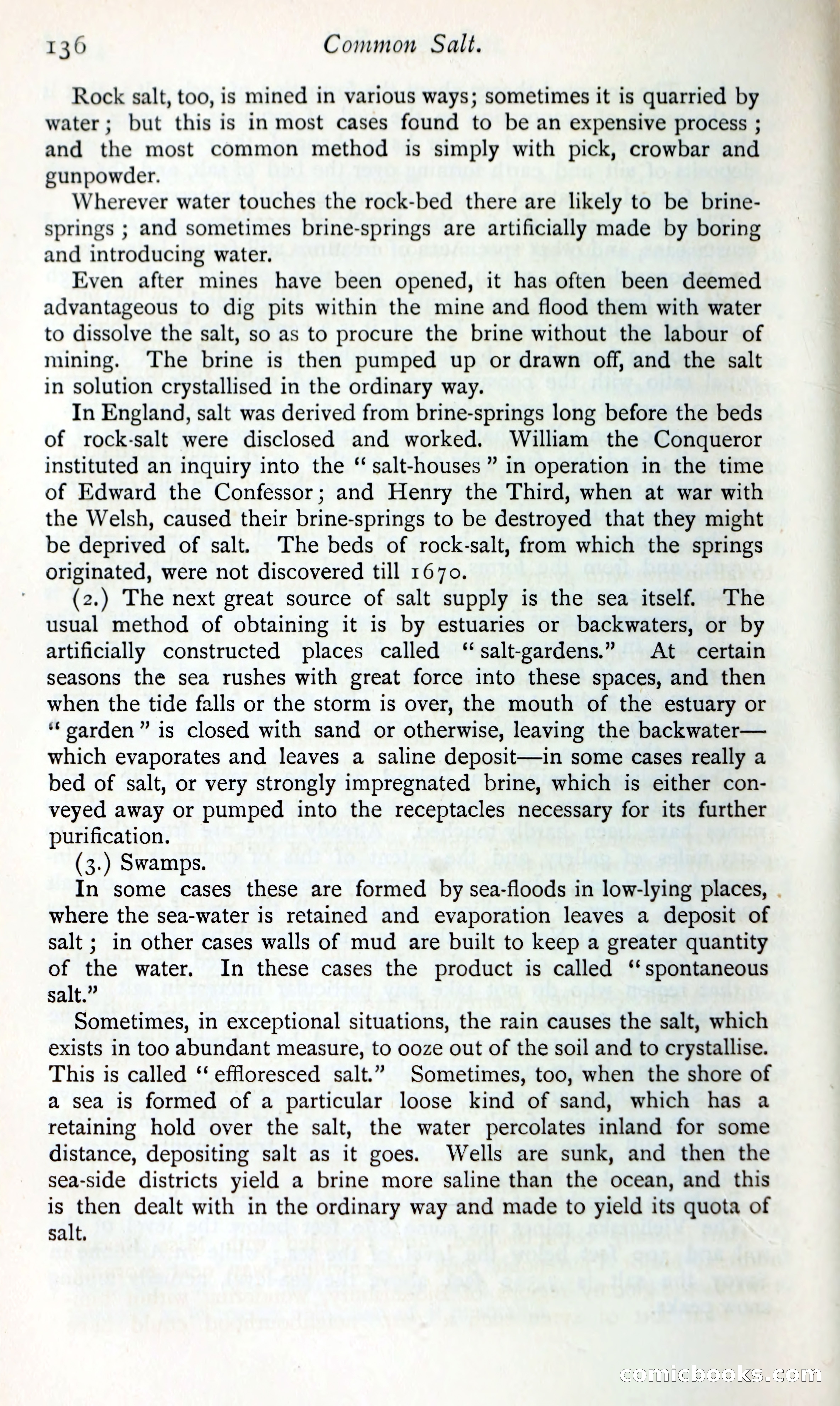
A restored page from Pulp Fiction, 1865. Page through the whole issue in the reader above.
📄 Transcribed text from this page (OCR, searchable)
Machine-transcribed from the original scan — historical spelling and the odd misread are preserved.
136 Common Salt. Rock salt, too, is mined in various ways; sometimes it is quarried by water; but this is in most cases found to be an expensive process ; and the most common method is simply with pick, crowbar and gunpowder. Wherever water touches the rock-bed there are likely to be brine- springs ; and sometimes brine-springs are artificially made by boring and introducing water. Even after mines have been opened, it has often been deemed advantageous to dig pits within the mine and flood them with water to dissolve the salt, so as to procure the brine without the labour of mining. The brine is then pumped up or drawn off, and the salt in solution crystallised in the ordinary way. In England, salt was derived from brine-springs long before the beds of rock-salt were disclosed and worked. William the Conqueror instituted an inquiry into the ‘ salt-houses ” in operation in the time of Edward the Confessor; and Henry the Third, when at war with the Welsh, caused their brine-springs to be destroyed that they might be deprived of salt. The beds of rock-salt, from which the springs originated, were not discovered till 1670. (2.) The next great source of salt supply is the sea itself. The usual method of obtaining it is by estuaries or backwaters, or by artificially constructed places called ‘‘salt-gardens.” At certain seasons the sea rushes with great force into these spaces, and then when the tide falls or the storm is over, the mouth of the estuary or ‘‘sarden” is closed with sand or otherwise, leaving the backwater— which evaporates and leaves a saline deposit—in some cases really a bed of salt, or very strongly impregnated brine, which is either con- veyed away or pumped into the receptacles necessary for its further purification. (3.) Swamps. In some cases these are formed by sea-floods in low-lying places, . where the sea-water is retained and evaporation leaves a deposit of salt ; in other cases walls of mud are built to keep a greater quantity of the water. In these cases the product is called ‘‘spontaneous salt.” Sometimes, in exceptional situations, the rain causes the salt, which exists in too abundant measure, to ooze out of the soil and to crystallise. This is called ‘‘ effloresced salt.” Sometimes, too, when the shore of a sea is formed of a particular loose kind of sand, which has a retaining hold over the salt, the water percolates inland for some distance, depositing salt as it goes. Wells are sunk, and then the sea-side districts yield a brine more saline than the ocean, and this is then dealt with in the ordinary way and made to yield its quota of salt. eom (©) JOOKSHEO