
Pulp Fiction, 1865 · page 149 of 400
The Argosy — page 149: what you’re looking at
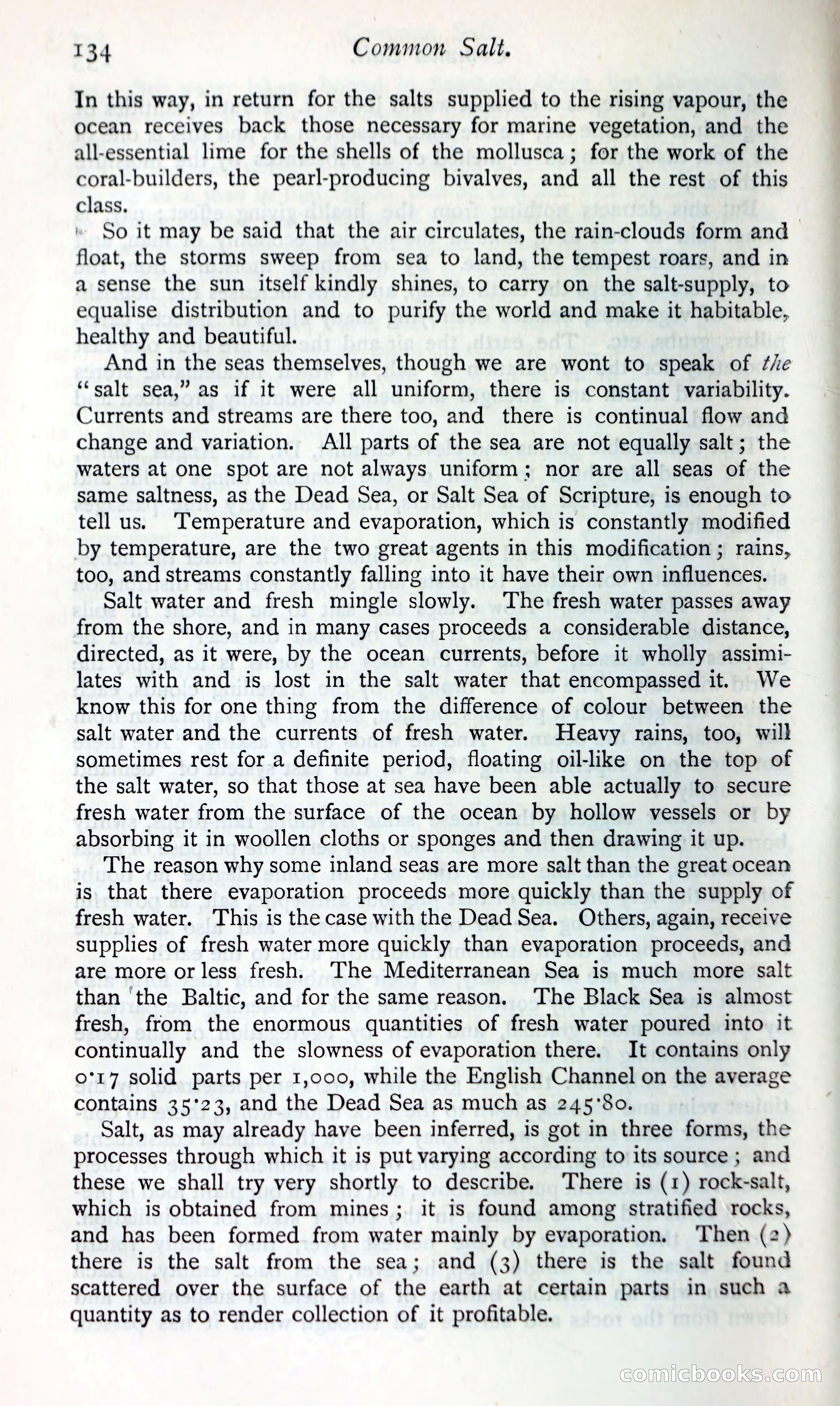
A restored page from Pulp Fiction, 1865. Page through the whole issue in the reader above.
📄 Transcribed text from this page (OCR, searchable)
Machine-transcribed from the original scan — historical spelling and the odd misread are preserved.
134 Common Salt. In this way, in return for the salts supplied to the rising vapour, the ocean receives back those necessary for marine vegetation, and the all-essential lime for the shells of the mollusca; for the work of the coral-builders, the pearl-producing bivalves, and all the rest of this class. So it may be said that the air circulates, the rain-clouds form and float, the storms sweep from sea to land, the tempest roars, and in a sense the sun itself kindly shines, to carry on the salt-supply, to equalise distribution and to purify the world and make it habitable, healthy and beautiful. And in the seas themselves, though we are wont to speak of //e “salt sea,” as if it were all uniform, there is constant variability. Currents and streams are there too, and there is continual flow and change and variation. All parts of the sea are not equally salt; the waters at one spot are not always uniform; nor are all seas of the same saltness, as the Dead Sea, or Salt Sea of Scripture, is enough to tell us. Temperature and evaporation, which is constantly modified by temperature, are the two great agents in this modification ; rains, too, and streams constantly falling into it have their own influences. Salt water and fresh mingle slowly. The fresh water passes away from the shore, and in many cases proceeds a considerable distance, directed, as it were, by the ocean currents, before it wholly assimi- lates with and is lost in the salt water that encompassed it. We know this for one thing from the difference of colour between the salt water and the currents of fresh water. Heavy rains, too, will sometimes rest for a definite period, floating oil-like on the top of the salt water, so that those at sea have been able actually to secure fresh water from the surface of the ocean by hollow vessels or by absorbing it in woollen cloths or sponges and then drawing it up. The reason why some inland seas are more salt than the great ocean is that there evaporation proceeds more quickly than the supply of fresh water. This is the case with the Dead Sea. Others, again, receive supplies of fresh water more quickly than evaporation proceeds, and are more or less fresh. ‘The Mediterranean Sea is much more salt than ‘the Baltic, and for the same reason. ‘The Black Sea is almost fresh, from the enormous quantities of fresh water poured into it continually and the slowness of evaporation there. It contains only o°17 solid parts per 1,000, while the English Channel on the average contains 35°23, and the Dead Sea as much as 245'8o. Salt, as may already have been inferred, is got in three forms, the processes through which it is put varying according to its source ; and these we shall try very shortly to describe. There is (1) rock-salt, which is obtained from mines; it is found among stratified rocks, and has been formed from water mainly by evaporation. Then (2) there is the salt from the sea; and (3) there is the salt found scattered over the surface of the earth at certain parts in such a quantity as to render collection of it profitable. COMMNICELOOOKS.E@ ()