
Pulp Fiction, 1865 · page 148 of 400
The Argosy — page 148: what you’re looking at
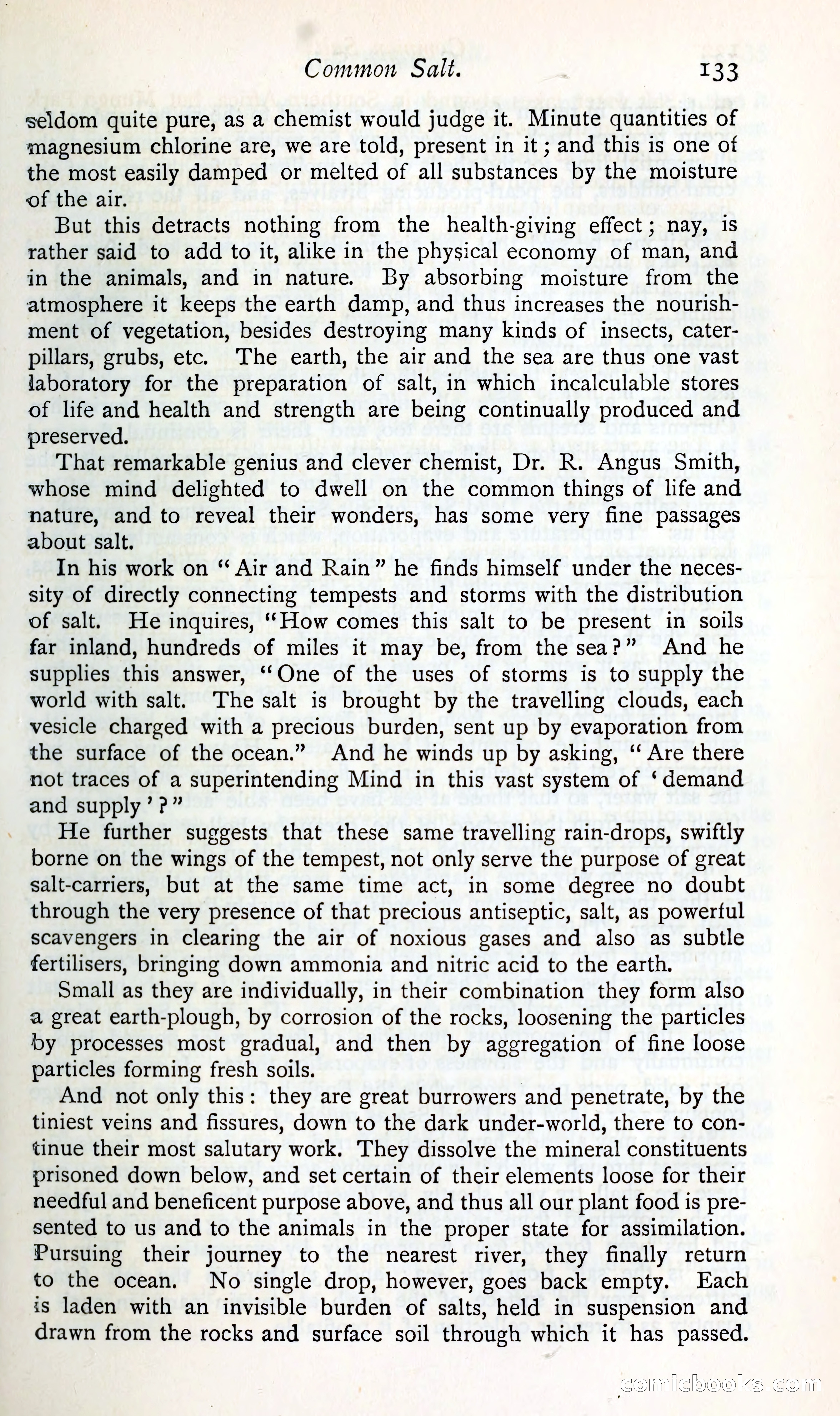
A restored page from Pulp Fiction, 1865. Page through the whole issue in the reader above.
📄 Transcribed text from this page (OCR, searchable)
Machine-transcribed from the original scan — historical spelling and the odd misread are preserved.
Common Salt. 133 seldom quite pure, as a chemist would judge it. Minute quantities of magnesium chlorine are, we are told, present in it ; and this is one of the most easily damped or melted of all substances by the moisture of the air. But this detracts nothing from the health-giving effect; nay, is rather said to add to it, alike in the physical economy of man, and in the animals, and in nature. By absorbing moisture from the atmosphere it keeps the earth damp, and thus increases the nourish- ment of vegetation, besides destroying many kinds of insects, cater- pillars, grubs, etc. The earth, the air and the sea are thus one vast Jaboratory for the preparation of salt, in which incalculable stores of life and health and strength are being continually produced and preserved. That remarkable genius and clever chemist, Dr. R. Angus Smith, whose mind delighted to dwell on the common things of life and nature, and to reveal their wonders, has some very fine passages about salt. In his work on ‘‘ Air and Rain” he finds himself under the neces- sity of directly connecting tempests and storms with the distribution of salt. He inquires, ‘‘How comes this salt to be present in soils far inland, hundreds of miles it may be, from the sea?” And he supplies this answer, ‘‘One of the uses of storms is to supply the world with salt. The salt is brought by the travelling clouds, each vesicle charged with a precious burden, sent up by evaporation from the surface of the ocean.” And he winds up by asking, ‘‘ Are there not traces of a superintending Mind in this vast system of ‘demand and supply ’ ?” He further suggests that these same travelling rain-drops, swiftly borne on the wings of the tempest, not only serve the purpose of great salt-carriers, but at the same time act, in some degree no doubt through the very presence of that precious antiseptic, salt, as powerful scavengers in clearing the air of noxious gases and also as subtle fertilisers, bringing down ammonia and nitric acid to the earth. Small as they are individually, in their combination they form also a great earth-plough, by corrosion of the rocks, loosening the particles Dy processes most gradual, and then by aggregation of fine loose particles forming fresh soils. | And not only this: they are great burrowers and penetrate, by the tiniest veins and fissures, down to the dark under-world, there to con- tinue their most salutary work. They dissolve the mineral constituents prisoned down below, and set certain of their elements loose for their needful and beneficent purpose above, and thus all our plant food is pre- sented to us and to the animals in the proper state for assimilation. Pursuing their journey to the nearest river, they finally return to the ocean. No single drop, however, goes back empty. Each is laden with an invisible burden of salts, held in suspension and drawn from the rocks and surface soil through which it has passed. Connicloooks (C(O)