
Pulp Fiction, 1865 · page 147 of 400
The Argosy — page 147: what you’re looking at
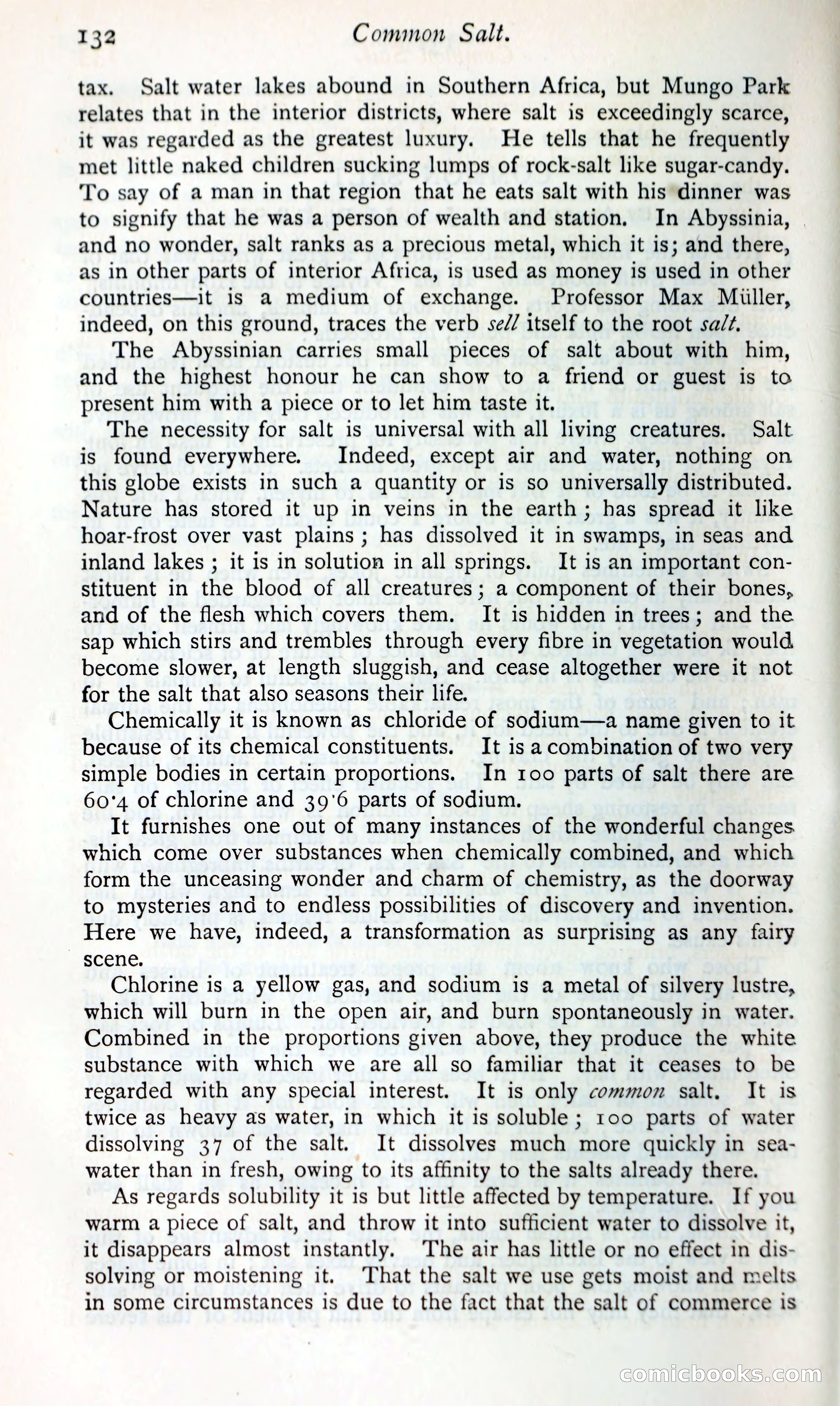
A restored page from Pulp Fiction, 1865. Page through the whole issue in the reader above.
📄 Transcribed text from this page (OCR, searchable)
Machine-transcribed from the original scan — historical spelling and the odd misread are preserved.
132 Common Salt. tax. Salt water lakes abound in Southern Africa, but Mungo Park relates that in the interior districts, where salt is exceedingly scarce, it was regarded as the greatest luxury. He tells that he frequently met little naked children sucking lumps of rock-salt like sugar-candy. To say of a man in that region that he eats salt with his dinner was to signify that he was a person of wealth and station. In Abyssinia, | and no wonder, salt ranks as a precious metal, which it is; and there, as in other parts of interior Africa, is used as money is used in other countries—it is a medium of exchange. Professor Max Miller, indeed, on this ground, traces the verb se// itself to the root sa/z. The Abyssinian carries small pieces of salt about with him, and the highest honour he can show to a friend or guest is to present him with a piece or to let him taste it. The necessity for salt is universal with all living creatures. Salt is found everywhere. Indeed, except air and water, nothing on this globe exists in such a quantity or is so universally distributed. Nature has stored it up in veins in the earth; has spread it like hoar-frost over vast plains ; has dissolved it in swamps, in seas and inland lakes ; it is in solution in all springs. It is an important con- stituent in the blood of all creatures; a component of their bones, and of the flesh which covers them. It is hidden in trees; and the sap which stirs and trembles through every fibre in vegetation would become slower, at length sluggish, and cease altogether were it not for the salt that also seasons their life. Chemically it is known as chloride of sodium—a name given to it because of its chemical constituents. It is acombination of two very simple bodies in certain proportions. In 100 parts of salt there are 60'4 of chlorine and 39'6 parts of sodium. It furnishes one out of many instances of the wonderful changes which come over substances when chemically combined, and which form the unceasing wonder and charm of chemistry, as the doorway to mysteries and to endless possibilities of discovery and invention. Here we have, indeed, a transformation as surprising as any fairy _-§eene. Chlorine is a yellow gas, and sodium is a metal of silvery lustre, which will burn in the open air, and burn spontaneously in water. Combined in the proportions given above, they produce the white substance with which we are all so familiar that it ceases to be regarded with any special interest. It is only common salt. It is twice as heavy as water, in which it is soluble; roo parts of water dissolving 37 of the salt. It dissolves much more quickly in sea- water than in fresh, owing to its affinity to the salts already there. As regards solubility it is but little affected by temperature. If you warm apiece of salt, and throw it into sufficient water to dissolve it, it disappears almost instantly. ‘The air has little or no effect in dis- solving or moistening it. That the salt we use gets moist and melts in some circumstances is due to the fact that the salt of commerce is CONMMIELOOOKS.E@ ()