
Pulp Fiction, 1865 · page 146 of 400
The Argosy — page 146: what you’re looking at
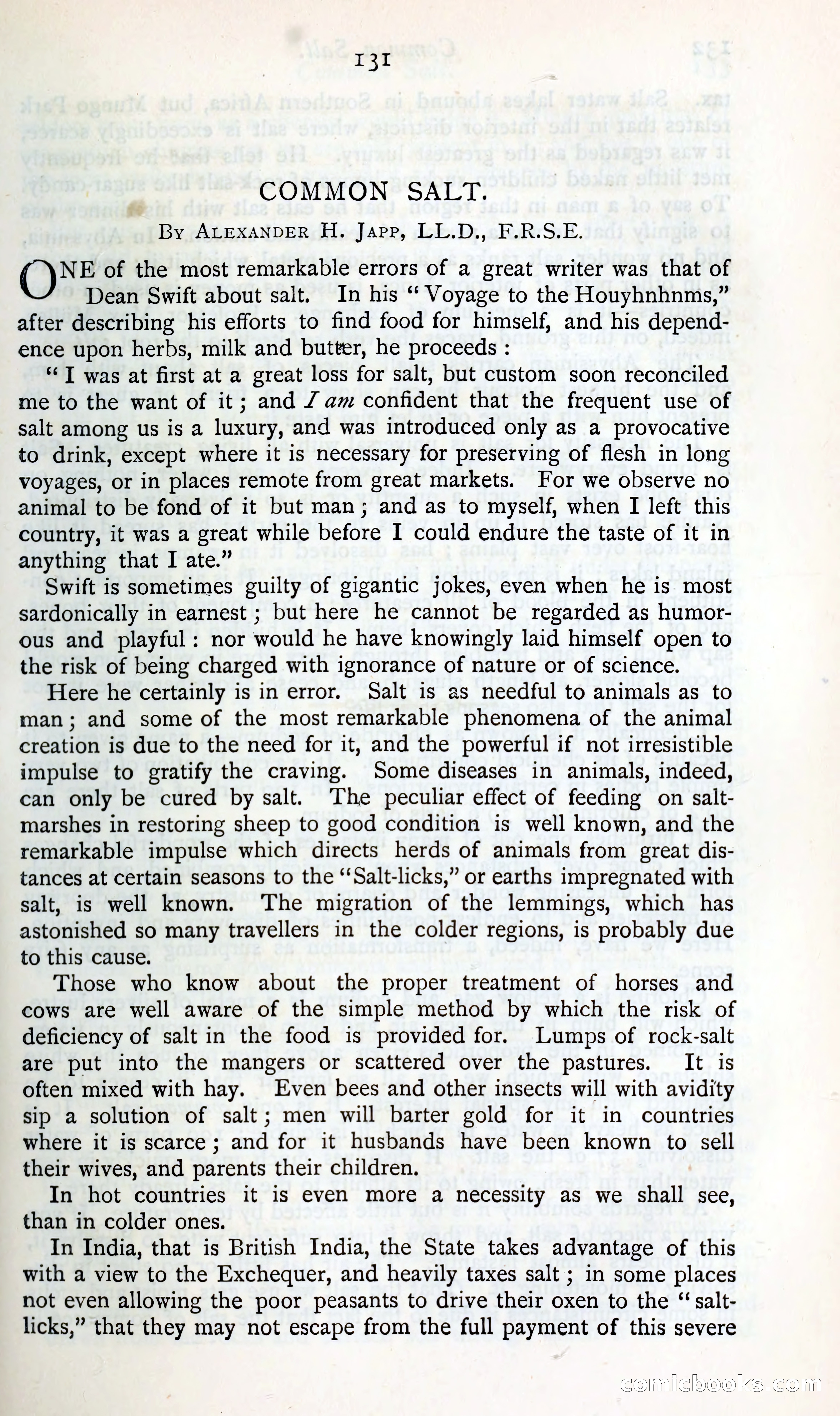
A restored page from Pulp Fiction, 1865. Page through the whole issue in the reader above.
📄 Transcribed text from this page (OCR, searchable)
Machine-transcribed from the original scan — historical spelling and the odd misread are preserved.
I 31 COMMON SALT. By ALEXANDER H. Japp, LL.D., F.R.S.E. NE of the most remarkable errors of a great writer was that of Dean Swift about salt. In his “ Voyage to the Houyhnhnms,” after describing his efforts to find food for himself, and his depend- ence upon herbs, milk and butter, he proceeds : ‘‘T was at first at a great loss for salt, but custom soon reconciled me to the want of it; and / am confident that the frequent use of salt among us is a luxury, and was introduced only as a provocative to drink, except where it is necessary for preserving of flesh in long voyages, or in places remote from great markets. For we observe no animal to be fond of it but man; and as to myself, when I left this country, it was a great while before I could endure the taste of it in anything that I ate.” Swift is sometimes guilty of gigantic jokes, even when he is most sardonically in earnest ; but here he cannot be regarded as humor- ous and playful: nor would he have knowingly laid himself open to the risk of being charged with ignorance of nature or of science. Here he certainly is in error. Salt is as needful to animals as to man; and some of the most remarkable phenomena of the animal creation is due to the need for it, and the powerful if not irresistible impulse to gratify the craving. Some diseases in animals, indeed, can only be cured by salt. The peculiar effect of feeding on salt- marshes in restoring sheep to good condition is well known, and the remarkable impulse which directs herds of animals from great dis- tances at certain seasons to the ‘‘Salt-licks,” or earths impregnated with salt, is well known. The migration of the lemmings, which has astonished so many travellers in the colder regions, is probably due to this cause. Those who know about the proper treatment of horses and cows are well aware of the simple method by which the risk of deficiency of salt in the food is provided for. Lumps of rock-salt are put into the mangers or scattered over the pastures. It is often mixed with hay. Even bees and other insects will with avidity sip a solution of salt; men will barter gold for it in countries where it is scarce; and for it husbands have been known to sell their wives, and parents their children. In hot countries it is even more a necessity as we shall see, than in colder ones. In India, that is British India, the State takes advantage of this with a view to the Exchequer, and heavily taxes salt ; in some places not even allowing the poor peasants to drive their oxen to the ‘“ salt- licks,” that they may not escape from the full payment of this severe COMICOOO SS (C(O)