
Pulp Fiction, 1865 · page 322 of 400
The Argosy — page 322: what you’re looking at
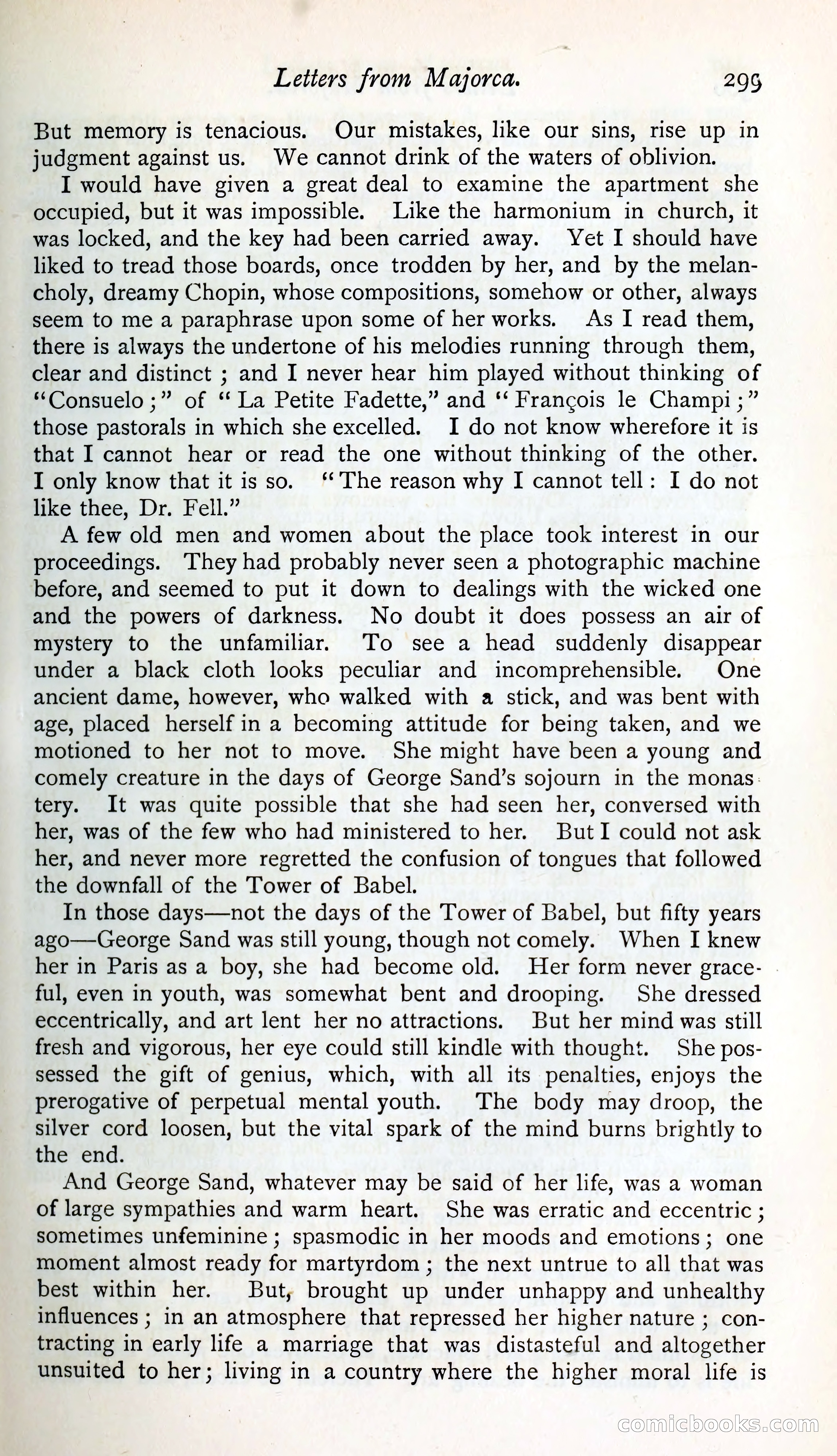
A restored page from Pulp Fiction, 1865. Page through the whole issue in the reader above.
📄 Transcribed text from this page (OCR, searchable)
Machine-transcribed from the original scan — historical spelling and the odd misread are preserved.
Letters from Majorca. 29G But memory is tenacious. Our mistakes, like our sins, rise up in judgment against us. We cannot drink of the waters of oblivion. I would have given a great deal to examine the apartment she occupied, but it was impossible. Like the harmonium in church, it was locked, and the key had been carried away. Yet I should have liked to tread those boards, once trodden by her, and by the melan- choly, dreamy Chopin, whose compositions, somehow or other, always seem to me a paraphrase upon some of her works. As I read them, there is always the undertone of his melodies running through them, clear and distinct ; and I never hear him played without thinking of “Consuelo ;” of “ La Petite Fadette,” and ‘‘ Francois le Champ ;” those pastorals in which she excelled. I do not know wherefore it is that I cannot hear or read the one without thinking of the other. I only know that it is so. ‘‘ The reason why I cannot tell: I do not like thee, Dr. Fell.” A few old men and women about the place took interest in our proceedings. ‘They had probably never seen a photographic machine before, and seemed to put it down to dealings with the wicked one and the powers of darkness. No doubt it does possess an air of mystery to the unfamiliar. To see a head suddenly disappear under a black cloth looks peculiar and incomprehensible. One ancient dame, however, who walked with a stick, and was bent with age, placed herself in a becoming attitude for being taken, and we motioned to her not to move. She might have been a young and comely creature in the days of George Sand’s sojourn in the monas: tery. It was quite possible that she had seen her, conversed with her, was of the few who had ministered to her. ButI could not ask her, and never more regretted the confusion of tongues that followed the downfall of the Tower of Babel. In those days—not the days of the Tower of Babel, but fifty years ago—George Sand was still young, though not comely. When I knew her in Paris as a boy, she had become old. Her form never grace- ful, even in youth, was somewhat bent and drooping. She dressed eccentrically, and art lent her no attractions. But her mind was still fresh and vigorous, her eye could still kindle with thought. She pos- sessed the gift of genius, which, with all its penalties, enjoys the prerogative of perpetual mental youth. The body may droop, the silver cord loosen, but the vital spark of the mind burns brightly to tne’ end. And George Sand, whatever may be said of her life, was a woman of large sympathies and warm heart. She was erratic and eccentric ; sometimes unfeminine ; spasmodic in her moods and emotions; one moment almost ready for martyrdom ; the next untrue to all that was best within her. But, brought up under unhappy and unhealthy influences ; in an atmosphere that repressed her higher nature ; con- tracting in early life a marriage that was distasteful and altogether unsuited to her; living in a country where the higher moral life is cComicooolks (SO)