
Pulp Fiction, 1865 · page 323 of 400
The Argosy — page 323: what you’re looking at
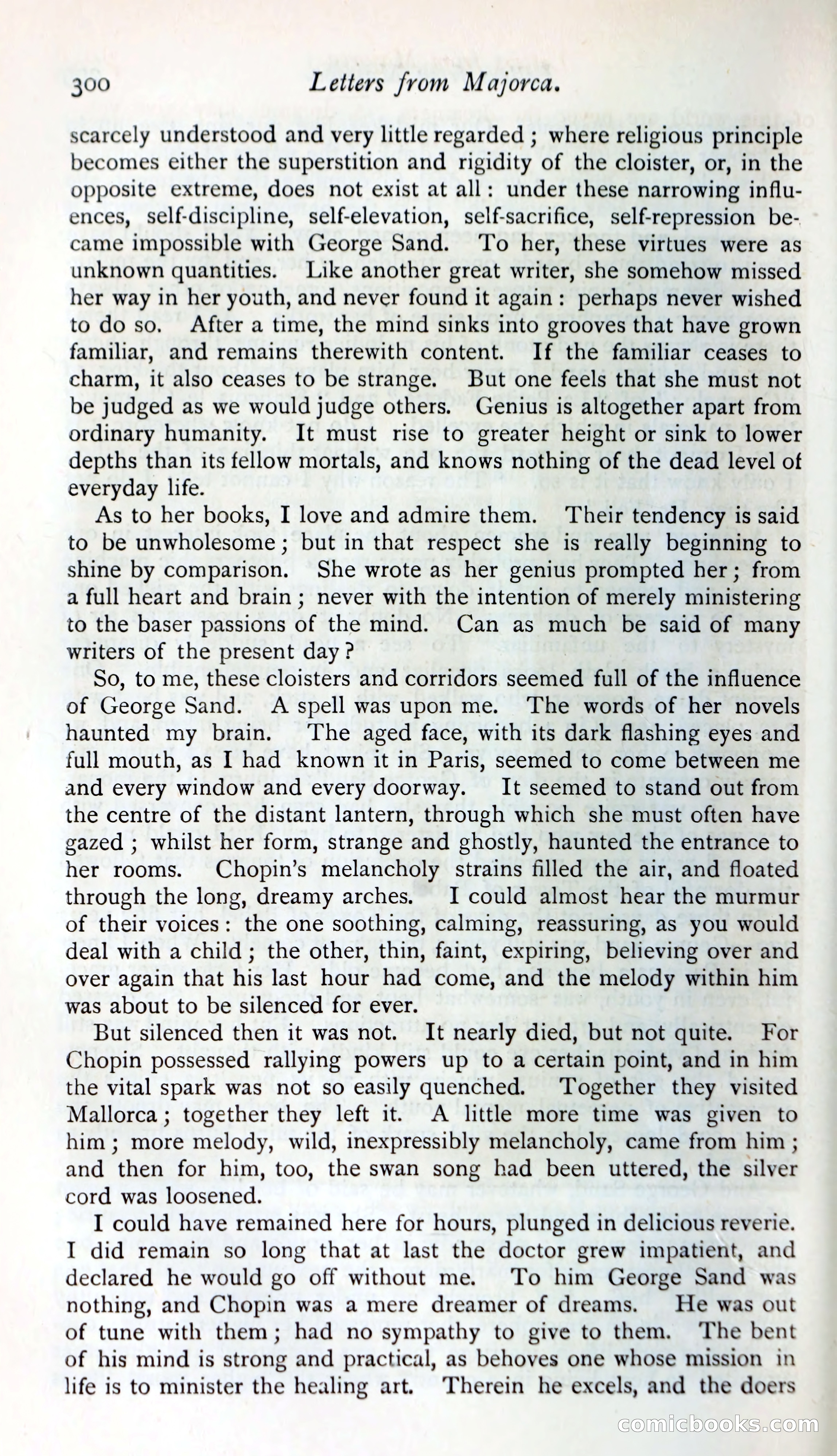
A restored page from Pulp Fiction, 1865. Page through the whole issue in the reader above.
📄 Transcribed text from this page (OCR, searchable)
Machine-transcribed from the original scan — historical spelling and the odd misread are preserved.
300 Letters from Majorca. scarcely understood and very little regarded ; where religious principle becomes either the superstition and rigidity of the cloister, or, in the opposite extreme, does not exist at all: under these narrowing influ- ences, self-discipline, self-elevation, self-sacrifice, self-repression be- came impossible with George Sand. ‘To her, these virtues were as unknown quantities. Like another great writer, she somehow missed her way in her youth, and never found it again: perhaps never wished to do so. After a time, the mind sinks into grooves that have grown familiar, and remains therewith content. If the familiar ceases to charm, it also ceases to be strange. But one feels that she must not be judged as we would judge others. Gentus is altogether apart from ordinary humanity. It must rise to greater height or sink to lower depths than its fellow mortals, and knows nothing of the dead level of everyday life. As to her books, I love and admire them. Their tendency is said to be unwholesome ; but in that respect she is really beginning to shine by comparison. She wrote as her genius prompted her; from a full heart and brain; never with the intention of merely ministering to the baser passions of the mind. Can as much be said of many writers of the present day? So, to me, these cloisters and corridors seemed full of the influence of George Sand. A spell was upon me. ‘The words of her novels haunted my brain. ‘The aged face, with its dark flashing eyes and full mouth, as I had known it in Paris, seemed to come between me and every window and every doorway. It seemed to stand out from the centre of the distant lantern, through which she must often have gazed ; whilst her form, strange and ghostly, haunted the entrance to her rooms. Chopin’s melancholy strains filled the air, and floated through the long, dreamy arches. I could almost hear the murmur of their voices: the one soothing, calming, reassuring, as you would deal with a child; the other, thin, faint, expiring, believing over and over again that his last hour had come, and the melody within him was about to be silenced for ever. | But silenced then it was not. It nearly died, but not quite. For Chopin possessed rallying powers up to a certain point, and in him the vital spark was not so easily quenched. ‘Together they visited Mallorca; together they left it. A litthke more time was given to him ; more melody, wild, inexpressibly melancholy, came from him ; and then for him, too, the swan song had been uttered, the silver cord was loosened. I could have remained here for hours, plunged in delicious reverie. I did remain so long that at last the doctor grew impatient, and declared he would go off without me. ‘To him George Sand was nothing, and Chopin was a mere dreamer of dreams. He was out of tune with them; had no sympathy to give to them. ‘The bent of his mind is strong and practical, as behoves one whose mission in life is to minister the healing art. Therein he excels, and the doers CONMIELIOOKS.(e©)