
Pulp Fiction, 1865 · page 371 of 400
The Argosy — page 371: what you’re looking at
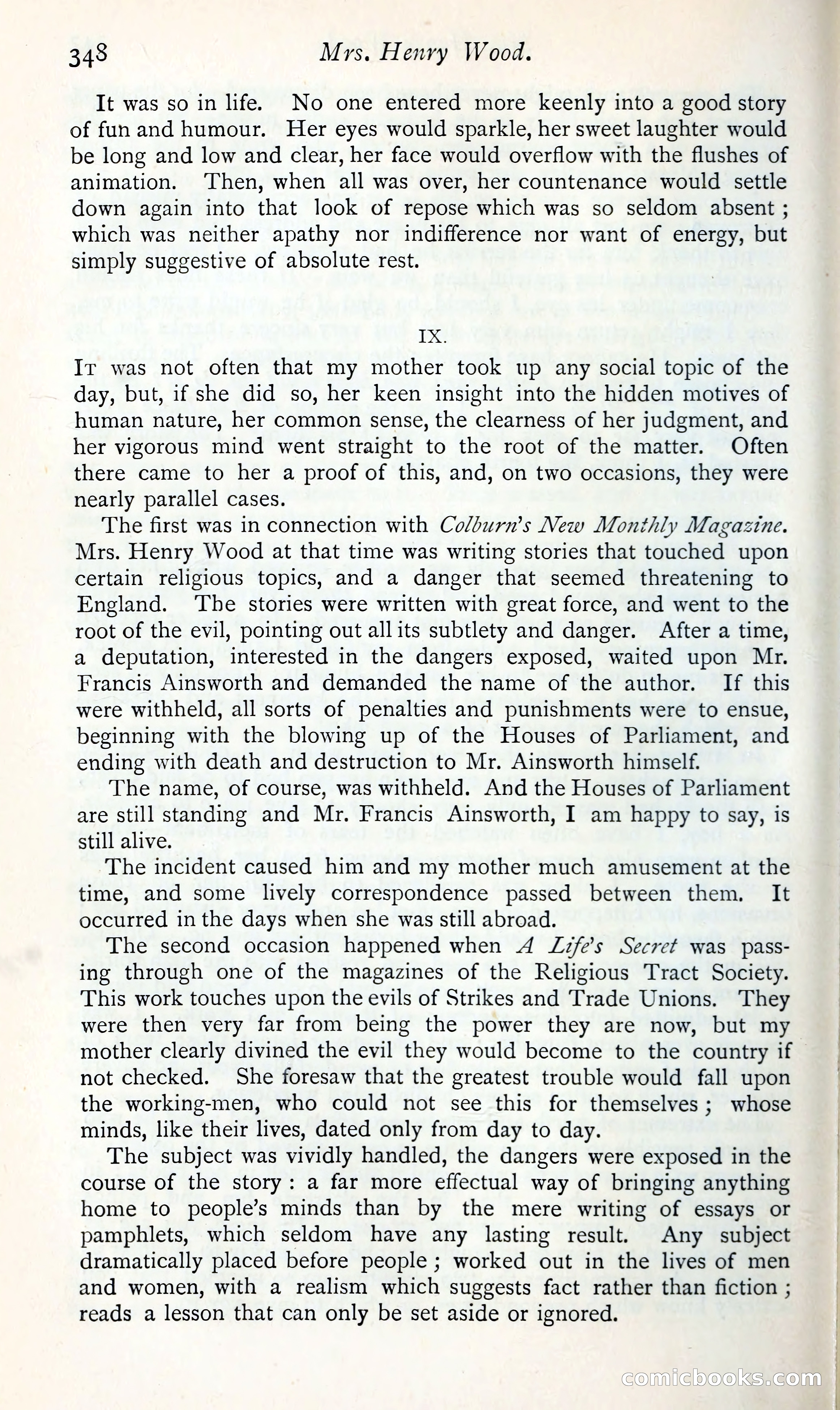
A restored page from Pulp Fiction, 1865. Page through the whole issue in the reader above.
📄 Transcribed text from this page (OCR, searchable)
Machine-transcribed from the original scan — historical spelling and the odd misread are preserved.
348 Mrs. Henry Wood. It was so in life. No one entered more keenly into a good story of fun and humour. Her eyes would sparkle, her sweet laughter would be long and low and clear, her face would overflow with the flushes of animation. ‘Then, when all was over, her countenance would settle down again into that look of repose which was so seldom absent ; which was neither apathy nor indifference nor want of energy, but simply suggestive of absolute rest. IX. Ir was not often that my mother took up any social topic of the day, but, if she did so, her keen insight into the hidden motives of human nature, her common sense, the clearness of her judgment, and her vigorous mind went straight to the root of the matter. Often there came to her a proof of this, and, on two occasions, they were nearly parallel cases. The first was in connection with Colburn’s New Monthly Magazine. Mrs. Henry Wood at that time was writing stories that touched upon certain religious topics, and a danger that seemed threatening to England. ‘The stories were written with great force, and went to the root of the evil, pointing out allits subtlety and danger. After a time, a deputation, interested in the dangers exposed, waited upon Mr. Francis Ainsworth and demanded the name of the author. If this were withheld, all sorts of penalties and punishments were to ensue, beginning with the blowing up of the Houses of Parliament, and ending with death and destruction to Mr. Ainsworth himself. The name, of course, was withheld. And the Houses of Parliament are still standing and Mr. Francis Ainsworth, I am happy to say, is still alive. The incident caused him and my mother much amusement at the time, and some lively correspondence passed between them, It occurred in the days when she was still abroad. The second occasion happened when 4 JLzfe’s Secret was pass- ing through one of the magazines of the Religious Tract Society. This work touches upon the evils of Strikes and Trade Unions. They were then very far from being the power they are now, but my mother clearly divined the evil they would become to the country if | not checked. She foresaw that the greatest trouble would fall upon the working-men, who could not see this for themselves; whose minds, like their lives, dated only from day to day. The subject was vividly handled, the dangers were exposed in the course of the story: a far more effectual way of bringing anything home to people’s minds than by the mere writing of essays or pamphlets, which seldom have any lasting result. Any subject dramatically placed before people ; worked out in the lives of men and women, with a realism which suggests fact rather than fiction ; reads a lesson that can only be set aside or ignored. ECONNIELIOOKS, EC) mn